
IAE Academy

GATE 2018 IN Q.11: solution and answer

GATE 2018 · INQ.11 · 1 mark · MCQ

An ideal square wave with period of 20 ms shown in the figure, is passed through an ideal low pass filter with cut-off frequency 120 Hz. Which of the following is an accurate description of the output?
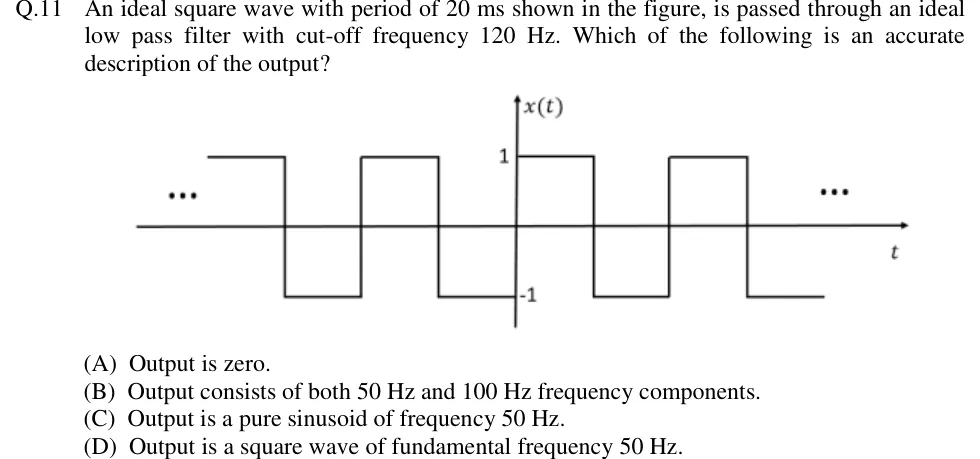
GATE 2018 IN question 11: Plot of x(t) against t: a periodic square wave, continuing both ways (dots at both ends), switching between +1 and -1 with…Tap to open full size
Figure from the GATE 2018 IN paper. It is part of the question.
Figure description

Plot of x(t) against t: a periodic square wave, continuing both ways (dots at both ends), switching between +1 and -1 with equal time at each level (50% duty cycle). It rises from -1 to +1 at t = 0, stays at +1 for half a period, then falls to -1 for the other half. The vertical axis is marked 1 and -1; the horizontal axis is t with no time values printed (the stem gives the period as 20 ms).

  1. (A)

    Output is zero.

  2. (B)

    Output consists of both 50 Hz and 100 Hz frequency components.

  3. (C)

    Output is a pure sinusoid of frequency 50 Hz.

  4. (D)

    Output is a square wave of fundamental frequency 50 Hz.

Answer and solution

ANSWER

(C) Output is a pure sinusoid of frequency 50 Hz.

Official answer: CSource: Official answer key, GATE 2018 IN (IIT Guwahati)

  1. Fundamental frequency: , so .

  2. DC term: the wave spends equal time at and in every period, so .

  3. Symmetry. From the figure, for and for , so . The function is odd, so every cosine coefficient is zero. It also has half-wave symmetry, , so every even harmonic is zero and the series has only odd harmonics.

  4. Sine coefficients: This gives for odd and for even .

  5. Fourier series:

  6. Components present: There is no term and no DC term.

  7. Ideal LPF with cut-off : only the component is below the cut-off. The next component, , is above it and is removed completely, and so is every higher harmonic.

  8. Output (taking the filter's passband gain as 1): . This is a pure sinusoid, which is option (C). It is not zero, which rules out (A). It has no term, which rules out (B). It has lost every harmonic that makes up a square shape, which rules out (D).

KEY IDEA

A zero-mean square wave with a 50% duty cycle has half-wave symmetry, so it contains only odd harmonics of its fundamental: With these are . An ideal LPF cutting off at passes only the fundamental, so the output is a single sinusoid.

WATCH OUT FOR

Assuming every harmonic is present and counting as a component below the cut-off, which leads to (B). A symmetric square wave has no even harmonics. A second trap is (D): reasoning that the square wave's fundamental is below the cut-off, so the square wave passes. A square shape needs the higher odd harmonics, and the filter removes all of them.

From the GATE 2018 IN paper. Every question of this paper · Download the full paper · All 11 Fourier series questions, with notes

More Fourier series questions