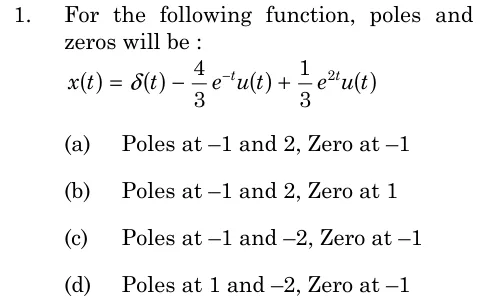
For the following function, poles and zeros will be :
- (A)
Poles at -1 and 2, Zero at -1
- (B)
Poles at -1 and 2, Zero at 1
- (C)
Poles at -1 and -2, Zero at -1
- (D)
Poles at 1 and -2, Zero at -1

For the following function, poles and zeros will be :
Poles at -1 and 2, Zero at -1
Poles at -1 and 2, Zero at 1
Poles at -1 and -2, Zero at -1
Poles at 1 and -2, Zero at -1
ANSWER
Poles at and , zero at (option B).
Official answer: BSource: ISRO's final answer key of 15 May 2026
Take the Laplace transform of each term: , , .
The poles come from the denominators: and . This rules out options (c) and (d).
Put everything over the common denominator : numerator .
Expand: .
The numerator vanishes at (a double zero), so the zero is at , not at . This rules out option (a).
Poles at and , zero at : option (b).
KEY IDEA
Transform each term, combine into a single rational function, and read poles from the denominator and zeros from the numerator after simplifying.
WATCH OUT FOR
Reading the zero from the individual terms, or forgetting that the impulse term contributes to the numerator, which moves the zero from to .
From the ISRO EC 2025 paper. Every question of this paper · The full paper (PDF, ISRO) · All 4 ISRO Laplace questions, with notes