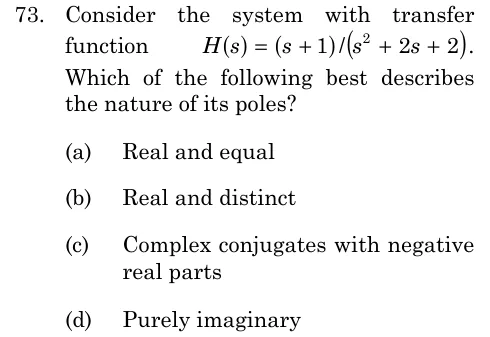
Consider the system with transfer function . Which of the following best describes the nature of its poles?
- (A)
Real and equal
- (B)
Real and distinct
- (C)
Complex conjugates with negative real parts
- (D)
Purely imaginary

Consider the system with transfer function . Which of the following best describes the nature of its poles?
Real and equal
Real and distinct
Complex conjugates with negative real parts
Purely imaginary
ANSWER
The poles are , complex conjugates with negative real parts: option (c).
Official answer: CSource: ISRO's final answer key of 15 May 2026
The poles of are the roots of the denominator: .
The discriminant is , so the roots are complex, not real. This rules out options (a) and (b).
The roots are .
The real part is , which is nonzero, so the poles are not purely imaginary. This rules out option (d).
The zero at is not at either pole (), so no pole-zero cancellation occurs and the pole nature is unchanged.
The poles are a complex-conjugate pair with negative real parts (an underdamped, stable system with and ), which is option (c).
KEY IDEA
Poles are the roots of the denominator. A negative discriminant gives a complex-conjugate pair, and the sign of the real part () tells you stability.
WATCH OUT FOR
Reading the numerator factor as affecting the poles, or assuming a complex pair must be purely imaginary. Zeros never change pole locations, and purely imaginary poles need a zero real part, which is not the case here.
From the ISRO EC 2025 paper. Every question of this paper · The full paper (PDF, ISRO) · All 4 ISRO Laplace questions, with notes