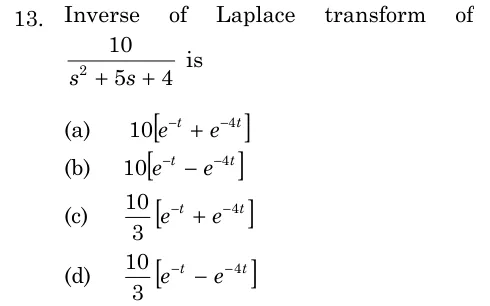
Inverse of Laplace transform of is
- (A)
- (B)
- (C)
- (D)

Inverse of Laplace transform of is
ANSWER
The inverse Laplace transform is , which is option (D).
Official answer: DSource: ISRO's final answer key of 15 May 2026
Factorise the denominator: , so the poles are at and .
Write the partial fractions: .
Residue at : .
Residue at : .
So .
Use to get .
Check by transforming back: . Also, , which agrees with . Options (a) and (c) start at and , so they are wrong. Option (b) transforms to , three times too large. Only (d) is correct.
KEY IDEA
Factorise the denominator into real poles, expand in partial fractions using the residue at each pole, then use .
WATCH OUT FOR
Forgetting that the residue is , not : the factor comes from the other pole. Another slip is taking the second residue with a plus sign, which gives instead of the difference.
From the ISRO EC 2025 paper. Every question of this paper · The full paper (PDF, ISRO) · All 4 ISRO Laplace questions, with notes