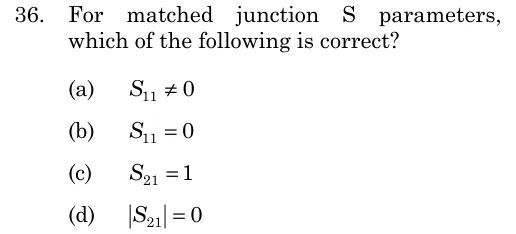
For matched junction S parameters, which of the following is correct?
- (A)
- (B)
- (C)
- (D)

For matched junction S parameters, which of the following is correct?
ANSWER
The correct option is (b): .
Official answer: BSource: ISRO's revised and final answer key of 16 February 2024
A junction is matched at a port when, with every other port terminated in a matched load, a wave sent into that port is not reflected.
The reflection coefficient at port 1 is . Matching means the reflected wave is zero, , for an incident wave . Hence , and in the same way every diagonal element .
Option (a), , describes a mismatched port, so it is wrong.
Option (c), , would need lossless transmission with zero phase shift. Matching does not require this: a matched attenuator has but , and a matched line section has , whose phase is not zero.
Option (d), , would mean that no power is transmitted. Matching does not imply this: a matched through-line has .
The only statement that always holds for a matched junction is , which is option (b).
KEY IDEA
A matched port reflects nothing, so its reflection coefficient (with the other port matched-terminated) is zero. Matching says nothing about the transmission coefficient .
WATCH OUT FOR
Assuming a matched junction must also pass the signal perfectly, so choosing . Matching only removes reflection; depends on loss and electrical length.
From the ISRO EC 2023 paper. Every question of this paper · The full paper (PDF, ISRO) · All 6 ISRO Transmission lines questions, with notes