IAE Academy

IN THE EE AND IN SYLLABUS

Magnetostatics, magnetic circuits and inductance

Magnetostatics is the study of the steady magnetic field set up by steady currents: finding and from a current by the Biot-Savart law or Ampere's circuital law, the force and torque that field exerts on moving charges, conductors and loops, and how it behaves inside magnetic materials and across boundaries. Applied to iron cores, the same two laws give the magnetic-circuit method (mmf, reluctance, air gaps) and the self and mutual inductance of coils and transmission lines. The worked examples cover each kind of calculation in turn: the field of a given current layout, a current density from a given field, a force, a boundary problem, the coil current, inductance and energy of a gapped core, and the inductance of a toroid.

12 previous-year questions · 12 solved · 5 practice questions

Conventions, B and H, and the Biot-Savart law

Conventions used throughout. SI units. H/m (exact before the 2019 SI revision and still correct to better than one part in ), so H/m and H/m. Unit vectors are written (Cartesian), (cylindrical) and (spherical). Magnetostatics means steady (DC) currents: nothing varies with time and . Right-hand rule: with the right thumb along the current, the fingers curl in the direction of (and ). For a closed path, with the fingers along the direction of travel, the thumb gives the direction in which enclosed current counts as positive.

Two field vectors. The magnetic field intensity (A/m) is fixed by the free currents; the magnetic flux density (tesla, T = Wb/m²) is what exerts force and what is counted as flux. They differ by the permeability of the medium. For a given current in a homogeneous linear medium filling all space, from the Biot-Savart law does not depend on the medium, while scales with .

PERMEABILITY AND THE CONSTITUTIVE RELATION

Linear, isotropic medium. is the magnetization (magnetic dipole moment per unit volume, A/m) and the magnetic susceptibility. In a ferromagnetic material is not a constant: it depends on and on the magnetic history (see the B-H curve below).

MAGNETIC FLUX

is normal to the surface. For a uniform normal to a flat area , .

BIOT-SAVART LAW

Steady current. points FROM the current element TO the field point. For a surface current density (A/m) replace by ; for a volume current density (A/m²) by . A point on the line of a straight segment (or its extension) gets no field from that segment, since .

FINITE STRAIGHT WIRE

is the perpendicular distance from the point to the line of the wire. are the angles, at the point, between that perpendicular and the lines to the two ends, when the ends lie on opposite sides of the foot of the perpendicular. If both ends are on the same side, use with the larger angle. Direction by the right-hand rule.

INFINITE AND SEMI-INFINITE STRAIGHT WIRE

Infinite wire: . Semi-infinite wire with the point on the perpendicular through its finite end: , .

CIRCULAR LOOP, ON ITS AXIS

Loop of radius in the -plane centred at the origin, current counter-clockwise seen from ; is the distance along the axis. Far away (), , the on-axis field of a magnetic dipole.

ARC, RECTANGULAR AND SQUARE LOOP, AT THE CENTRE

Arc of radius subtending angle at its centre (radial leads to the centre add nothing). Rectangle of sides and : four finite wires, all giving fields in the same direction at the centre; each side of length is at with , and likewise for the other pair. Square of side (): each side has and .

SOLENOID, ON ITS AXIS

turns per metre, radius , point on the axis inside the solenoid at axial distances and from the two ends (for a point on the axis beyond one end, subtract the near-end term from the far-end term). A long, closely wound solenoid has a uniform inside and outside.

TOROID

closely wound turns; is the distance from the toroid's axis. does not depend on the core material; does.

INFINITE CURRENT SHEET

Uniform surface current density (A/m); is the unit normal from the sheet towards the field point. at any distance. Two parallel sheets carrying and : between them and outside.

WORKED EXAMPLE

A long conductor is bent into a hairpin: two parallel semi-infinite straight legs joined by a semicircle of radius cm, the legs tangent to the semicircle at its ends. It carries A in air. Find and at the centre of the semicircle.

Solution
  1. The current runs in along one leg, round the semicircle and out along the other leg, so every part circulates the same way round the centre: all three contributions are normal to the plane, in the same direction, and add.

  2. Semicircle: A/m.

  3. Each leg ends at an end of the semicircle, and the centre lies on the perpendicular to the leg through that end, at distance . Semi-infinite wire: A/m per leg, so A/m for both legs.

  4. A/m, and T.

Answer: A/m and μT, normal to the plane of the hairpin (direction by the right-hand rule on the circulation).

EXAM TIP

Superposition, piece by piece. Break any conductor into straight segments and arcs and add the vector contributions. A straight segment whose line passes through the field point contributes nothing (for example radial leads to the centre of an arc). Fix the direction of each piece with the right-hand rule before adding magnitudes; with opposite currents, pieces can cancel.

Ampere's circuital law, curl and the magnetostatic equations

AMPERE'S CIRCUITAL LAW (INTEGRAL FORM)

Steady currents. is any surface bounded by the closed path ; the positive sense of follows the right-hand rule on the direction of travel round . For turns threading the path, . Always true for steady currents, but it yields directly only when symmetry lets a path be chosen along which is tangential and constant in magnitude, and elsewhere perpendicular to the path or zero: infinite wire, round conductor, coaxial cable, current sheet, solenoid, toroid.

AMPERE'S LAW (POINT FORM) AND CURRENT CONTINUITY

Magnetostatics only (time-varying fields add the displacement current density ). In a current-free region .

GAUSS'S LAW FOR MAGNETISM

No isolated magnetic poles: flux lines close on themselves and the net flux out of any closed surface is zero. Holds for time-varying fields too. It is the flux-junction rule of magnetic circuits.

CURL IN CARTESIAN COORDINATES

The curl is circulation per unit area: , with the small path and related by the right-hand rule.

CURL IN CYLINDRICAL COORDINATES

For the common case (the field round a straight current) this reduces to .

STOKES' THEOREM

Links the two forms of Ampere's law. is any open surface bounded by , with oriented by the right-hand rule on the direction of travel round .

MAGNETIC VECTOR POTENTIAL

Homogeneous medium of permeability (use otherwise), with the choice . is in Wb/m. Each current element contributes to in its own direction, so the field of a straight current has parallel to that current. The flux through any surface equals the circulation of round its edge.

MAGNETIC SCALAR POTENTIAL

is in amperes. It exists only in a current-free region, because whereas . It is not single-valued round a current: each complete circuit of a path enclosing a current changes by in magnitude.

Using Ampere's law to find H

  1. From the symmetry of the current, decide which component of exists and what it depends on (for example for any straight, axially uniform current whose density depends only on ).

  2. Choose an Amperian path along which that component is tangential and constant in magnitude, and which is elsewhere perpendicular to or runs where (a circle for ; a rectangle for a sheet or a solenoid).

  3. Find with its sign. For a uniform current density the enclosed fraction is the enclosed area over the conductor's area; return currents inside the path subtract.

  4. Equate: for a circle, ; for a rectangle of length with one side inside a long solenoid, .

  5. Check with the point form: must give back the known inside conductors and zero outside them.

SOLID ROUND CONDUCTOR (UNIFORM CURRENT)

Radius , current spread uniformly (, DC). rises linearly from zero on the axis to its maximum at the surface, then falls as . Inside a hollow tube whose current flows only in the wall, .

Coaxial cable. Inner conductor of radius carrying ; outer conductor from to carrying ; both currents uniformly distributed (DC). Ampere's law on a circle of radius gives:

Region

WORKED EXAMPLE

In a region described in cylindrical coordinates, A/m. Find the current density and the total current crossing the disc m in the plane (positive along ). Check the result with Ampere's circuital law.

Solution
  1. Only exists, so A/m².

  2. A.

  3. Check: on the circle m, A. The two agree, as Stokes' theorem requires.

Answer: A/m² and A.

EXAM TIP

Quick tests. Outside a straight conductor whose current density depends only on , whatever the distribution inside, so a coaxial cable with equal and opposite currents has no field outside it. A given can exist in a current-free region only if its curl is zero. A given is a possible magnetic field at all only if its divergence is zero.

Magnetic materials, permeability and the B-H curve

An applied field aligns the atomic magnetic moments of a material, giving a magnetization (net dipole moment per unit volume). Its effect is that of bound currents, in the volume and on the surface ( the outward normal). So , while involves free current only. That is why , not , appears in Ampere's law when materials are present.

Class

and

Behaviour

Examples

Diamagnetic

small and negative; slightly below 1

Weakly repelled by a field; susceptibility essentially independent of temperature

Copper, silver, bismuth, water

Paramagnetic

small and positive; slightly above 1

Weakly attracted; where the effect comes from permanent atomic moments, the susceptibility falls as temperature rises ()

Aluminium, platinum, oxygen

Ferromagnetic

and not constant

Strongly attracted; nonlinear B-H curve with saturation and hysteresis; becomes paramagnetic above its Curie temperature

Iron, nickel, cobalt and their alloys

Ferrimagnetic (ferrites)

and not constant

Like ferromagnetic, but with high electrical resistivity, so eddy-current loss stays low at high frequency

Manganese-zinc and nickel-zinc ferrites

B-H curve and hysteresis. Starting from a demagnetized ferromagnetic sample, rises with along the initial magnetization curve, steeply at first and then flattening as the material saturates. When is brought back to zero, does not retrace the curve: it is left at the remanence (residual flux density) . A reverse field equal to the coercivity (coercive force) is needed to bring to zero. Cycling between and traces a closed hysteresis loop. Soft magnetic materials (silicon steel, soft iron, soft ferrites) have a narrow loop (small , small loss per cycle) and suit transformer, machine and inductor cores. Hard materials (hard ferrites, rare-earth magnet alloys) have a wide loop (large , usually with a large ) and suit permanent magnets.

PERMEABILITY FROM THE B-H CURVE

For a ferromagnetic material depends on the operating point: it rises from its initial value to a maximum near the knee of the curve and then falls towards in deep saturation. A constant in a problem means the core is being treated as linear (unsaturated).

HYSTERESIS LOSS FROM THE LOOP

The energy lost per cycle per unit volume equals the area enclosed by the B-H loop; multiply by the frequency and the core volume for the power.

EMPIRICAL CORE-LOSS RELATIONS

= peak flux density, = lamination thickness, and material constants, an empirical exponent that depends on the material (1.6 is the classical value). At a fixed , hysteresis loss is proportional to and eddy-current loss to . Building the core from thin insulated laminations cuts eddy loss through the factor; it does not reduce hysteresis loss.

EXAM TIP

H is set by the current, B by the material. In a toroid or a long solenoid filled with a core, does not change when the core is changed; , the flux and the inductance do. Doubling doubles , and but leaves unchanged, as long as the material stays linear.

Lorentz force, forces between currents, torque and dipoles

LORENTZ FORCE

carries its sign (an electron has C). The magnetic part is perpendicular to the velocity, so it does no work: it changes the direction of motion, never the speed or the kinetic energy.

CHARGED PARTICLE IN A UNIFORM B

and are the velocity components perpendicular and parallel to ; with the path is a circle (if ) or a helix. The period and angular frequency do not depend on the speed (non-relativistic motion). A charge accelerated from rest through a potential difference has , so entering perpendicular to it moves on a circle of radius . In crossed and (both perpendicular to and to each other, forces opposed), a charge passes undeflected when .

FORCE ON A CURRENT ELEMENT AND ON A STRAIGHT CONDUCTOR

points along the current and is the angle between the conductor and ; the second and third forms need a straight conductor in a uniform . A closed loop of any shape in a UNIFORM field feels zero net force (it can still feel a torque).

HALL EFFECT

A slab carries a current perpendicular to a uniform ; is the slab's thickness measured along , the number density of the charge carriers and their charge (one type of carrier). The magnetic force pushes the carriers, drifting at speed , towards one side until the transverse Hall field balances it. does not depend on the slab's width. The Hall coefficient (m³/C) is negative for electrons and positive for holes, so the polarity of identifies the carrier type; because , it is far larger in a semiconductor than in a metal.

FORCE BETWEEN TWO LONG PARALLEL WIRES

Infinitely long parallel wires with separation , in air. Currents in the same direction attract; in opposite directions they repel. It follows from with .

MAGNETIC DIPOLE MOMENT, TORQUE AND ENERGY

Planar loop of area with turns carrying ; is the normal given by the right-hand rule on the current; in A·m². Uniform ; is the angle between and , so the torque is largest when the PLANE of the loop is parallel to . Stable equilibrium (minimum , zero torque) is parallel to .

FIELD OF A MAGNETIC DIPOLE (FAR FIELD)

Small current loop at the origin with , spherical coordinates, much larger than the loop. On the axis (), , which matches the loop-axis formula for .

FIELD OF AN ELECTRIC DIPOLE (FAR FIELD)

Charges and separated by , with directed from to along ; ; F/m. In a uniform : torque , energy .

Quantity

Electric dipole

Magnetic dipole

Source

Charges separated by

Current loop: turns, area , current

Moment

(C·m), from to

(A·m²), right-hand rule

Far field

Falls as ; pattern

Falls as ; same angular pattern

Torque in a uniform field

Potential energy

Net force in a uniform field

Zero

Zero

Net force in a non-uniform static field (fixed moment)

WORKED EXAMPLE

Two long parallel wires in air are 10 cm apart and carry 10 A and 20 A in opposite directions. Find (a) midway between them, (b) where, in the plane of the wires, , and (c) the force per metre on each wire.

Solution
  1. (a) Between two wires with opposite currents the two fields point the same way, so they add: T.

  2. (b) The fields can cancel only outside the pair, on the side of the smaller current. At a distance beyond the 10 A wire: , so m.

  3. (c) N/m, repulsive because the currents are opposite; equal and opposite on the two wires.

Answer: (a) μT; (b) on the line 10 cm beyond the 10 A wire, on the side away from the 20 A wire (20 cm from the 20 A wire); (c) mN/m, repulsive.

EXAM TIP

Torque angle trap. uses the angle between the loop's NORMAL and . Plane of the coil parallel to the field means and maximum torque; plane of the coil perpendicular to the field means , zero torque and maximum flux linkage.

EXAM TIP

Speed-independent quantities. In a uniform , doubling a charge's speed doubles the radius of its circle but leaves the period and the cyclotron frequency unchanged. Its kinetic energy stays constant, because the magnetic force does no work.

Boundary conditions for B and H

At the interface between two magnetic media, apply Gauss's law for magnetism to a thin pillbox and Ampere's law to a thin rectangular loop straddling the surface. Let be the unit normal pointing from medium 2 into medium 1, and any free surface current density (A/m) on the interface. unless the problem places a current sheet there; a conductor of finite conductivity carries volume current, not surface current.

NORMAL COMPONENT OF B

Always, from . The normal component of is therefore discontinuous whenever .

TANGENTIAL COMPONENT OF H

points from medium 2 into medium 1. The tangential jumps by in the tangential component perpendicular to . With no surface current the tangential is continuous and the tangential changes in the ratio of the permeabilities.

REFRACTION OF B LINES

Linear isotropic media, no surface current; are measured from the NORMAL. Going from air into iron () the lines bend towards the surface inside the iron; coming out of iron into air they leave almost normal to the iron surface, unless they run exactly along it inside.

WORKED EXAMPLE

The plane separates medium 1 (, ) from medium 2 (, ); there is no surface current. At the interface in medium 1, mT. Find and the angle each field makes with the normal.

Solution
  1. The normal is . Normal B is continuous: mT.

  2. Tangential H is continuous (), so the tangential B scales by : mT and mT.

  3. mT.

  4. Angles: , so ; , so . Check: .

Answer: mT; and from the normal.

EXAM TIP

Which component carries across. Normal always, and tangential when there is no surface current. The usual slip is to carry or across unchanged. When converting between B and H on either side, use the permeability of the medium the field is in.

Magnetic circuits: mmf, reluctance and air gaps

A magnetic circuit is a path of high-permeability material, usually with one or more short air gaps, that guides the flux produced by a coil. Applying Ampere's law round the mean path, , and taking as uniform over each cross-section gives a relation of the same form as a resistive circuit: the mmf drives flux through reluctances.

MMF, RELUCTANCE AND FLUX

= mean length of the flux path in that part, = its cross-sectional area, = permeance (H). Valid while the material is linear, is uniform over the cross-section and leakage flux is neglected.

LOOP AND JUNCTION LAWS FOR MAGNETIC CIRCUITS

The loop law is Ampere's circuital law; the junction law is . Parts in series carry one flux and . Parallel limbs between the same two junctions have equal mmf drops; their combined reluctance follows , and the flux divides between them in inverse ratio of their reluctances.

Electric circuit

Magnetic circuit

emf (V)

mmf (A-t)

Current (A)

Flux (Wb)

Resistance (Ω)

Reluctance (A-t/Wb)

Conductivity

Permeability

Conductance

Permeance

Field and current density

Field intensity and flux density

AIR GAP AND FRINGING

Air gap of length . With fringing neglected, equals the core area. Fringing spreads the flux over a larger area, lowering the gap's reluctance and its flux density; the rule is an approximate correction for a short gap between rectangular faces. The gap's reluctance exceeds that of an iron path of length and the same area whenever , which for a core with a large is a very short gap.

INDUCTANCE FROM RELUCTANCE

Linear core, every turn linked by the same flux. . When the gap dominates, and , nearly independent of the core's (variable) permeability, which is one reason inductor cores are gapped. Two coils of and turns on the same core with no leakage: , and , so and .

ENERGY IN A MAGNETIC CIRCUIT AND PULL OF AN ELECTROMAGNET

Linear circuit. At the same , the energy density in air is times that in iron, so the gap holds much of the energy. The pull on a pole face of area across a gap with uniform (no fringing) follows from virtual work at constant flux; a U-shaped magnet lifting a bar across two gaps exerts twice this.

Solving a magnetic circuit with a nonlinear (B-H curve) core

  1. Draw the equivalent circuit: an mmf source and one reluctance per part (limb, yoke, gap), in series and parallel as the flux paths run.

  2. Forward problem (flux given, find ): in each part, using that part's own area and the flux that part carries.

  3. Find in each iron part from its B-H curve (or if a constant is given); in each air gap .

  4. Add round the loop to get , and divide by for the current.

  5. For parallel limbs, the mmf drops between the same two junctions are equal; in a symmetric shell core each outer limb carries half the central-limb flux.

  6. Reverse problem ( given, find flux): with a nonlinear core it needs trial and error or a graphical load line, because the iron's reluctance depends on the unknown flux. With a constant it is simply .

WORKED EXAMPLE

An iron core has an iron path of mean length 40 cm, a uniform cross-section of 4 cm², a 1 mm air gap, and relative permeability 2000 (treat it as linear). A 500-turn coil must set up T in the gap. Neglecting leakage and fringing, find the coil current, the inductance and the stored energy.

Solution
  1. A-t/Wb.

  2. A-t/Wb: five times the iron's, although the gap is 1/400 of the iron length.

  3. Wb, and A-t (795.8 A-t across the gap, 159.2 A-t across the iron).

  4. A.

  5. H.

  6. J. Check with energy density: gap J, iron J, total 0.191 J.

Answer: A, H and J, of which about 83% is stored in the air gap.

EXAM TIP

Gap first. In a core with an air gap, find the gap's reluctance first. When the iron can be neglected for a quick estimate, (in the example above this estimate is 796 A-t against 955 A-t with the iron included, because there is only five times ). Keep units in SI: 1 cm² = m² and 1 mm = m.

EXAM TIP

What the circuit analogy misses. There is no magnetic insulator, so some flux always leaks outside the intended path; the iron's reluctance changes with the flux (saturation); and a steady flux dissipates no power, unlike a current in a resistor. Core loss appears only when the flux changes with time.

Self and mutual inductance, and stored magnetic energy

Inductance measures how much flux a current links. The flux linkage counts each turn's share of flux (if different turns link different flux, ). In a linear medium, inductance depends only on the geometry and the permeability, never on the current. There are two routes to . Flux route: assume a current , find by Ampere's law, take , integrate for the flux, multiply by the turns it links and divide by . Energy route: compute and use . The energy route is the natural one for internal inductance, where flux inside a conductor links only part of the current.

SELF INDUCTANCE

Linear medium. For a nonlinear core the incremental inductance depends on the operating point.

MUTUAL INDUCTANCE

is the flux produced by coil 1 that links each turn of coil 2. Reciprocity () holds in any linear medium, so compute from whichever coil's field is easier to find. The double line integral is the general form for two thin single-turn loops in a homogeneous non-magnetic medium, being the distance between the two elements.

COUPLING COEFFICIENT AND SERIES CONNECTION

Plus sign when the two fluxes aid (the current enters both dotted ends), minus when they oppose; hence . only if every flux line of each coil links every turn of the other. The polarity of the induced voltage follows the dot convention.

STORED MAGNETIC ENERGY

Linear medium. For two coupled coils, , plus when the fluxes aid.

LONG SOLENOID

Length much greater than the radius, uniform core of permeability filling it, = cross-sectional area, . End effects make the of a real, finite solenoid somewhat smaller.

TOROID

Rectangular cross-section of height , inner radius and outer radius , from integrating across the section. Thin toroid: mean radius much larger than the section's dimensions, = section area; for a circular section of radius , .

COAXIAL LINE (PER UNIT LENGTH)

Inner conductor radius , outer conductor inner radius . External part: flux in the dielectric of permeability . Internal part: solid inner conductor of permeability carrying a uniform (DC) current, found by the energy route. The last form is for non-magnetic conductors and dielectric with a thin outer conductor. At high frequency the current crowds to the surface (skin effect) and .

TWO-WIRE LINE (PER UNIT LENGTH)

Two parallel wires of radius with centre-to-centre spacing , carrying equal and opposite currents. The second form () adds the internal inductance of EACH wire (non-magnetic, uniform current); is the geometric mean radius of a solid round wire.

MUTUAL INDUCTANCE: COIL ON A LONG SOLENOID; WIRE AND COPLANAR LOOP

First: a coil of turns coaxial with a long air-cored solenoid of turns/m and placed well inside its length, away from the ends; is the cross-section of whichever winding is inside, because the solenoid's field is confined to its own cross-section. Second: an infinitely long straight wire and a coplanar rectangular loop with sides parallel and perpendicular to the wire, the nearer side at distance , in air.

WORKED EXAMPLE

An air-cored toroid of rectangular cross-section has inner radius 5 cm, outer radius 8 cm, height 2 cm and 400 turns. Find its inductance exactly, and compare it with the thin-toroid approximation using the mean radius.

Solution
  1. Ampere's law: for . Flux through the section: .

  2. H.

  3. Thin-toroid estimate: cm and cm² m², so H.

  4. The estimate is 1.8% low here. The error grows as grows, because varies as across the section.

Answer: mH exactly; the mean-radius formula gives mH.

EXAM TIP

Numbers worth remembering. μH/m, so a coaxial line's external inductance is μH/m and a two-wire line's is about μH/m (air). The internal inductance of a solid non-magnetic round conductor at DC is μH/m, whatever its radius. Inductance scales as : doubling the turns on the same core quadruples .

EXAM TIP

Mutual inductance traps. Use the flux of the coil whose field is easy to find, then rely on reciprocity. For a coil and a long solenoid, the area is that of the INNER winding. For a wire and a coplanar loop, the logarithm is with the distance to the NEAR side, not .

PREVIOUS-YEAR QUESTIONS

12 questions from the EE and IN papers

Try each question first, then open the answer. We placed each question under a topic ourselves; the exam paper does not label topics.

See these papers in full: GATE EE 2026 · GATE EE 2024 · GATE EE 2023 · GATE EE 2022 · GATE EE 2020 · GATE EE 2018 · GATE IN 2026 · GATE IN 2025 · GATE IN 2024 · GATE IN 2023

GATE 2026 EE Q.16

GATE 2026 · EEQ.16 · 1 mark · MCQ

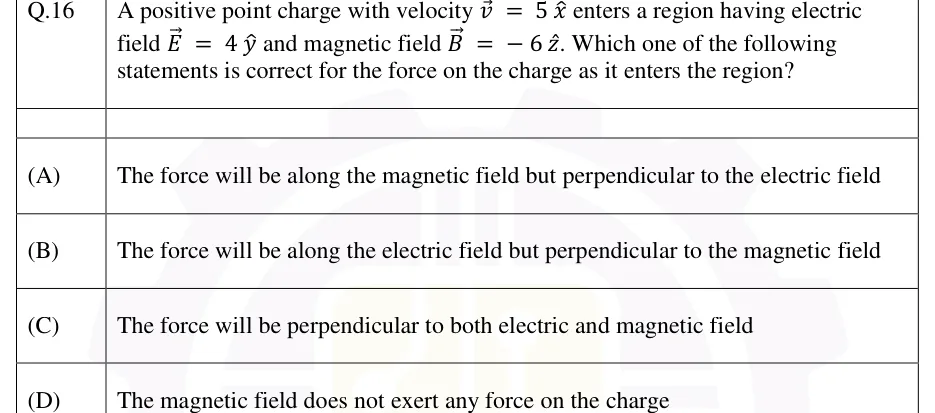
A positive point charge with velocity enters a region having electric field and magnetic field . Which one of the following statements is correct for the force on the charge as it enters the region?

  1. (A)

    The force will be along the magnetic field but perpendicular to the electric field

  2. (B)

    The force will be along the electric field but perpendicular to the magnetic field

  3. (C)

    The force will be perpendicular to both electric and magnetic field

  4. (D)

    The magnetic field does not exert any force on the charge
Answer and solution
See the question in the paper
GATE 2026 EE Q.16: answer and solution

GATE 2026 IN Q.38

GATE 2026 · INQ.38 · 2 marks · MCQ

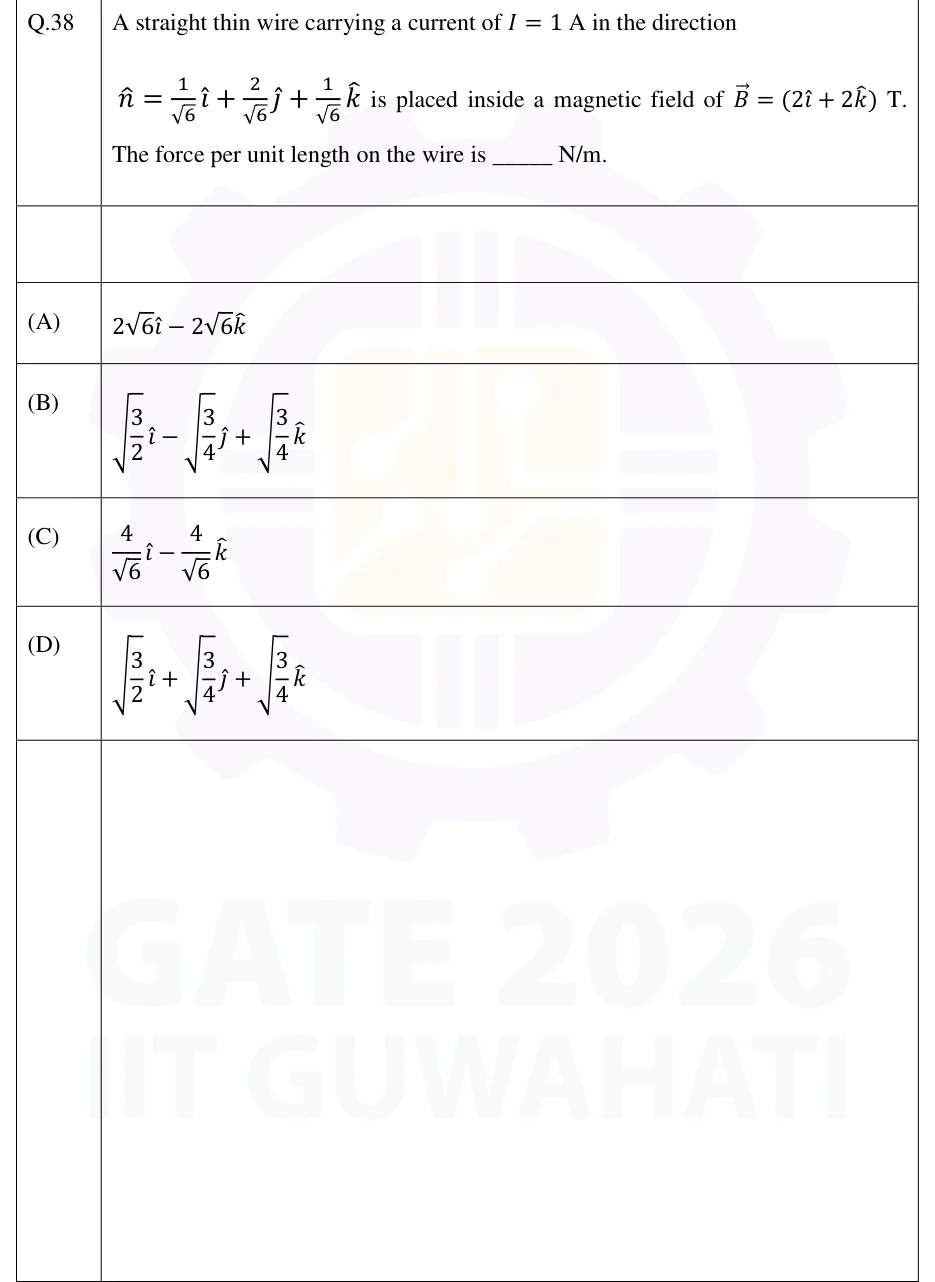
A straight thin wire carrying a current of A in the direction is placed inside a magnetic field of T. The force per unit length on the wire is ______ N/m.

  1. (A)

  2. (B)

  3. (C)

  4. (D)

Answer and solution
See the question in the paper
GATE 2026 IN Q.38: answer and solution

GATE 2025 IN Q.30

GATE 2025 · INQ.30 · 1 mark · MCQ

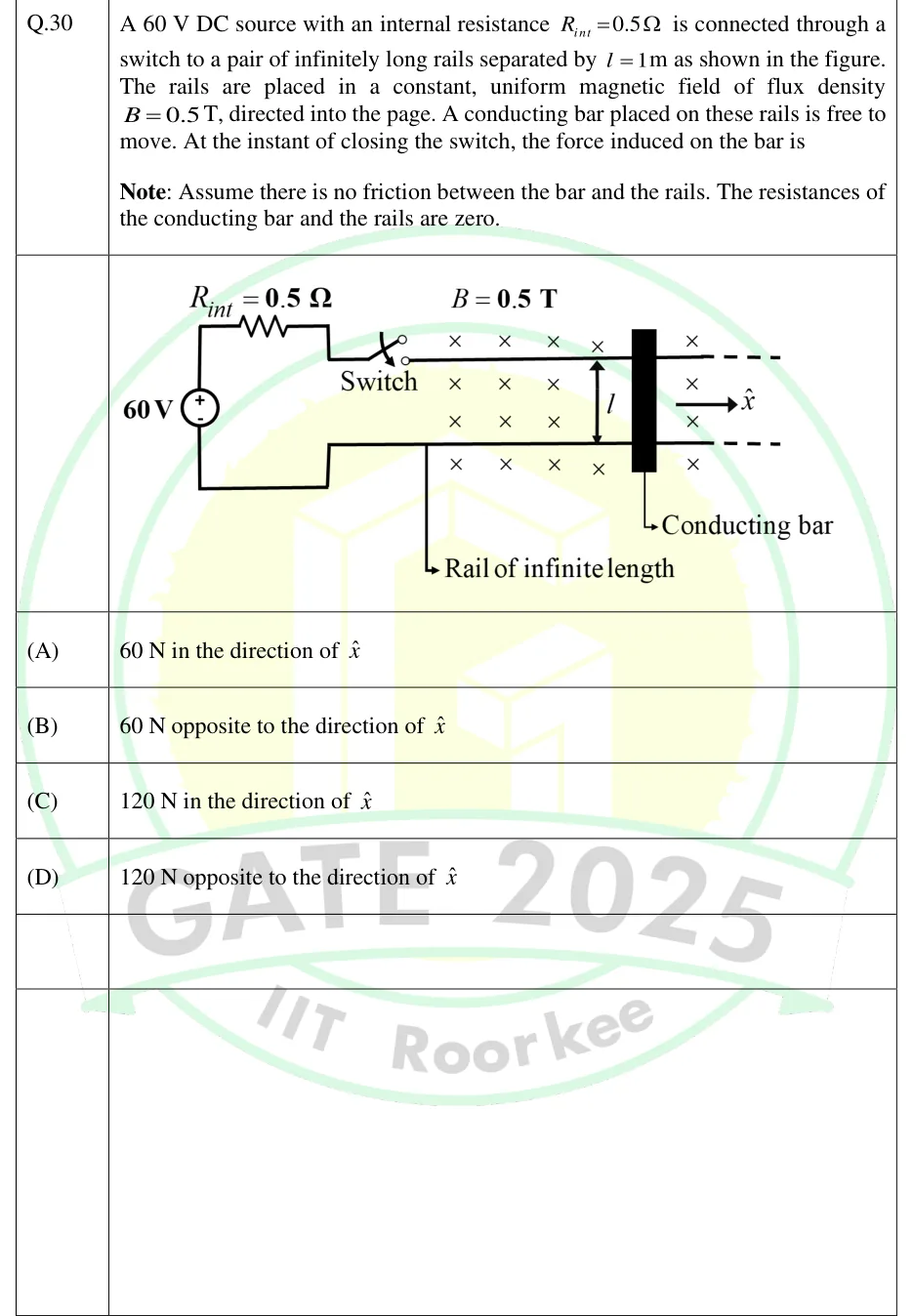
A 60 V DC source with an internal resistance is connected through a switch to a pair of infinitely long rails separated by as shown in the figure. The rails are placed in a constant, uniform magnetic field of flux density , directed into the page. A conducting bar placed on these rails is free to move. At the instant of closing the switch, the force induced on the bar is

Note: Assume there is no friction between the bar and the rails. The resistances of the conducting bar and the rails are zero.

GATE 2025 IN question 30: A 60 V DC source is on the left, with its + terminal at the top and its - terminal at the bottom.Tap to open full size
Figure from the GATE 2025 IN paper. It is part of the question.
Figure description

A 60 V DC source is on the left, with its + terminal at the top and its - terminal at the bottom. From the + terminal a wire goes up, then right through a resistor labelled R_int = 0.5 Ohm, then down a little into a switch (drawn open) at the left end of the upper of two horizontal parallel rails. From the - terminal a wire goes down, then right, then up into the lower rail. The rails are a distance l apart, marked with a double-headed vertical arrow. They run off to the right with dashed ends, meaning they are infinitely long, and one is labelled 'Rail of infinite length'. A vertical conducting bar, drawn as a thick black rectangle, lies across both rails to the right of the l arrow and is labelled 'Conducting bar'. The region is filled with 'x' symbols (above, between and below the rails, on both sides of the bar), meaning a uniform magnetic field, labelled B = 0.5 T, directed into the page. A unit vector x-hat is drawn to the right of the bar, pointing right along the rails.

  1. (A)

    60 N in the direction of

  2. (B)

    60 N opposite to the direction of

  3. (C)

    120 N in the direction of

  4. (D)

    120 N opposite to the direction of

Answer and solution
GATE 2025 IN Q.30: answer and solution

GATE 2024 EE Q.52

GATE 2024 · EEQ.52 · 2 marks · NAT

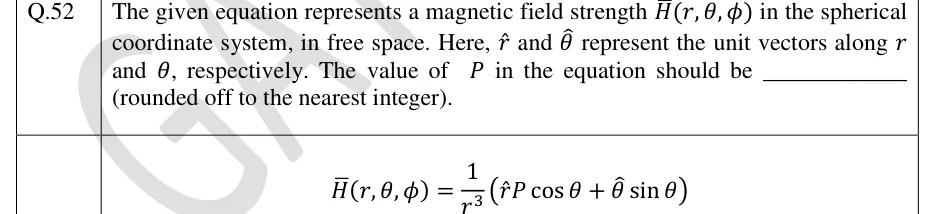
The given equation represents a magnetic field strength in the spherical coordinate system, in free space. Here, and represent the unit vectors along and , respectively. The value of in the equation should be ______ (rounded off to the nearest integer).

Answer and solution
See the question in the paper
GATE 2024 EE Q.52: answer and solution

GATE 2024 IN Q.36

GATE 2024 · INQ.36 · 2 marks · MCQ

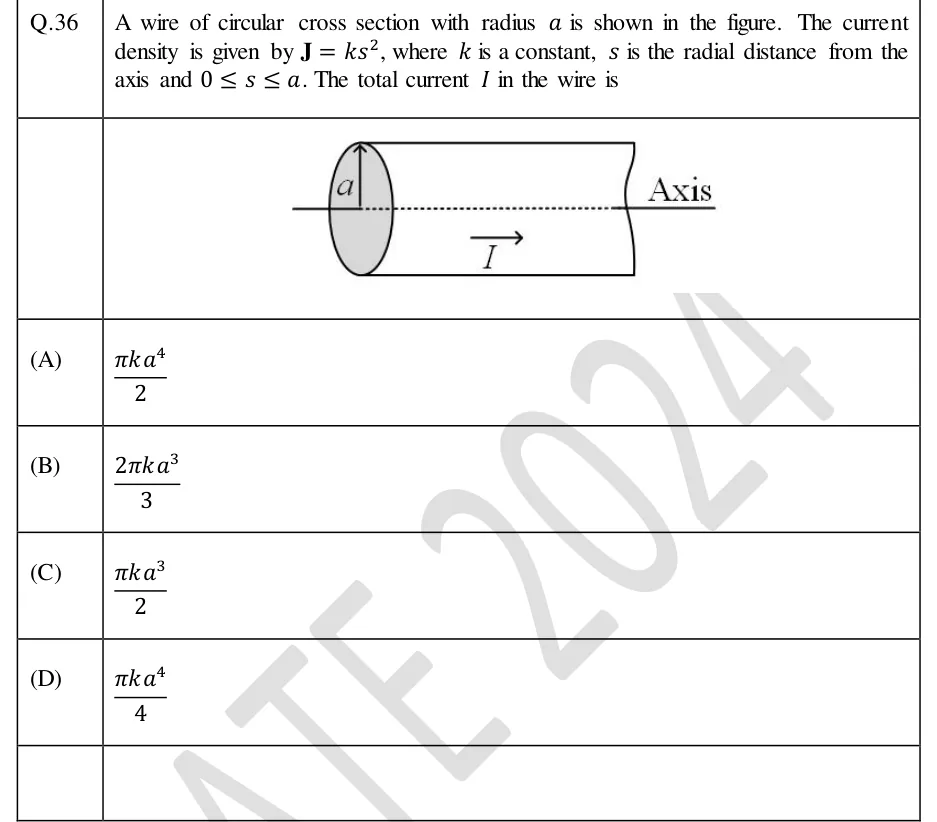
A wire of circular cross section with radius is shown in the figure. The current density is given by , where is a constant, is the radial distance from the axis and . The total current in the wire is

GATE 2024 IN question 36: A straight cylindrical wire drawn horizontally.Tap to open full size
Figure from the GATE 2024 IN paper. It is part of the question.
Figure description

A straight cylindrical wire drawn horizontally. Its left end is shown as a shaded circular cross-section, with an arrow from the centre up to the rim labelled a (the radius). A horizontal line runs through the centre, dashed inside the wire, and is labelled "Axis" on the right. The right end of the wire is drawn as a wavy break line. Inside the wire, below the axis, an arrow points to the right and is labelled I, so the current flows along the axis.

  1. (A)

  2. (B)

  3. (C)

  4. (D)

Answer and solution
GATE 2024 IN Q.36: answer and solution

GATE 2023 EE Q.43

GATE 2023 · EEQ.43 · 2 marks · MSQ

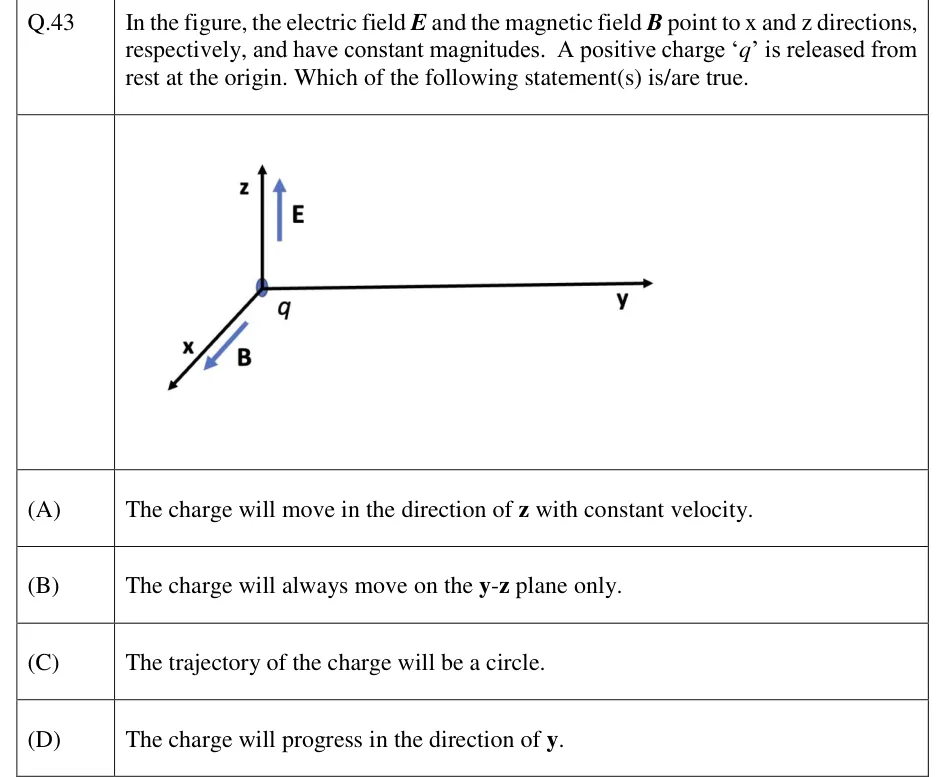
In the figure, the electric field and the magnetic field point to x and z directions, respectively, and have constant magnitudes. A positive charge '' is released from rest at the origin. Which of the following statement(s) is/are true.

GATE 2023 EE question 43: Right-handed 3D axes with the origin marked by a dot labelled q.Tap to open full size
Figure from the GATE 2023 EE paper. It is part of the question.
Figure description

Right-handed 3D axes with the origin marked by a dot labelled q. The z axis points vertically up, the y axis points horizontally to the right, and the x axis points diagonally down-left, out of the page. A blue arrow labelled E runs parallel to the z axis, pointing up (+z). A blue arrow labelled B runs parallel to the x axis, pointing along +x (down-left). No dimensions are given.

  1. (A)

    The charge will move in the direction of z with constant velocity.

  2. (B)

    The charge will always move on the y-z plane only.

  3. (C)

    The trajectory of the charge will be a circle.

  4. (D)

    The charge will progress in the direction of y.

Answer and solution
GATE 2023 EE Q.43: answer and solution

GATE 2023 EE Q.61

GATE 2023 · EEQ.61 · 2 marks · NAT

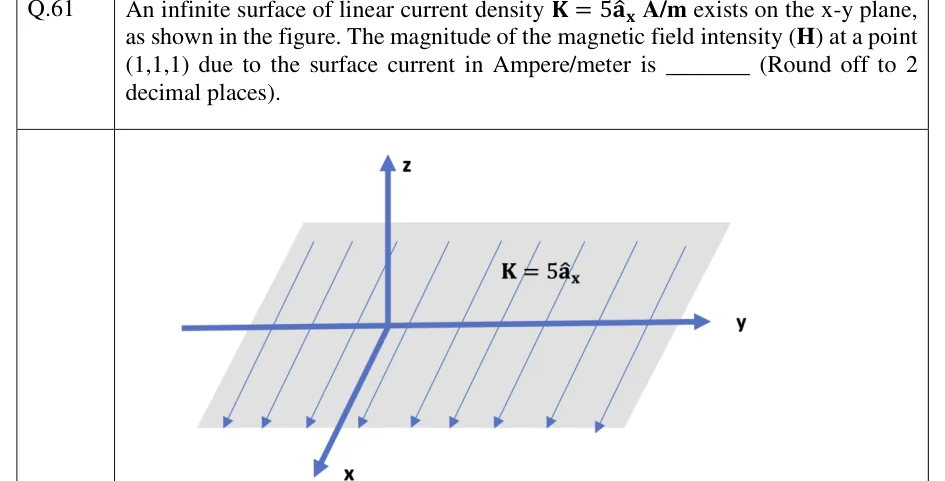
An infinite surface of linear current density A/m exists on the x-y plane, as shown in the figure. The magnitude of the magnetic field intensity () at a point (1,1,1) due to the surface current in Ampere/meter is ________ (Round off to 2 decimal places).

GATE 2023 EE question 61: A 3-D sketch of a right-handed axis set.Tap to open full size
Figure from the GATE 2023 EE paper. It is part of the question.
Figure description

A 3-D sketch of a right-handed axis set. The z axis points up, the y axis points to the right and the x axis points toward the viewer (drawn going down to the lower left). A grey shaded parallelogram lies in the x-y plane (z = 0) and stands for the infinite current sheet. Parallel thin lines with arrowheads run across the sheet parallel to the x axis. The arrows point in the +x direction, toward the viewer. The sheet is labelled K = 5 a-hat_x. No dimensions or other charges or conductors are drawn. The field point (1,1,1) is given only in the text.

Answer and solution
GATE 2023 EE Q.61: answer and solution

GATE 2022 EE Q.23

GATE 2022 · EEQ.23 · 1 mark · MCQ

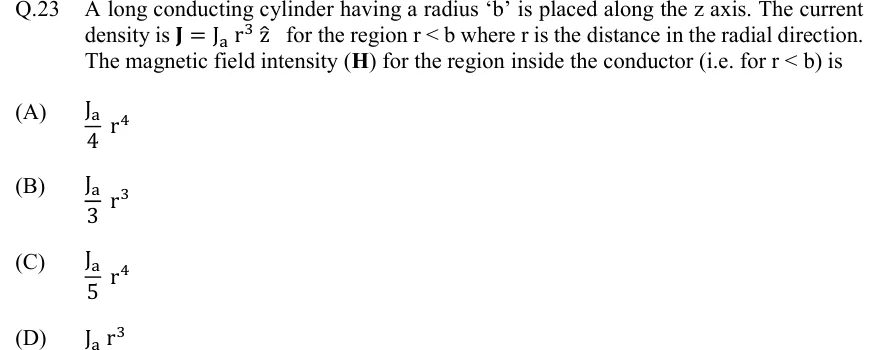
A long conducting cylinder having a radius 'b' is placed along the z axis. The current density is for the region where is the distance in the radial direction. The magnetic field intensity () for the region inside the conductor (i.e. for ) is

  1. (A)

  2. (B)

  3. (C)

  4. (D)

Answer and solution
See the question in the paper
GATE 2022 EE Q.23: answer and solution

GATE 2020 EE Q.55

GATE 2020 · EEQ.55 · 2 marks · NAT

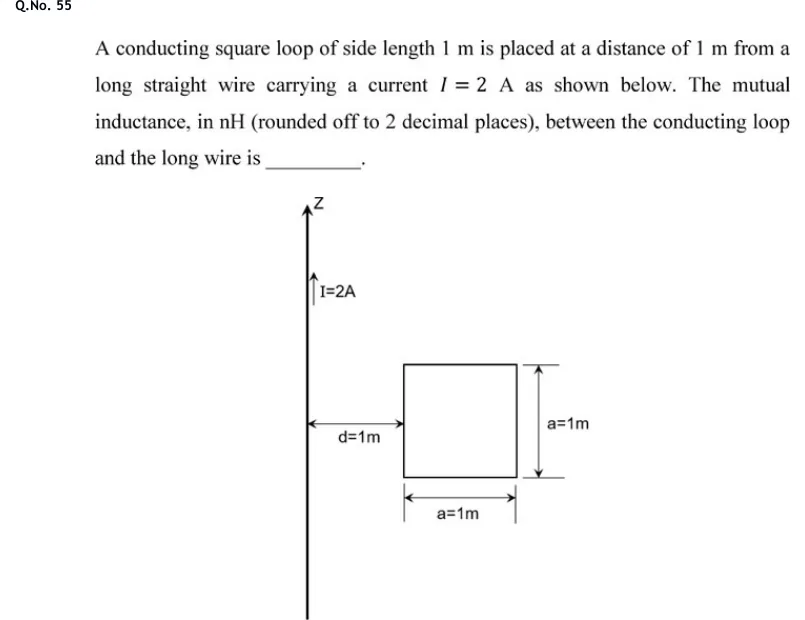
A conducting square loop of side length 1 m is placed at a distance of 1 m from a long straight wire carrying a current A as shown below. The mutual inductance, in nH (rounded off to 2 decimal places), between the conducting loop and the long wire is ________.

GATE 2020 EE question 55: A long straight vertical wire along the z-axis (arrow at the top labelled Z), carrying current I = 2A upward (small upward…Tap to open full size
Figure from the GATE 2020 EE paper. It is part of the question.
Figure description

A long straight vertical wire along the z-axis (arrow at the top labelled Z), carrying current I = 2A upward (small upward arrow beside the wire labelled I=2A). To the right of the wire, in the same plane as the wire, is a square loop. The horizontal distance from the wire to the near (left) side of the square is marked d=1m with a double-headed arrow. The square's width is marked a=1m below it and its height is marked a=1m to its right. The left and right sides of the square are parallel to the wire, so the loop spans distances 1 m to 2 m from the wire.

Answer and solution
GATE 2020 EE Q.55: answer and solution

GATE 2018 EE Q.26

GATE 2018 · EEQ.26 · 2 marks · MCQ

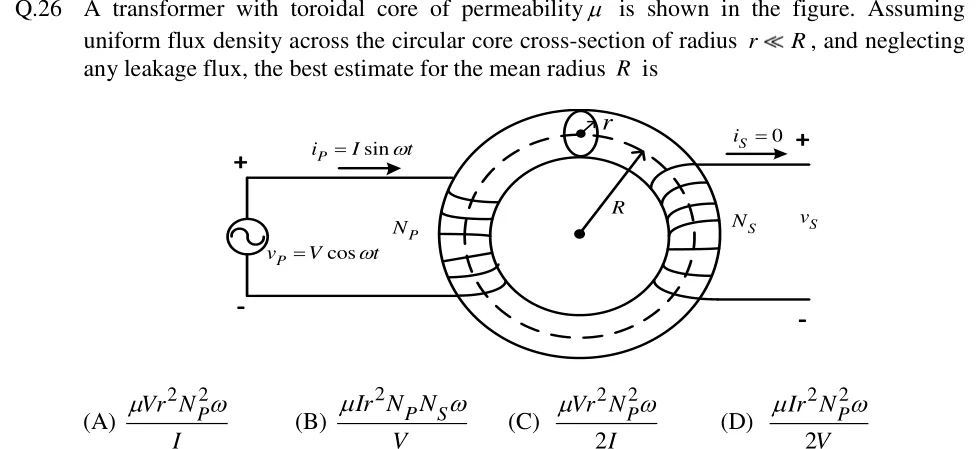
A transformer with toroidal core of permeability is shown in the figure. Assuming uniform flux density across the circular core cross-section of radius , and neglecting any leakage flux, the best estimate for the mean radius is

GATE 2018 EE question 26: A toroidal core with mean radius R (dashed mean-path circle, R drawn as an arrow from the centre to the dashed circle) and…Tap to open full size
Figure from the GATE 2018 EE paper. It is part of the question.
Figure description

A toroidal core with mean radius R (dashed mean-path circle, R drawn as an arrow from the centre to the dashed circle) and circular cross-section of radius r (small circle drawn on the top of the ring with r marked). A primary winding of N_P turns is wound on the left side of the toroid and a secondary winding of N_S turns on the right side. The primary is connected to an AC source v_P = V cos(omega t), + terminal at top, - at bottom; the primary current i_P = I sin(omega t) flows along the top wire towards the winding (arrow pointing right). The secondary terminals are open: i_S = 0 (arrow pointing right on the top wire), with output voltage v_S, + at top and - at bottom.

  1. (A)

  2. (B)

  3. (C)

  4. (D)

Answer and solution
GATE 2018 EE Q.26: answer and solution

PRACTICE

5 questions to test yourself

PRACTICE 11 mark · MCQ

A rectangular coil of 100 turns, 5 cm × 4 cm, carries 0.5 A in a uniform magnetic flux density of 0.2 T. The plane of the coil is parallel to . The magnitude of the torque on the coil, in N·m, is

  1. (A)

    0

  2. (B)

    0.01

  3. (C)

    0.02

  4. (D)

    0.04

Answer and solution

Answer: (C)

  1. A·m².

  2. The plane of the coil is parallel to , so its normal is perpendicular to : .

  3. N·m, the largest torque this coil can feel in this field.

PRACTICE 22 marks · MSQ

Which of the following statements about static magnetic fields are correct? (SI units; linear, isotropic media.)

  1. (A)

    The magnetic force on a moving point charge does no work on the charge.

  2. (B)

    At a current-free interface between two media of different permeability, the normal component of is continuous.

  3. (C)

    Inside a long, closely wound solenoid completely filled with a linear magnetic core, for a given current does not depend on the permeability of the core.

  4. (D)

    The field A/m can exist in a current-free region.

Answer and solution

Answer: (A), (C)

  1. (A) Correct: is perpendicular to , so and no power is delivered to the charge.

  2. (B) Incorrect: the normal component of is continuous, so and jumps when . It is the tangential that is continuous here.

  3. (C) Correct: Ampere's law round a rectangle with one side of length inside gives , so whatever the core; only changes.

  4. (D) Incorrect: A/m², which is not zero, so this field needs a current density to support it.

PRACTICE 32 marks · NAT

A shell-type core of linear material with has the same cross-sectional area, 5 cm², in every part. A 400-turn coil is wound on the central limb, whose iron path length (excluding the gap) is 10 cm and which also contains an air gap of 0.5 mm. Each of the two identical outer paths, from the top of the central limb round an outer limb to its bottom, has a mean length of 30 cm. Neglecting leakage and fringing, the coil current in amperes needed to produce a flux density of 0.8 T in the air gap is ______ (rounded to two decimal places).

Answer and solution

Answer: (accepted range )

  1. H·m, so A-t/Wb.

  2. Central iron: A-t/Wb. Each outer path: A-t/Wb.

  3. The two outer paths are in parallel: A-t/Wb. Total reluctance seen by the coil: A-t/Wb.

  4. The gap is in the central limb, so the central-limb flux is Wb. Then A-t and A.

PRACTICE 42 marks · MCQ

A long straight wire and a single-turn rectangular loop lie in the same plane in air. The loop's 20 cm sides are parallel to the wire and its 10 cm sides are perpendicular to it; the nearer 20 cm side is 5 cm from the wire. The wire carries A. The peak emf induced in the loop is closest to

  1. (A)

    87 μV

  2. (B)

    101 μV

  3. (C)

    138 μV

  4. (D)

    276 μV

Answer and solution

Answer: (C)

  1. The wire's field at distance is , normal to the plane of the loop.

  2. Flux: , so H.

  3. , and the peak of is A/s.

  4. V μV. (Using gives 87 μV; swapping the loop's sides gives 101 μV; using in place of gives 276 μV.)

PRACTICE 51 mark · NAT

A wire of fixed length carries a steady current . It is bent first into a circular loop and then into a square loop. The ratio of the magnetic flux density at the centre of the square loop to that at the centre of the circular loop is ______ (rounded to two decimal places).

Answer and solution

Answer: (accepted range )

  1. Let the wire length be . Circle: radius , so .

  2. Square: side . Each side is a finite wire at distance from the centre with , so .

  3. .

OFFICIAL GATE 2027 SYLLABUS WORDING

Copied from the GATE 2027 syllabus; see all 2027 syllabi.

GATE EE

Biot‐Savart’s law, Ampere’s law, Curl … Lorentz force, Inductance, Magnetomotive force, Reluctance, Magnetic circuits, Self and Mutual inductance of simple configurations

GATE IN

magnetic field intensity, magnetic flux density, Biot‐Savart’s law, Ampere’s law … Lorentz force, permeability, self and mutual inductance, electrical and magnetic dipoles … magnetomotive force, reluctance, magnetic circuits, B-H curve

Preparing in Kolkata? IAE Academy's course for GATE EE or GATE IN.