IAE Academy

IN THE EC SYLLABUS

Plane waves

Propagation, reflection, polarization and skin depth

A uniform plane wave is the simplest solution of Maxwell's equations away from sources: the electric field, the magnetic field and the direction of travel are mutually perpendicular, and the medium fixes how fast the wave moves (phase constant, phase and group velocity), how quickly it dies out (attenuation constant, skin depth) and how the electric field relates to the magnetic field (intrinsic impedance). Problems on this topic come down to reading a field expression correctly, choosing the right loss approximation, classifying polarisation and its handedness, and applying reflection and transmission coefficients at normal or oblique incidence.

10 previous-year questions · 10 solved · 7 practice questions

Conventions and the uniform plane wave in a lossless medium

Conventions used throughout. SI units; F/m, H/m, m/s. Time-harmonic fields are phasors with time factor , so a wave travelling in carries . Unit vectors are written . Phasor amplitudes are peak values. Reflection and transmission coefficients are ratios of electric fields unless stated otherwise.

A uniform plane wave has and with constant amplitude and phase over every plane perpendicular to the direction of travel. It is a TEM wave: , and the propagation direction are mutually perpendicular, and neither field has a component along . In a source-free region each field satisfies the Helmholtz equation, and a lossless medium is described completely by two numbers: the phase constant and the intrinsic impedance .

VECTOR HELMHOLTZ EQUATION

Source-free, linear, homogeneous, isotropic medium; the same equation holds for . For a lossless medium (), .

PLANE WAVE TRAVELLING IN +Z (LOSSLESS)

Time form ( real): and , in time phase. A wave in has , i.e. .

PHASE CONSTANT (LOSSLESS)

In rad/m; is the wavelength in the medium.

PHASE VELOCITY AND WAVELENGTH (LOSSLESS)

is the free-space wavelength. Refractive index . The frequency does not change when a wave enters a new medium; the wavelength does.

INTRINSIC IMPEDANCE (LOSSLESS)

Ratio for a single travelling wave. For a non-magnetic dielectric .

DIRECTION RELATIONS

Use these to get from (or back) for any propagation direction, including a reflected wave travelling in . They also hold in a lossy medium, with complex .

PLANE WAVE IN AN ARBITRARY DIRECTION

Lossless medium; and . Time form (real ): . Example: with in metres has rad/m and . The wavelength measured along one axis, e.g. , is never shorter than .

TIME-AVERAGE POWER DENSITY (LOSSLESS)

In W/m². Power through an area normal to is . With RMS amplitudes, drop the factor 1/2.

ENERGY DENSITIES (LOSSLESS)

Single travelling wave with peak amplitudes and , energy densities in J/m³. The electric and magnetic energy densities are equal, and the energy moves at (equal to in a non-dispersive medium): .

EXAM TIP

Reading a field expression. In the wave moves toward ; in toward . The coefficient of the space variable is , so and , and for you can back out . Then get from and .

Lossy media: propagation constant, loss tangent and skin depth

In a medium with conductivity the conduction current density adds to the displacement current density . The propagation constant becomes complex, : (Np/m) sets how fast the amplitude decays and (rad/m) sets the phase. The intrinsic impedance becomes complex too, so and are no longer in time phase. The ratio of conduction to displacement current density, the loss tangent, decides which approximation applies.

PROPAGATION CONSTANT

Take the root with and for a wave travelling in as .

EXACT ATTENUATION AND PHASE CONSTANTS

Valid for any . Use it when the loss tangent is neither very small nor very large.

LOSS TANGENT AND COMPLEX PERMITTIVITY

Equals . Writing and assumes all the loss is conduction loss. Good dielectric: ; good conductor: . The same material can be either, depending on frequency.

INTRINSIC IMPEDANCE (LOSSY)

and . leads in time by .

FIELDS IN A LOSSY MEDIUM (+Z)

real. Both envelopes decay as ; lags by .

POWER DECAY AND ATTENUATION IN DB

Power decays at , twice the field rate, but the dB figure is the same for field and power: 1 Np = 8.686 dB.

GOOD DIELECTRIC APPROXIMATIONS

For , to first order in the loss tangent. If and do not depend on frequency, is then independent of frequency; , and are essentially the lossless values.

GOOD CONDUCTOR APPROXIMATIONS

For . is tiny (a small fraction of an ohm for metals at radio frequencies), so a good conductor looks almost like a short circuit to an incident wave.

SKIN DEPTH

Distance over which the field amplitude falls to of its value (power to ). In a good conductor ; the last two results hold only there.

SURFACE RESISTANCE AND AC RESISTANCE OF A WIRE

Good conductor, with thickness (or wire radius ) much greater than : the current is treated as flowing uniformly in a surface layer of depth . is the wire length.

Quantity

Lossless

Good dielectric (loss tangent much less than 1)

Good conductor (loss tangent much greater than 1)

Attenuation constant

Phase constant

Intrinsic impedance

, real

, small positive angle

Phase velocity

Group velocity

Time phase of relative to

In phase

Leads by about rad

Leads by

WORKED EXAMPLE

Seawater has S/m, , . For a 1 MHz uniform plane wave travelling into it, find (a) the loss tangent, (b) , and , (c) , (d) the wavelength and phase velocity in the water, and (e) the depth at which the electric-field amplitude is 1% of its value just below the surface.

Solution
  1. Loss tangent: , so the good-conductor formulas apply.

  2. Np/m (and rad/m).

  3. m, about 25 cm.

  4. , so .

  5. m (against 300 m in free space); m/s.

  6. 1% of the field means , so m. Cross-check in dB: the loss rate is dB/m and m.

Answer: (a) about 888; (b) Np/m, m; (c) ; (d) m, m/s; (e) about 1.16 m.

EXAM TIP

Loss-regime traps. (1) Evaluate the loss tangent at the given frequency before choosing formulas: if S/m and are taken as constant, is about 888 at 1 MHz but only about 0.3 at 3 GHz, where neither the good-dielectric nor the good-conductor approximation holds and the exact formulas are needed. (2) is in Np/m; multiply by 8.686 for dB/m. (3) Power falls as : at the power is 13.5% of its surface value, not 36.8%. (4) After the field is below 1% ().

Phase velocity, group velocity and dispersion

Phase velocity is the speed of a point of constant phase of a single-frequency wave. A signal occupies a band of frequencies, and its envelope travels at the group velocity. A medium in which is not proportional to is dispersive: changes with frequency and . A lossless simple dielectric ( and independent of frequency) is non-dispersive (); a good conductor, an ionised gas (plasma) and a hollow metal waveguide are dispersive.

PHASE AND GROUP VELOCITY

Evaluate at the carrier frequency.

GROUP VELOCITY FROM THE DISPERSION OF THE PHASE VELOCITY

is the wavelength in the medium. Normal dispersion () gives .

ENVELOPE VELOCITY OF TWO CLOSE FREQUENCIES

For the envelope moves at , while the carrier moves at .

WAVE IN A LOSSLESS PLASMA (IONISED GAS)

= electron density per m³, and the electron charge and mass. Propagation only for ; below the wave is evanescent and is reflected. Here and .

PRODUCT AND RATIO RESULTS

holds whenever (plasma, air-filled waveguide above cut-off). In a good conductor gives .

EXAM TIP

can exceed (plasma, waveguide) without violating relativity: no energy or information moves at . In these low-loss cases the energy and the signal envelope travel at . If a question gives as a function of frequency, differentiate rather than guessing .

Polarisation: linear, circular, elliptical and handedness

Polarisation is the path traced by the tip of at a fixed point in space as time passes. For a wave in , write both transverse components as cosines of the same argument and compare their amplitudes and the relative phase (phase of minus phase of ). Handedness in these notes follows the IEEE convention: point the right thumb along the direction of propagation; if the fingers curl the way rotates, the wave is right-handed.

GENERAL TRANSVERSE FIELD (+Z)

and . Phasor form: .

Condition

Polarisation

Handedness for a wave in +z (IEEE)

or (or one component zero)

Linear, at to the x-axis for and at for

None

and

Circular

Right-hand (RHCP)

and

Circular

Left-hand (LHCP)

, not circular

Elliptical

Right-hand

, not circular

Elliptical

Left-hand

Procedure for any polarisation question:

  1. Find the propagation direction from the sign of the space term.

  2. Write both components as with the same space-time argument and positive amplitudes, using , and .

  3. Reduce the phase difference to the range to . Classify: phase difference or gives linear; equal amplitudes and gives circular; anything else gives elliptical.

  4. The tip of rotates from the leading component toward the lagging component, because the leading component reaches its peak first.

  5. If (leading-axis unit vector) (lagging-axis unit vector) , the wave is right-handed; if it equals , it is left-handed.

CIRCULAR POLARISATION PHASOR SHORTCUT (IEEE)

Reverse both for a wave travelling in (). The optics convention names handedness the opposite way, so use the definition the question states.

AXIAL RATIO AND TILT OF THE ELLIPSE

AR = 1 for circular and for linear. is the angle of the major axis from the x-axis (take the root that lies along the major axis). For the axes lie along x and y, and AR .

SEMI-AXES OF THE POLARISATION ELLIPSE

OA (with ) is the semi-major axis and OB (with ) the semi-minor axis, for any . Checks: and . Example: , , gives OA = 4, OB = 3, AR = 4/3.

EXAM TIP

Polarisation facts that always hold. A linearly polarised wave is the sum of an RHCP and an LHCP wave of equal amplitude. Any polarisation in a lossless medium carries , which is for a circularly polarised wave. On normal reflection from a perfect conductor the sense of rotation in the transverse plane is unchanged but the propagation direction reverses, so RHCP becomes LHCP. An ideal linearly polarised receiving antenna collects half the power of a circularly polarised wave, and an ideal antenna of the opposite circular hand collects none.

Normal incidence: reflection, transmission and standing waves

Medium 1 (impedance ) fills and medium 2 () fills ; the wave arrives from medium 1. The boundary conditions are continuity of tangential , and continuity of tangential when there is no surface current (true for any finite ). They give the coefficients below, which also hold for complex (lossy media).

REFLECTION AND TRANSMISSION COEFFICIENTS (E-FIELD)

For real : and . Perfect conductor: , so and .

COEFFICIENTS FOR THE MAGNETIC FIELD

The reflected has the opposite sign to the reflected ratio because the propagation direction reverses.

NON-MAGNETIC DIELECTRICS IN TERMS OF REFRACTIVE INDEX

Follows from . Entering a denser medium () gives .

REFLECTED AND TRANSMITTED POWER FRACTIONS

These need only medium 1 to be lossless; may be complex. For a good conductor , a tiny fraction. When both impedances are real, ; because the impedances on the two sides differ.

STANDING WAVE RATIO IN MEDIUM 1

. With lossless medium 1, and .

WHERE THE MAXIMA AND MINIMA SIT (REAL Γ)

Adjacent maximum and minimum are apart. when (e.g. dielectric into air); when (e.g. air into a dielectric or conductor). has its maxima where has its minima. For complex (lossy medium 2, lossless medium 1), is maximum at , with the integers chosen so that , and minimum from each maximum.

PURE STANDING WAVE IN FRONT OF A PERFECT CONDUCTOR

real, conductor at . nulls at (including the wall), nulls at ; no net power flows ().

SLAB OF THICKNESS D BETWEEN TWO MEDIA (LOSSLESS SLAB)

Same form as a transmission-line input impedance. Quarter-wave slab (, or any odd multiple): , so removes the reflection, but only at the design frequency. Half-wave slab (): , so the reflection is the same as if medium 3 met medium 1 directly; it is zero only when (e.g. a dielectric sheet in air).

WORKED EXAMPLE

A 300 MHz uniform plane wave in air, V/m, is normally incident on a lossless non-magnetic dielectric with filling . Find , , the reflected and transmitted field amplitudes, the SWR in air, the first two field minima and first two field maxima in air, and the incident, reflected and transmitted power densities.

Solution
  1. and .

  2. and .

  3. V/m, so the reflected wave is V/m; V/m.

  4. , with V/m and V/m.

  5. m. Since there is a minimum at the interface: minima at and m, maxima at m and m.

  6. W/m², W/m², W/m².

  7. Check: W/m² , and .

Answer: , ; V/m, V/m; ; minima at and m, maxima at m and m; W/m², W/m², W/m².

EXAM TIP

Normal-incidence traps. Transmitted power is of the incident power, never : exceeds 1 when although the transmitted power is still less than the incident power. Swapping the two media flips the sign of but not its magnitude, so and are the same from either side. A good conductor has , so and almost all the power is reflected; the small transmitted part decays within a few skin depths.

Oblique incidence: Snell's law, Brewster angle and total internal reflection

The plane of incidence contains the incident direction and the normal to the boundary. Here the boundary is the plane , medium 1 (carrying the incident wave) is , medium 2 is , and the plane of incidence is the xz-plane. Any incident wave splits into two cases handled separately: perpendicular polarisation (TE, s), with normal to the plane of incidence, and parallel polarisation (TM, p), with in the plane of incidence. Angles are measured from the normal and both media are lossless.

LAW OF REFLECTION AND SNELL'S LAW

. Both follow from phase matching: the phase constant along the boundary is the same for all three waves.

FRESNEL COEFFICIENTS, PERPENDICULAR (TE) POLARISATION

Electric-field ratios. At they reduce to the normal-incidence and .

FRESNEL COEFFICIENTS, PARALLEL (TM) POLARISATION

Sign convention chosen so that at normal incidence; some texts define with the opposite sign. and the Brewster condition do not depend on that choice.

BREWSTER ANGLE (NON-MAGNETIC MEDIA)

Equivalently . The angle at which . Between non-magnetic media there is no Brewster angle for perpendicular polarisation, so an unpolarised wave incident at reflects as a purely perpendicular-polarised wave (the polarising angle).

CRITICAL ANGLE

Exists only going from the denser to the rarer medium. For , (total internal reflection) for both polarisations, and the reflected wave picks up a phase shift that differs between the two.

EVANESCENT FIELD UNDER TOTAL INTERNAL REFLECTION

; is the distance into medium 2 from the boundary and runs along the boundary in the plane of incidence. The field in medium 2 is not zero, but it carries no time-average power across the boundary.

Procedure for an oblique-incidence question:

  1. Identify the polarisation relative to the plane of incidence ( normal to it: perpendicular/TE; in it: parallel/TM). Split a general wave into both parts.

  2. If , compute first; for the answer is with no power transmitted.

  3. Otherwise find from Snell's law, then .

  4. Substitute into the Fresnel formula for that polarisation. The reflected power fraction is and the transmitted fraction is (lossless media).

  5. For 'no reflection' questions between non-magnetic media, only the parallel component can be fully transmitted, and only at .

EXAM TIP

Oblique-incidence traps. A Brewster angle exists from either side, and the two Brewster angles add to . From the denser side , and since this is always smaller than . Total internal reflection never happens going from a rarer to a denser medium. At grazing incidence () both and tend to 1.

PREVIOUS-YEAR QUESTIONS

10 questions from the EC and IN papers

Try each question first, then open the answer. We placed each question under a topic ourselves; the exam paper does not label topics.

See these papers in full: GATE ECE 2026 · GATE ECE 2024 · GATE ECE 2023 · GATE ECE 2020 · GATE ECE 2018 · GATE IN 2020

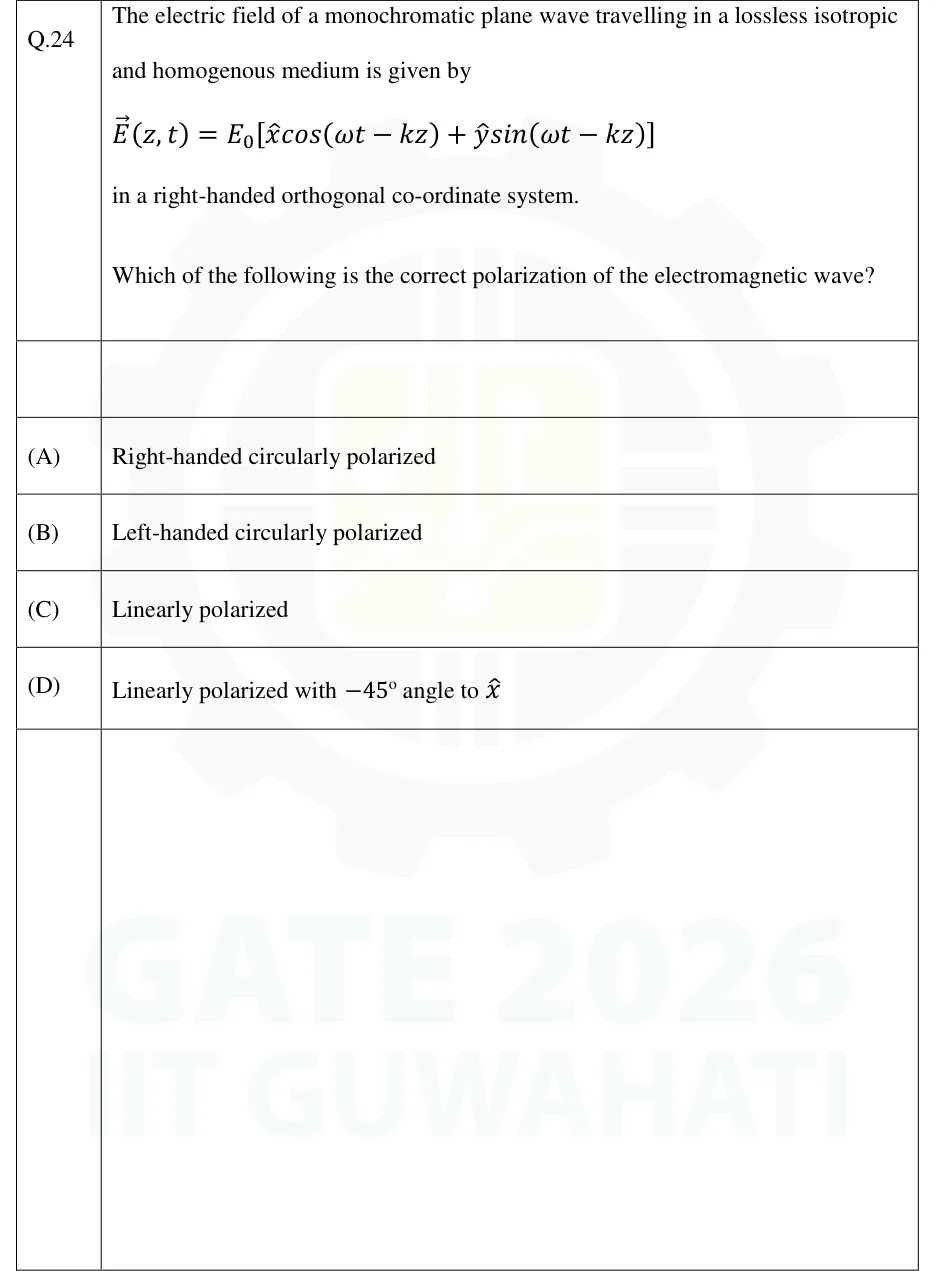
GATE 2026 EC Q.24

GATE 2026 · ECQ.24 · 1 mark · MCQ

The electric field of a monochromatic plane wave travelling in a lossless isotropic and homogenous medium is given by

in a right-handed orthogonal co-ordinate system.

Which of the following is the correct polarization of the electromagnetic wave?

  1. (A)

    Right-handed circularly polarized

  2. (B)

    Left-handed circularly polarized

  3. (C)

    Linearly polarized

  4. (D)

    Linearly polarized with angle to
Answer and solution
See the question in the paper
GATE 2026 EC Q.24: answer and solution

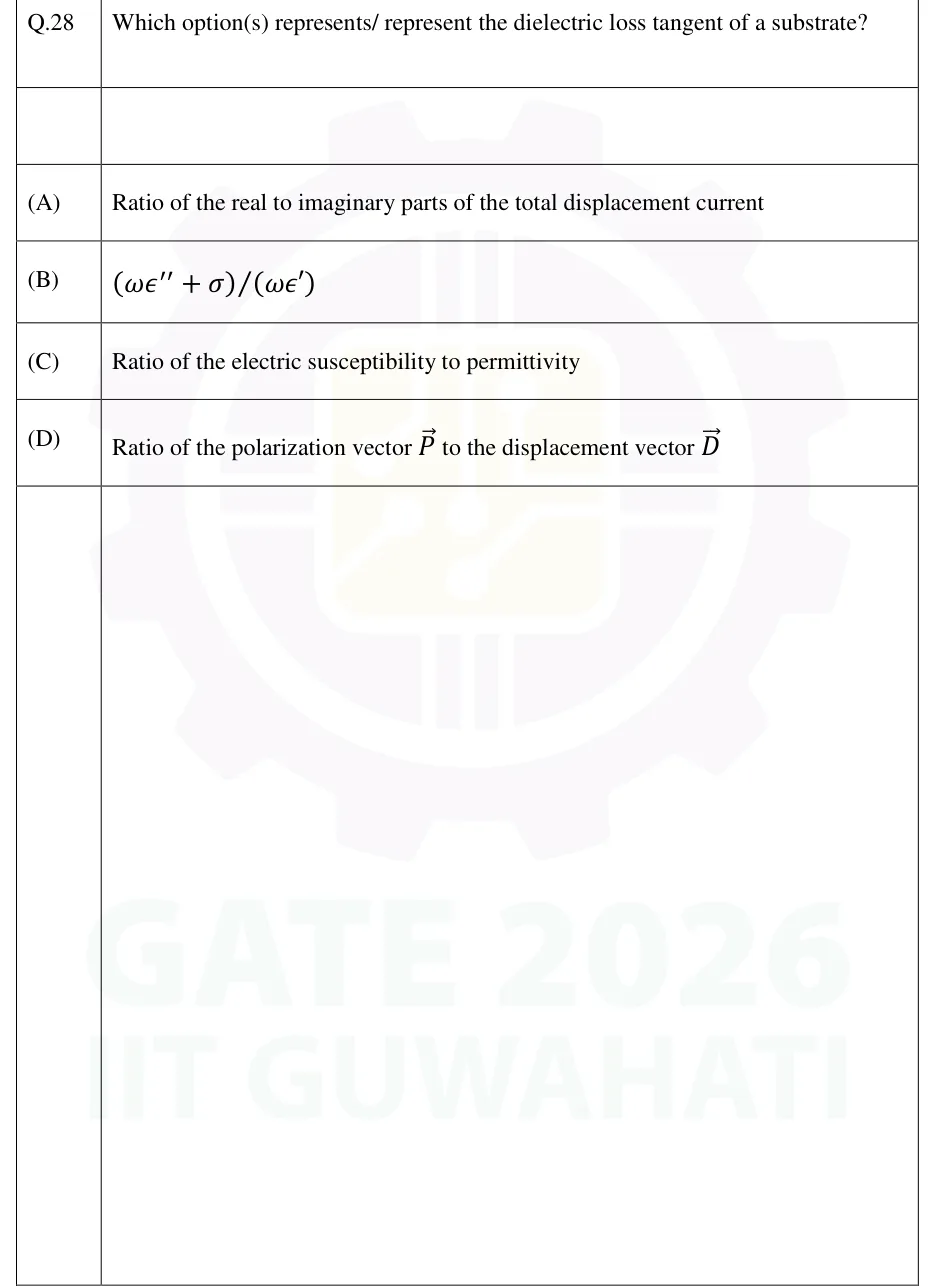
GATE 2026 EC Q.28

GATE 2026 · ECQ.28 · 1 mark · MSQ

Which option(s) represents/ represent the dielectric loss tangent of a substrate?

  1. (A)

    Ratio of the real to imaginary parts of the total displacement current

  2. (B)

  3. (C)

    Ratio of the electric susceptibility to permittivity

  4. (D)

    Ratio of the polarization vector to the displacement vector

Answer and solution
See the question in the paper
GATE 2026 EC Q.28: answer and solution

GATE 2024 EC Q.39

GATE 2024 · ECQ.39 · 2 marks · MCQ

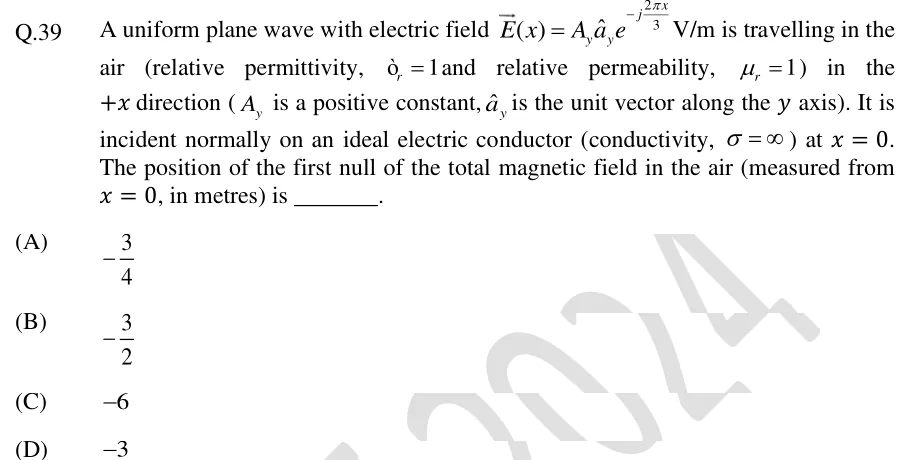
A uniform plane wave with electric field V/m is travelling in the air (relative permittivity, and relative permeability, ) in the direction ( is a positive constant, is the unit vector along the axis). It is incident normally on an ideal electric conductor (conductivity, ) at . The position of the first null of the total magnetic field in the air (measured from , in metres) is ______.

  1. (A)

  2. (B)

  3. (C)

  4. (D)

Answer and solution
See the question in the paper
GATE 2024 EC Q.39: answer and solution

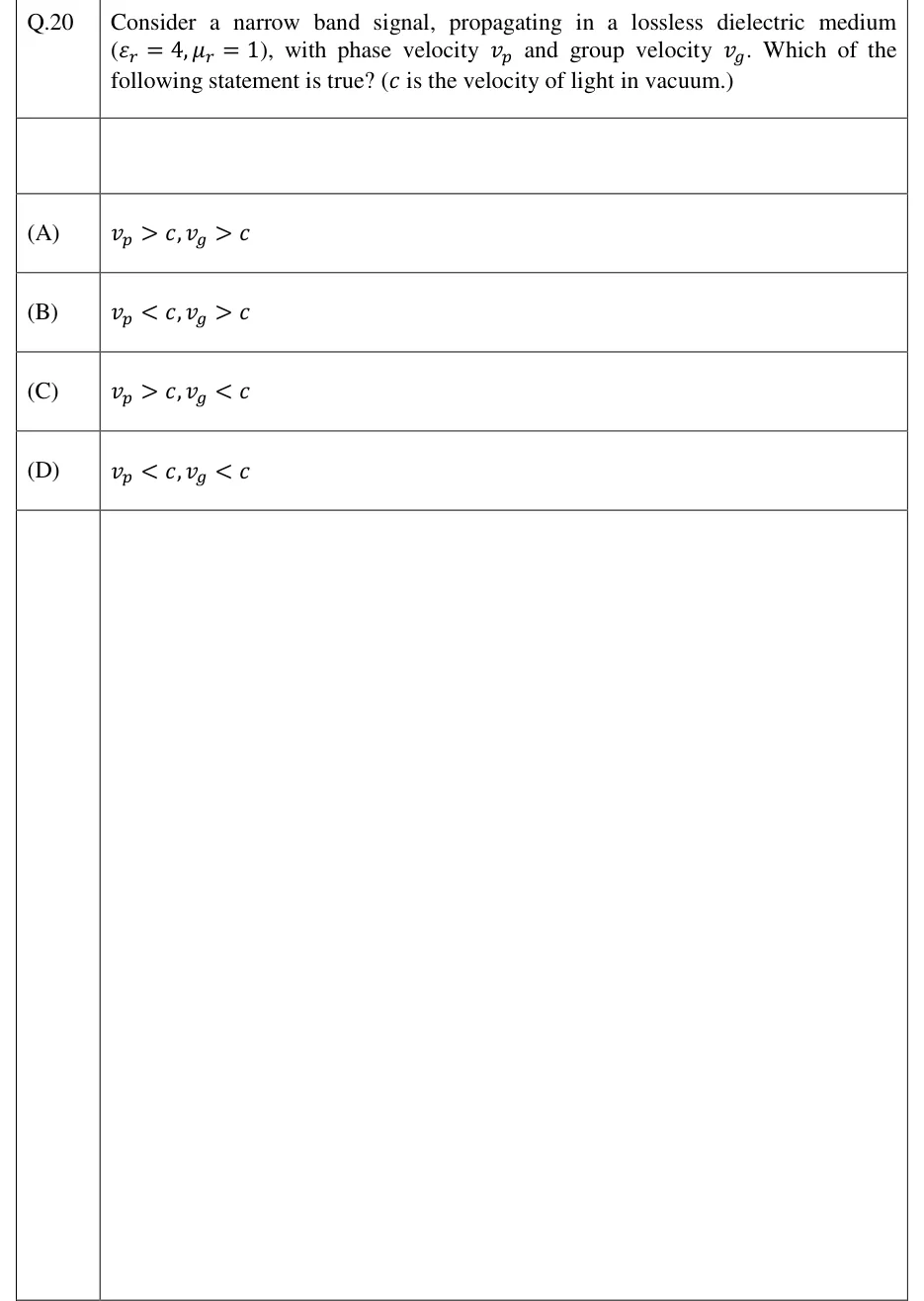
GATE 2023 EC Q.20

GATE 2023 · ECQ.20 · 1 mark · MCQ

Consider a narrow band signal, propagating in a lossless dielectric medium (), with phase velocity and group velocity . Which of the following statement is true? ( is the velocity of light in vacuum.)

  1. (A)

  2. (B)

  3. (C)

  4. (D)

Answer and solution
See the question in the paper
GATE 2023 EC Q.20: answer and solution

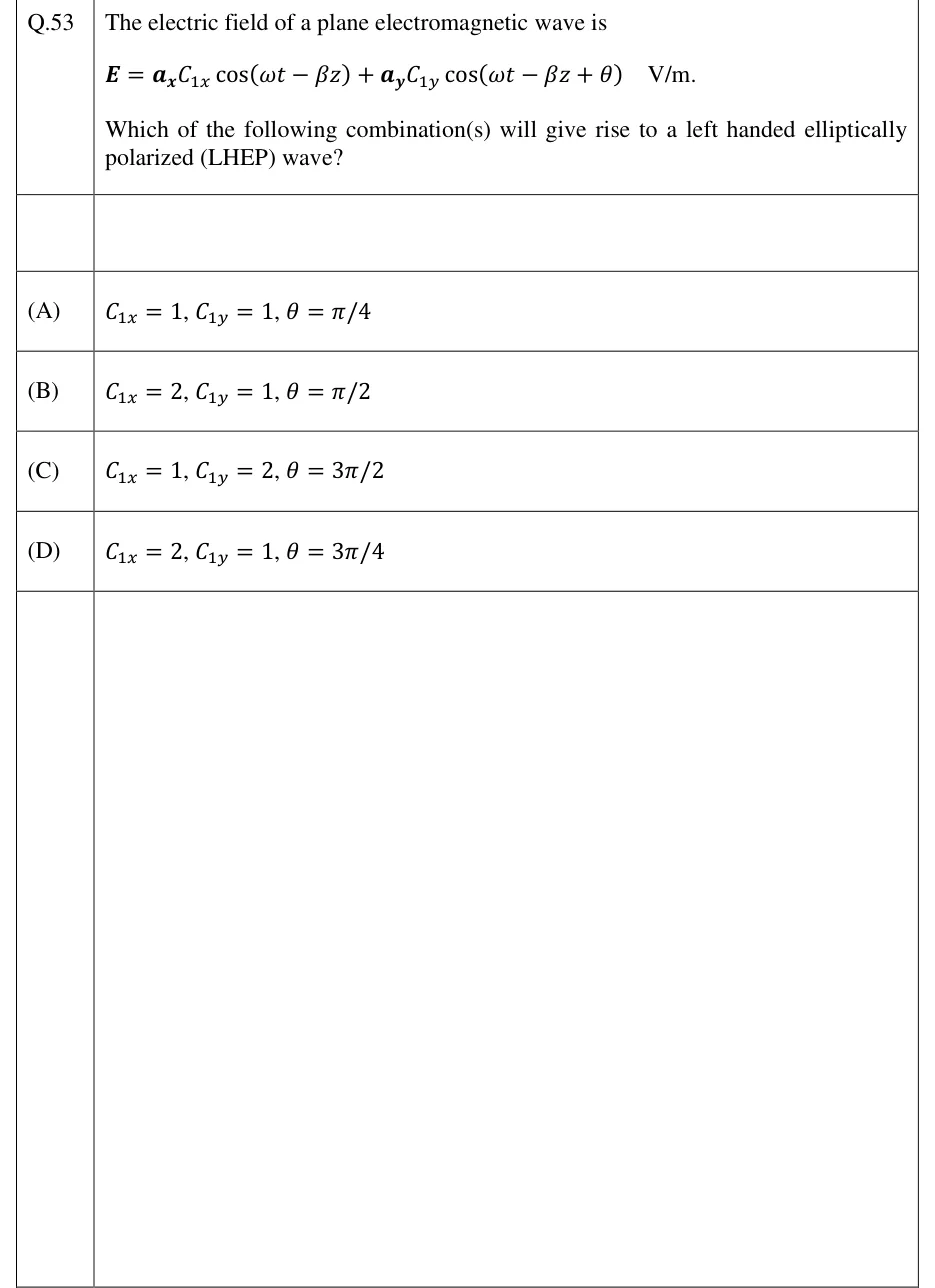
GATE 2023 EC Q.53

GATE 2023 · ECQ.53 · 2 marks · MSQ

The electric field of a plane electromagnetic wave is

Which of the following combination(s) will give rise to a left handed elliptically polarized (LHEP) wave?

  1. (A)

  2. (B)

  3. (C)

  4. (D)

Answer and solution
See the question in the paper
GATE 2023 EC Q.53: answer and solution

GATE 2020 IN Q.47

GATE 2020 · INQ.47 · 2 marks · NAT

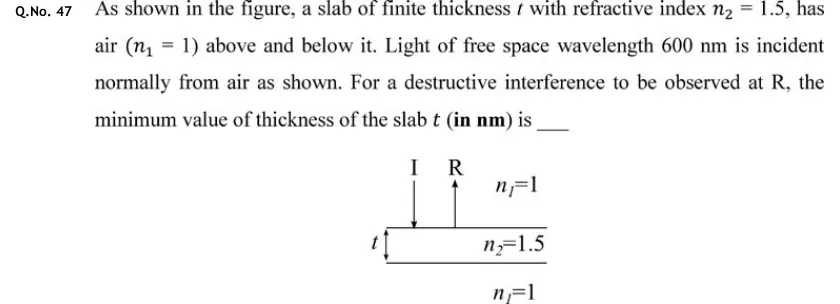
As shown in the figure, a slab of finite thickness with refractive index , has air () above and below it. Light of free space wavelength 600 nm is incident normally from air as shown. For a destructive interference to be observed at R, the minimum value of thickness of the slab (in nm) is ____

GATE 2020 IN question 47: A horizontal slab bounded by two parallel horizontal lines, the gap between them marked with a vertical double arrow…Tap to open full size
Figure from the GATE 2020 IN paper. It is part of the question.
Figure description

A horizontal slab bounded by two parallel horizontal lines, the gap between them marked with a vertical double arrow labelled t on the left. Above the slab is the region labelled n_1 = 1, inside the slab n_2 = 1.5, and below the slab n_1 = 1. Above the slab, a downward arrow labelled I (incident ray) meets the top surface normally, and just to its right an upward arrow labelled R (reflected ray) leaves the top surface normally.

Answer and solution
GATE 2020 IN Q.47: answer and solution

GATE 2018 EC Q.49

GATE 2018 · ECQ.49 · 2 marks · NAT

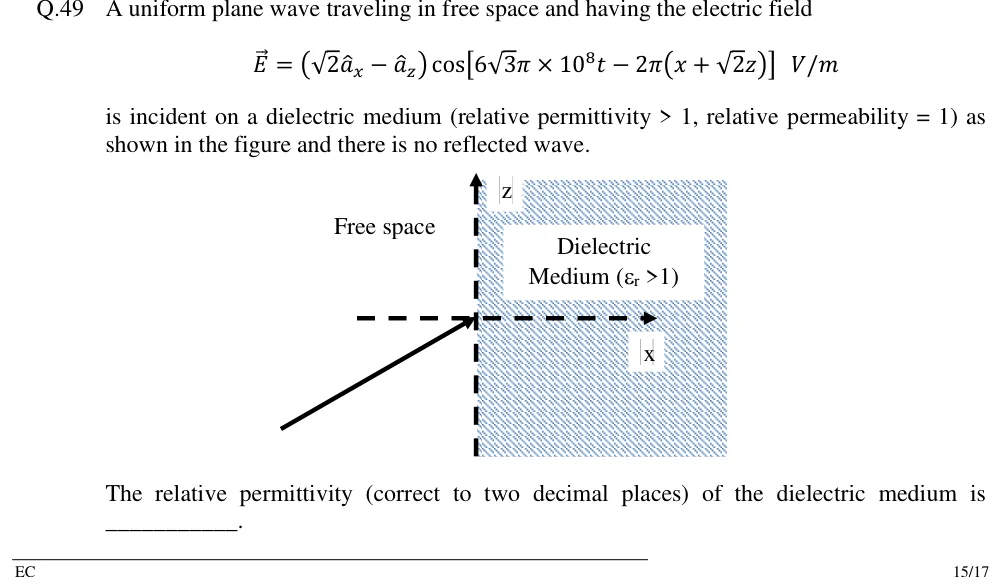
A uniform plane wave traveling in free space and having the electric field

is incident on a dielectric medium (relative permittivity > 1, relative permeability = 1) as shown in the figure and there is no reflected wave.

The relative permittivity (correct to two decimal places) of the dielectric medium is ________.

GATE 2018 EC question 49: The figure shows a vertical dashed line: the z-axis, with its arrow pointing up and labelled z.Tap to open full size
Figure from the GATE 2018 EC paper. It is part of the question.
Figure description

The figure shows a vertical dashed line: the z-axis, with its arrow pointing up and labelled z. This line is the interface, the plane x = 0. To the left of it is the label "Free space". To the right, the region x > 0 is hatched and labelled "Dielectric Medium (ε_r > 1)". A horizontal dashed line (the x-axis) runs through the origin on the interface, with its arrow pointing right into the dielectric and labelled x. A solid line comes from the lower left in free space and ends at the origin. It is the incident ray, travelling up and to the right, so its direction has positive x and positive z components. No reflected or transmitted ray is drawn.

Answer and solution
GATE 2018 EC Q.49: answer and solution

PRACTICE

7 questions to test yourself

PRACTICE 11 mark · MCQ

Using the IEEE convention (right thumb along the direction of propagation, fingers curling in the sense in which rotates at a fixed point), the wave V/m, with , is

  1. (A)

    right-hand circularly polarised, travelling in

  2. (B)

    left-hand circularly polarised, travelling in

  3. (C)

    right-hand circularly polarised, travelling in

  4. (D)

    left-hand circularly polarised, travelling in

Answer and solution

Answer: (D)

  1. The argument means the wave travels in .

  2. : equal amplitudes and lags by , so the wave is circularly polarised.

  3. At : at and a quarter period later, so rotates from to . The right-hand axis of that rotation is .

  4. The wave travels along , opposite to that axis, so it is left-hand circularly polarised.

PRACTICE 22 marks · MCQ

A plane wave travels inside glass (, non-magnetic, lossless) toward a flat glass–air interface (). Let be the angle of incidence at which a parallel-polarised (TM) wave is transmitted with no reflection, and the critical angle. The pair is closest to

  1. (A)

  2. (B)

  3. (C)

  4. (D)

Answer and solution

Answer: (A)

  1. Brewster angle for non-magnetic media: , so . ( is the Brewster angle for a wave going from air into the glass.)

  2. Critical angle: , so . ( is its complement, not the critical angle.)

  3. Check: from the denser side , so always, which is consistent with option A.

PRACTICE 31 mark · NAT

A 10 MHz uniform plane wave travels through a lossless ionised gas (plasma) whose plasma frequency is 6 MHz. Taking m/s, the group velocity of the wave is ______ m/s.

Answer and solution

Answer: (accepted range )

  1. MHz exceeds MHz, so the wave propagates.

  2. , so and .

  3. m/s.

  4. Check: m/s and .

PRACTICE 42 marks · NAT

A glass surface (non-magnetic, lossless, refractive index 1.5) in air is to be made reflection-free for normally incident waves of free-space wavelength 600 nm by a single coating layer that is non-magnetic and lossless. The minimum thickness of the coating is ______ nm (rounded off to one decimal place).

Answer and solution

Answer: (accepted range )

  1. Medium 1 is air (), medium 3 is glass (). No reflection requires at the front face of the coating.

  2. Setting : the real parts give , which is false, unless . So the layer must be a quarter wave thick (or an odd multiple), and then .

  3. Non-magnetic, so : .

  4. Minimum thickness nm nm.

PRACTICE 51 mark · NAT

A uniform plane wave in air is normally incident on a lossless, non-magnetic dielectric half-space. The standing wave ratio measured in the air is 3, and an electric-field minimum lies at the interface. The relative permittivity of the dielectric is ______.

Answer and solution

Answer: (accepted range )

  1. .

  2. An electric-field minimum at the interface means , so .

  3. .

  4. .

PRACTICE 62 marks · MSQ

A uniform plane wave propagates in a good conductor (, ) whose skin depth at the operating frequency is . Which of the following statements are correct?

  1. (A)

    The attenuation constant equals the phase constant.

  2. (B)

    The electric field leads the magnetic field in time phase by .

  3. (C)

    The group velocity is half the phase velocity.

  4. (D)

    The wavelength inside the conductor is .

Answer and solution

Answer: (A), (B), (D)

  1. Good conductor: , so . (A) is correct.

  2. , and the phasor amplitudes are related by , so leads by . (B) is correct.

  3. gives , so , not . (C) is wrong.

  4. . (D) is correct.

PRACTICE 72 marks · NAT

A metal sheet with S/m and is used to shield against a 2.5 MHz uniform plane wave. Ignoring reflections at both faces and considering only the attenuation of the wave inside the metal, the minimum sheet thickness that reduces the electric-field amplitude by 60 dB is ______ mm (rounded off to three decimal places).

Answer and solution

Answer: (accepted range )

  1. Loss tangent: , so the metal is a good conductor.

  2. m.

  3. A 60 dB drop in field amplitude means , so .

  4. m mm.

OFFICIAL GATE 2027 SYLLABUS WORDING

Copied from the GATE 2027 syllabus; see all 2027 syllabi.

GATE EC

Plane Waves and Properties: Reflection and refraction, polarization, phase and group velocity, propagation through various media, skin depth

Preparing in Kolkata? IAE Academy's course for GATE ECE.