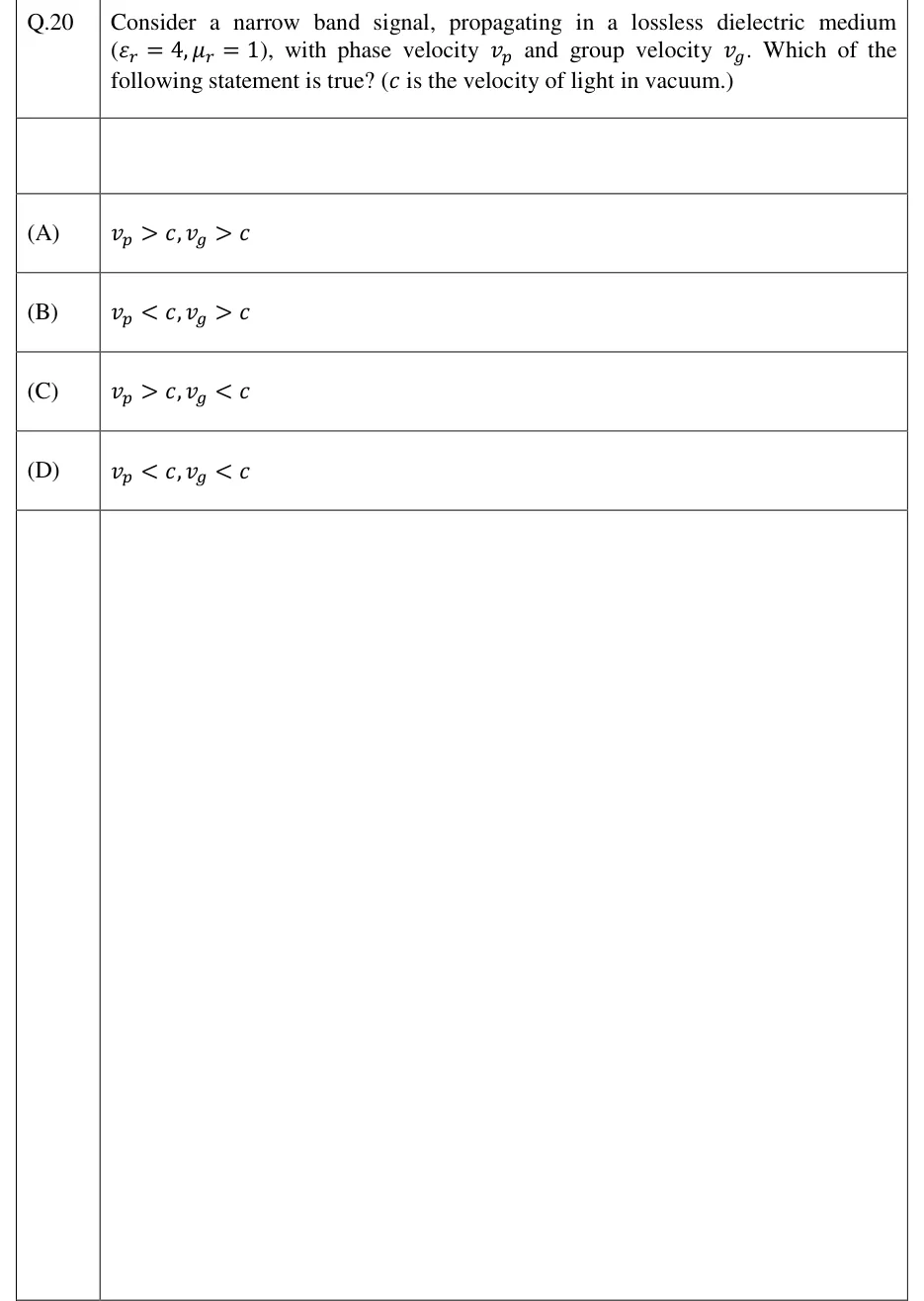
Consider a narrow band signal, propagating in a lossless dielectric medium (), with phase velocity and group velocity . Which of the following statement is true? ( is the velocity of light in vacuum.)
- (A)
- (B)
- (C)
- (D)

Consider a narrow band signal, propagating in a lossless dielectric medium (), with phase velocity and group velocity . Which of the following statement is true? ( is the velocity of light in vacuum.)
ANSWER
(D) . In a lossless dielectric with and , the medium is non-dispersive, so .
Official answer: DSource: Official answer key, GATE 2023 EC (IIT Kanpur)
For a uniform plane wave in an unbounded, lossless dielectric, the phase constant is where , with and .
Phase velocity:
Group velocity: . With and constant, is directly proportional to , so
The medium is non-dispersive (the ratio does not depend on frequency), so every frequency component of the narrow-band signal moves at the same speed and . Their product is , not . The result belongs to a dispersive guided wave such as an air-filled hollow waveguide, where and . It does not apply to an unbounded plane wave.
Both velocities are , so and . Option (D) is correct.
KEY IDEA
In an unbounded lossless dielectric with constant and , is linear in . The medium is therefore non-dispersive, and the phase and group velocities are equal: . With , both velocities equal , which is less than .
WATCH OUT FOR
Using the waveguide result and so picking (C), and . That relation comes from the dispersive cut-off behaviour of an air-filled hollow waveguide. A plane wave in an unbounded lossless dielectric has no cut-off and no dispersion, so . The words 'narrow band' only make group velocity meaningful. They do not make the medium dispersive.
From the GATE 2023 EC paper. Every question of this paper · Download the full paper · All 10 Plane waves questions, with notes