
IAE Academy

GATE 2026 EC Q.28: solution and answer

GATE 2026 · ECQ.28 · 1 mark · MSQ

Which option(s) represents/ represent the dielectric loss tangent of a substrate?

  1. (A)

    Ratio of the real to imaginary parts of the total displacement current

  2. (B)

  3. (C)

    Ratio of the electric susceptibility to permittivity

  4. (D)

    Ratio of the polarization vector to the displacement vector
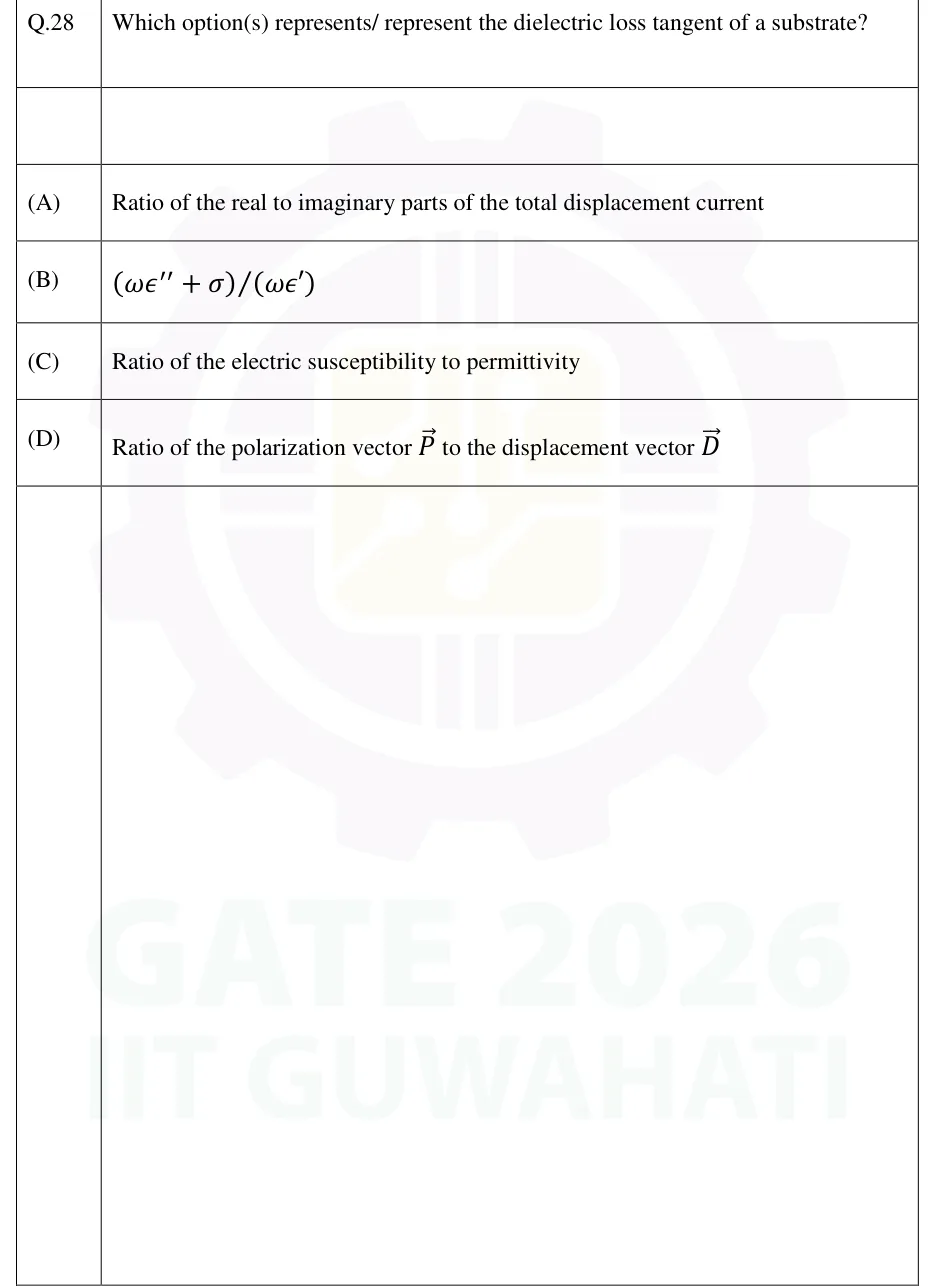
See the question in the paper

Answer and solution

ANSWER

The correct options are (A) and (B). The loss tangent is the ratio of the real (in-phase, lossy) part to the imaginary (quadrature, stored-energy) part of the total displacement current.

Official answer: A, BSource: Official answer key, GATE 2026 EC (IIT Guwahati)

  1. Write the complex permittivity of a lossy dielectric, with time dependence, as . Here accounts for polarisation (damping) loss and for conduction loss.

  2. Write the Ampère–Maxwell law in phasor form and group the terms in phase with and those in quadrature with it: At high frequencies the conduction term cannot be told apart from the damping term , so the whole right-hand side is treated as the total displacement current.

  3. The loss tangent is the in-phase (lossy) part of this current divided by the quadrature (reactive) part: This is exactly option (B), so (B) is correct.

  4. Option (A): take as the phase reference. The real part of the total displacement current is then and the imaginary part is . Their ratio is . If only the pure displacement term is used, the ratio is , which is the dielectric loss tangent of a non-conducting substrate. Either way, (A) describes the loss tangent, so (A) is correct.

  5. Option (C): has units of , so it is not dimensionless. It also contains no loss term, so it cannot be . Incorrect.

  6. Option (D): and , so , with . This measures how strongly the material polarises, not how much energy it loses per cycle. Incorrect.

  7. The correct options are (A) and (B).

KEY IDEA

Put into and split the current into a part in phase with , , and a part in quadrature, . The loss tangent is their ratio, . That single formula is both option (B) and the wording of option (A).

WATCH OUT FOR

Rejecting (A) because the word 'displacement' seems to leave out conduction, or because it names 'real to imaginary' rather than 'imaginary to real'. With as the phase reference, the lossy part of is the real part and the stored-energy part is the imaginary part, so real/imaginary is exactly . Another trap is picking (D) because looks like a dimensionless material ratio. It is , which measures polarisation, not loss.

From the GATE 2026 EC paper. Every question of this paper · Download the full paper · All 10 Plane waves questions, with notes

More Plane waves questions