GATE 2026 EC Q.33
The cutoff frequency (in GHz) for the dominant mode of an air-filled rectangular waveguide of inner dimension inch inch is ____. (rounded off to two decimal places).

IN THE EC SYLLABUS
A hollow metal pipe carries microwaves only above a cut-off frequency set by its cross-section, and each field pattern (mode) has its own cut-off. A step-index optical fibre guides light by total internal reflection at the boundary between a higher-index core and a lower-index cladding. The working results on this page are: which modes propagate at a given frequency; the dominant mode's cut-off, guide wavelength, phase and group velocities, wave impedance and power; and, for fibres, the numerical aperture, acceptance angle, V-number, single-mode condition, number of modes, modal delay and loss in decibels.
6 previous-year questions · 6 solved · 5 practice questions
Conventions on this page. SI units throughout. Time-harmonic fields are phasors with . The guide axis is , and a propagating mode varies as (as below cut-off). Metal guides have perfectly conducting walls and a lossless, homogeneous filling with and , where H/m and F/m. In the filling, is the speed of light, is the intrinsic impedance, is the wavelength and is the wavenumber. Air is treated as free space: m/s and Ω, which is usually rounded to Ω.
A hollow pipe has only one conductor, so it cannot carry a TEM wave. TEM needs at least two separate conductors, as in a coaxial line. Instead, the fields form discrete modes. In a TE (transverse electric, or H) mode, and . In a TM (transverse magnetic, or E) mode, and . Each mode has a cut-off frequency set by the cross-section. Above the mode propagates. Below it is evanescent: its fields decay exponentially along and it carries no average power. A metal waveguide is therefore a high-pass structure.
PROPAGATION CONSTANT OF A WAVEGUIDE MODE
is the mode's cut-off wavenumber, set by the guide's shape and size, and . is real (the mode propagates) only when .
A useful picture: a propagating mode is a superposition of plane waves bouncing between the walls, each travelling at an angle to the axis, with . For a mode this is exactly one pair of plane waves; for there are four. The pattern moves along at , while energy moves at . As falls to , the waves bounce straight across () and stop moving forward. Far above cut-off they travel almost along the axis.
Take inner dimensions along and along , with ( is the broad wall). In and , counts the half-cycle field variations across the broad dimension (along ) and counts them across the narrow dimension (along ).
CUT-OFF FREQUENCY, RECTANGULAR GUIDE (TE AND TM)
Same formula for TE and TM. Allowed indices: with but not both zero, and with . A filling with divides every air-filled cut-off by .
CUT-OFF WAVENUMBER AND CUT-OFF WAVELENGTH
depends only on the geometry, not on the filling. A mode propagates when the wavelength in the filling, , is shorter than its .
DOMINANT TE10 MODE
When , has the lowest cut-off of all modes, so it is the dominant mode. Its cut-off does not depend on . In a square guide (), has the same cut-off.
TE10 FIELD PATTERN
is the wave impedance, given in the next section. has only a -component. It peaks at the centre , is zero on the side walls and , and is uniform along (). .
Mode existence and ordering (example: a = 2b, every mode up to 3 times the TE10 cut-off)
Mode (m, n) | Exists as TE? | Exists as TM? | when |
|---|---|---|---|
(1, 0) | Yes, (dominant) | No | 1 |
(2, 0) | Yes | No | 2 |
(0, 1) | Yes | No | 2 |
(1, 1) | Yes | Yes (lowest TM mode) | |
(2, 1) | Yes | Yes | |
(3, 0) | Yes | No | 3 |
Procedure: which modes propagate at frequency f
If the guide is filled with a dielectric of , divide every air-filled cut-off by (in general, by ).
Work out for the candidate low-order modes (, , , /, , /, …) and sort them. The order depends on : for it is , , /, ; for it is , , , /, , /.
Keep every mode with . All the others are evanescent.
For , and are two different modes with the same cut-off (they are degenerate). Count both.
There is no , or .
EXAM TIP
Single-mode band. If , only propagates for (air-filled), because the next mode is . If , the next mode is at , which narrows the band. At , and have the same cut-off, .
EXAM TIP
Missing and paired modes. and do not exist, because their is zero everywhere. So the lowest TM mode is , and it always has the same cut-off as . In a square guide (), and have the same cut-off, so whenever one can propagate, so can the other.
GUIDE WAVELENGTH
is the wavelength in the unbounded filling, and for every propagating mode. For , , so .
WAVELENGTH RELATION
is the wavelength in the filling. This says the same thing as . It is the quickest route when two of the three wavelengths are given.
PHASE AND GROUP VELOCITY
is the speed of the phase pattern and carries no energy or information. is the speed of energy in a lossless guide. Also, .
WAVE IMPEDANCE OF TE AND TM MODES
This is the ratio of the mode's transverse to its transverse (for , ). Above cut-off, . Equivalently, and .
ATTENUATION BELOW CUT-OFF (EVANESCENT MODE)
For the fields vary as , with no phase shift. becomes inductive and becomes capacitive, so no average power flows. Well below cut-off, .
POWER CARRIED BY THE TE10 MODE
Time-average power in a lossless guide. is the peak phasor amplitude of on the centre line , and is the wave impedance.
WORKED EXAMPLE
An air-filled rectangular waveguide has cm and cm and is driven at GHz. Find the propagating mode(s), the guide wavelength, , , and the wave impedance. If the peak field on the centre line is kV/m, what time-average power flows? Take m/s and Ω.
Cut-offs from , with and : is at GHz, at 12 GHz, at GHz, and / at GHz. Only has GHz, so the guide carries a single mode.
, so .
cm, so cm.
rad/m. Check: rad/m and rad/m.
m/s and m/s. Their product is , as it should be.
Ω.
W.
Answer: Only propagates. cm, rad/m, m/s, m/s, Ω and mW.
EXAM TIP
Limits that check your answer. At : , , , , and . As , the ratios , , , and all tend to 1. If you get , or , you have inverted the square-root factor.
EXAM TIP
Dielectric-filled guides. Use the filling's values everywhere, together with the lowered : , and (for ). In terms of the free-space wavelength, . Using the free-space in place of in the air-filled formulas is a common slip.
In a circular guide of inner radius , the fields vary with radius as Bessel functions and around the axis as or . In and , the first index counts the full-cycle variations around the circumference, and the second index numbers the root (the radial variations). The wall conditions fix . For TM, must vanish at , so , the -th non-zero root of . For TE, the tangential field must vanish, so , the -th non-zero root of . The root is never counted: it would give and no field.
CUT-OFF FREQUENCY AND WAVELENGTH, CIRCULAR GUIDE
is the RADIUS. is the -th non-zero root of (TM), and is the -th non-zero root of (TE). The , , , and / formulas from the previous section apply unchanged with this .
Lowest circular-guide modes (D = 2a is the diameter)
Mode (in order of cut-off) | Bessel-root constant | |
|---|---|---|
(dominant) | (= ) | |
and (degenerate) | ||
DOMINANT TE11 MODE OF A CIRCULAR GUIDE
Air-filled: GHz, with in cm. Only propagates for , that is, up to the cut-off, a frequency ratio of about 1.31.
Two non-dominant circular modes are worth recognising. has a field pattern symmetric about the axis (), which suits rotating joints. has only circumferential wall currents, and its conductor loss falls as frequency rises, which makes it attractive for long low-loss runs. At any frequency where propagates, the lower modes (, , ) and the degenerate propagate too, so the guide must be kept from converting into them.
EXAM TIP
Bessel-root trap. TE modes use roots of ; TM modes use roots of . The dominant circular mode is (1.841), not (2.405) and not (3.832). and share 3.832 because . Before using , check whether the question gives the radius or the diameter.
A step-index fibre has a core of refractive index and radius , surrounded by a cladding of lower index . Light is launched from a medium of index ( for air). A refractive index is , the speed of light in vacuum divided by the speed in the medium, and denotes the free-space wavelength. Rays are trapped by total internal reflection at the core–cladding boundary. This happens only when light travels from the higher index to the lower one and hits the boundary at more than the critical angle. The ray picture below (meridional rays, which pass through the axis) holds for multimode fibres whose core is many wavelengths wide.
CRITICAL ANGLE AT THE CORE–CLADDING BOUNDARY
is measured from the NORMAL to the boundary, inside the core. Rays that meet the boundary at are totally reflected and stay guided; is the limiting ray.
Deriving the acceptance condition
A ray enters the end face at angle to the axis and refracts: .
It meets the core–cladding boundary at from the normal.
It is guided only if (equality being the limiting ray), that is, .
So . The largest is the acceptance angle , and is the numerical aperture.
NUMERICAL APERTURE
is the relative index difference. With the first form of , exactly. The form is the usual approximation for . NA depends only on and , not on the launch medium.
ACCEPTANCE ANGLE
is a half-angle measured from the fibre AXIS, outside the fibre. Rays inside this cone are guided. For the same fibre, a denser launch medium (larger ) gives a smaller . The formula needs ; if , every ray entering the end face is guided. This is the acceptance angle for meridional rays; skew rays, which never cross the axis, can be guided at somewhat larger launch angles.
EXAM TIP
Two different angles. The critical angle is inside the core and measured from the normal to the core–cladding boundary. The acceptance angle is outside the fibre and measured from the axis. They are linked by , not by , which ignores refraction at the end face.
NORMALISED FREQUENCY (V-NUMBER)
is the core RADIUS and is the free-space wavelength. grows with core size and NA and falls as the wavelength rises.
SINGLE-MODE CONDITION (STEP-INDEX FIBRE)
2.405 is the first zero of . The fundamental mode (, also called ) has no cut-off, and below it is the only guided mode (in two orthogonal polarisations). Here is the fibre's cut-off wavelength: the fibre is single-mode at every longer wavelength.
GRADED-INDEX (POWER-LAW) CORE PROFILE
is the profile exponent: is the parabolic profile and is the step index. At the formula gives exactly , with and the index on the axis.
APPROXIMATE NUMBER OF GUIDED MODES
These are the usual large- estimates (), counting both polarisations. Use them only for multimode fibres. Both are cases of for the power-law profile above.
MODAL (INTERMODAL) DELAY, STEP-INDEX FIBRE, RAY MODEL
The difference in arrival time over length between the axial ray (path ) and the steepest guided ray, at the critical angle (path ), both travelling at . It is proportional to and, for , to .
Modal dispersion spreads a short input pulse by , so it limits the bit rate of multimode step-index fibre. A graded-index core, whose index falls from the axis outward, removes much of this spread. Rays on longer, steeper paths spend more time in lower-index (faster) glass. For a near-parabolic profile, the delay difference scales as instead of , which makes it smaller by a factor of the order of . A single-mode fibre has no intermodal dispersion. The spreading that remains is mainly chromatic dispersion (material and waveguide), with a smaller contribution from polarisation-mode dispersion.
FIBRE LOSS IN DECIBELS
Losses in dB add along a link: a fibre of dB/km loses dB over km. A loss of 3 dB leaves about half the power, and 10 dB leaves one tenth.
WORKED EXAMPLE
A step-index fibre has , and core radius m, and is used at m with light launched from air. Find (a) the NA and the acceptance angle, (b) the V-number and the approximate number of modes, (c) the modal delay over 1 km (ray model), and (d) the largest core radius that would make the fibre single-mode at this wavelength with the same indices. Take m/s.
(a) , so (full cone ).
Cross-check through the critical angle: , so and , the same NA.
(b) . This is far above 2.405, so the fibre is multimode, with modes.
(c) s ns. The approximation with , that is , gives 66.7 ns.
(d) m.
Answer: and . , with about 429 modes. ns over 1 km. Single-mode operation would need m.
EXAM TIP
V-number slips. Use the core radius, not the diameter, and the free-space wavelength , not . Because , a fibre that is single-mode at 1550 nm can be multimode at 850 nm. It is single-mode only for above its cut-off wavelength.
EXAM TIP
Bit-rate questions. If a question asks for the maximum bit rate allowed by modal dispersion, use the criterion it states. One common criterion is (pulse spread no more than half a bit period). Another is . The two differ by a factor of 2.
PREVIOUS-YEAR QUESTIONS
Try each question first, then open the answer. We placed each question under a topic ourselves; the exam paper does not label topics.
See these papers in full: GATE ECE 2026 · GATE ECE 2022 · GATE ECE 2018 · GATE IN 2023 · GATE IN 2020 · GATE IN 2018
The cutoff frequency (in GHz) for the dominant mode of an air-filled rectangular waveguide of inner dimension inch inch is ____. (rounded off to two decimal places).
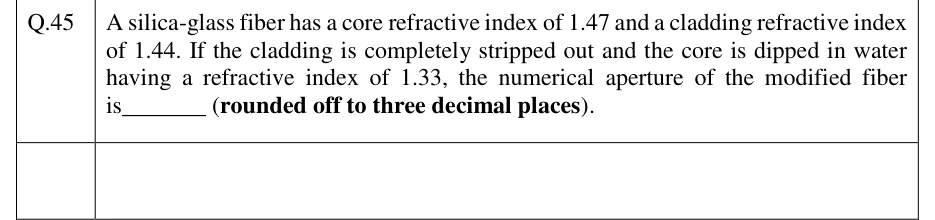
A silica-glass fiber has a core refractive index of 1.47 and a cladding refractive index of 1.44. If the cladding is completely stripped out and the core is dipped in water having a refractive index of 1.33, the numerical aperture of the modified fiber is ________ (rounded off to three decimal places).
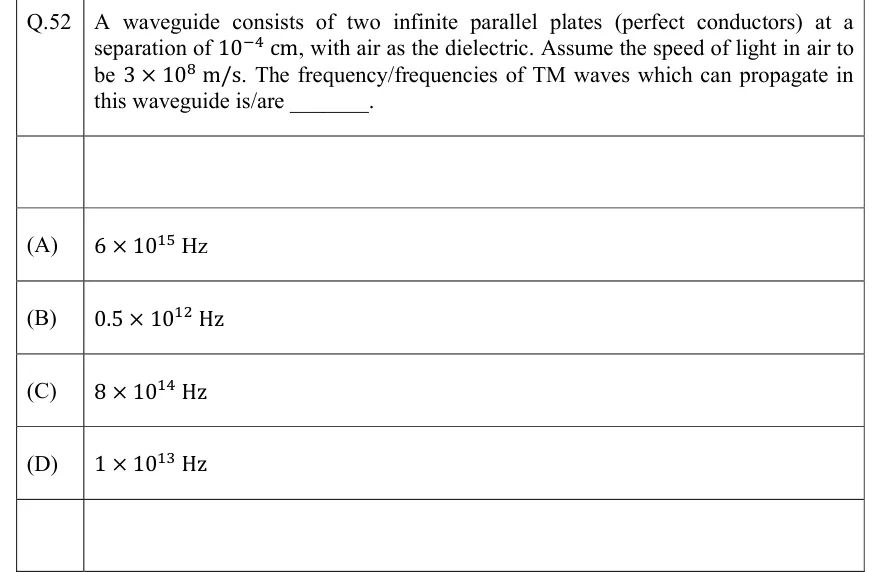
A waveguide consists of two infinite parallel plates (perfect conductors) at a separation of cm, with air as the dielectric. Assume the speed of light in air to be m/s. The frequency/frequencies of TM waves which can propagate in this waveguide is/are ________.
Hz
Hz
Hz
Hz
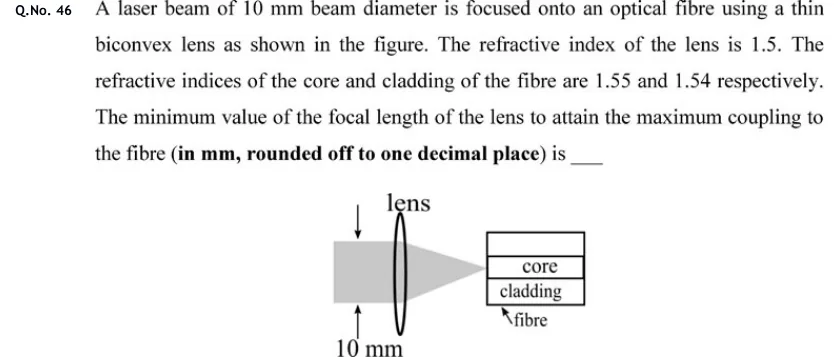
A laser beam of 10 mm beam diameter is focused onto an optical fibre using a thin biconvex lens as shown in the figure. The refractive index of the lens is 1.5. The refractive indices of the core and cladding of the fibre are 1.55 and 1.54 respectively. The minimum value of the focal length of the lens to attain the maximum coupling to the fibre (in mm, rounded off to one decimal place) is ____
 Tap to open full size
A collimated laser beam, drawn as a grey horizontal band, travels from left to right. A downward arrow above it and an upward arrow below it mark its full height, labelled '10 mm' (the beam diameter). The beam hits a thin biconvex lens, drawn as a tall narrow vertical ellipse labelled 'lens'. To the right of the lens the grey beam narrows as a cone to a point at the left (entrance) face of an optical fibre. The fibre is a horizontal rectangle split into three horizontal strips: an unlabelled top strip (the cladding), the middle strip labelled 'core', and the bottom strip labelled 'cladding'. An arrow from below points to the rectangle, labelled 'fibre'. The apex of the cone is on the core at the fibre's end face, and the fibre axis is in line with the lens axis. The figure does not show or name the medium around the fibre; the solution takes it to be air.
The cutoff frequency of mode of an air filled rectangular waveguide having inner dimensions cm cm is twice that of the dominant mode. When the waveguide is operated at a frequency which is 25% higher than the cutoff frequency of the dominant mode, the guide wavelength is found to be 4 cm. The value of (in cm, correct to two decimal places) is ________.
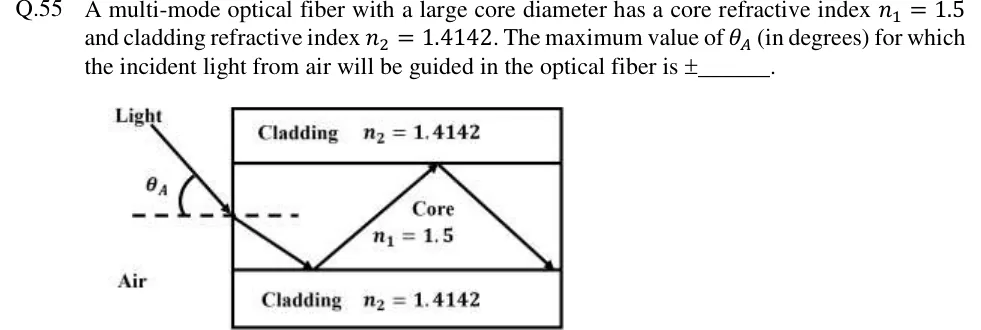
A multi-mode optical fiber with a large core diameter has a core refractive index and cladding refractive index . The maximum value of (in degrees) for which the incident light from air will be guided in the optical fiber is ______.
 Tap to open full size
Longitudinal section of a step-index fiber: a horizontal core strip labelled 'Core, n_1 = 1.5' lies between two cladding strips, the top one labelled 'Cladding n_2 = 1.4142' and the bottom one labelled 'Cladding n_2 = 1.4142'. The region to the left of the fiber's flat end face is labelled 'Air'. A ray marked 'Light' comes down from the upper left and hits the end face at the fiber axis (shown as a horizontal dashed line). The angle between the incoming ray and the dashed axis is marked theta_A. Inside the core the ray is refracted towards the axis, goes down to the lower core-cladding interface, reflects up to the upper interface, reflects down again and exits at the right, making a zig-zag path of total internal reflections.
PRACTICE
An air-filled rectangular waveguide has inner dimensions cm and cm. Taking m/s, what is the cut-off frequency of the mode in GHz, rounded to two decimal places?
Answer: (accepted range )
, with and .
.
Hz, i.e. 11.18 GHz. has the same cut-off.
A multimode step-index fibre of length 2 km has core index and relative index difference . Using the ray model and m/s, what is the difference in arrival time, in ns, between the ray travelling along the axis and the ray travelling at the critical angle?
Answer: (accepted range )
.
The axial ray travels . The critical-angle ray travels . Both move at .
s.
So ns. The approximation gives 100 ns.
An air-filled circular waveguide has an inner radius of 2 cm. The first root of is 1.841, the first root of is 2.405 and the first non-zero root of is 3.832. What are the dominant mode and its cut-off wavelength?
, 5.23 cm
, 6.83 cm
, 3.28 cm
, 13.65 cm
Answer: (B)
The dominant mode is the one with the smallest Bessel-root constant: , with . has 2.405 and has 3.832.
cm.
Option D uses the diameter (4 cm) in place of the radius. Options A and C use the constants of non-dominant modes.
An air-filled rectangular waveguide with cm and cm is operated at 10 GHz. Take m/s and Ω. Which of the following statements is/are correct?
Only the mode propagates.
The guide wavelength is approximately 4.54 cm.
The group velocity is approximately m/s.
The wave impedance of the propagating mode is approximately 249 Ω.
Answer: (A), (B)
Cut-offs: is at GHz, and are both at 15 GHz, and / are at about 16.8 GHz. Only is below 10 GHz, so A is correct.
. With cm, cm, so B is correct.
m/s. The value m/s is the phase velocity, so C is wrong.
Ω. The value 249 Ω is , which is the TM formula, so D is wrong.
A step-index fibre has core index and cladding index . Using the single-mode condition , what is the largest core radius, in m and rounded to two decimal places, that gives single-mode operation at a free-space wavelength of 1.55 m?
Answer: (accepted range )
.
gives .
m.
OFFICIAL GATE 2027 SYLLABUS WORDING
Copied from the GATE 2027 syllabus; see all 2027 syllabi.
GATE EC
Rectangular and circular waveguides, light propagation in optical fibers
Preparing in Kolkata? IAE Academy's course for GATE ECE.