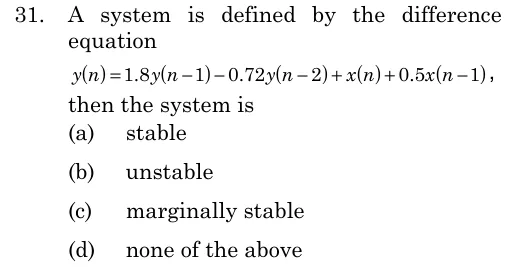
A system is defined by the difference equation , then the system is
- (A)
stable
- (B)
unstable
- (C)
marginally stable
- (D)
none of the above

A system is defined by the difference equation , then the system is
stable
unstable
marginally stable
none of the above
ANSWER
The system is unstable, option (B), because a pole at lies outside the unit circle.
Official answer: BSource: ISRO's revised and final answer key of 16 February 2024
Take the z-transform with zero initial conditions: .
So . Stability depends on the poles, which are the roots of the denominator.
Poles: , so .
This gives and .
The difference equation is solved forward in time, so the system is causal. A causal system is BIBO stable only if all poles lie strictly inside the unit circle.
The pole at has , so the impulse response contains a term that grows without bound.
The numerator zero at (and the factor ) does not cancel this pole, so the system is unstable. Option (B).
KEY IDEA
Stability of a causal discrete-time system depends only on the poles of : all of them must lie strictly inside the unit circle. Find them from the roots of the denominator polynomial.
WATCH OUT FOR
Looking at the coefficients 1.8 and 0.72 (both below 2, the second below 1) and concluding stable without computing the roots, or letting the numerator term influence the stability test. Only the feedback (output) coefficients set the poles.
From the ISRO EC 2023 paper. Every question of this paper · The full paper (PDF, ISRO) · All 5 ISRO z-transform questions, with notes