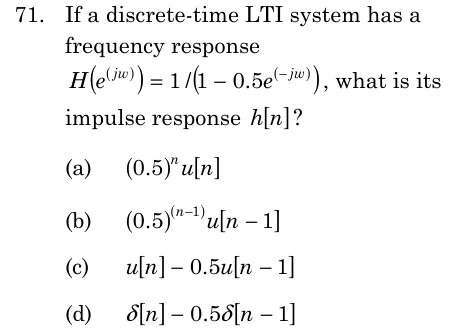
If a discrete-time LTI system has a frequency response , what is its impulse response ?
- (A)
- (B)
- (C)
- (D)

If a discrete-time LTI system has a frequency response , what is its impulse response ?
ANSWER
, option (A).
Official answer: ASource: ISRO's final answer key of 15 May 2026
Recall the standard DTFT pair: for .
Compare with : here and , so the series converges on the unit circle and the frequency response exists.
Check with the geometric series (valid since ): Reading off the coefficients of gives for and for .
Hence , option (A).
Why the others fail. Option (B) is the same sequence delayed by one sample; a delay multiplies the transform by , giving . Option (D) is a finite sequence with transform , the reciprocal of the given . Option (C), , has transform (the step has transform apart from an impulse term at ), which does not match.
KEY IDEA
A first-order pole factor is the DTFT of the causal decaying exponential (for ).
WATCH OUT FOR
Choosing the delayed form , or confusing the transform with its reciprocal , which belongs to the two-term FIR sequence .
From the ISRO EC 2025 paper. Every question of this paper · The full paper (PDF, ISRO) · All 5 ISRO z-transform questions, with notes