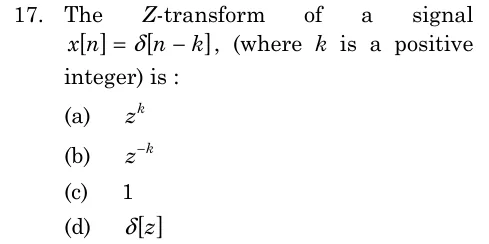
The -transform of a signal , (where is a positive integer) is :
- (A)
- (B)
- (C)
- (D)

The -transform of a signal , (where is a positive integer) is :
ANSWER
The Z-transform of is , which is option (b).
Official answer: BSource: ISRO's final answer key of 15 May 2026
The Z-transform of a discrete-time signal is .
Here , which equals only at and for every other .
So only one term of the sum survives: .
Check with the time-shift property: , and delaying a signal by samples multiplies its transform by , giving again.
The transform is defined for every except , because puts in the denominator.
Option (a), , would be the transform of the advanced impulse . Option (c), , is the transform of the undelayed impulse . Option (d) is not meaningful, since is a function of integer time, not of the complex variable .
KEY IDEA
A delay of samples in time multiplies the Z-transform by , so . The sum keeps just the single term at .
WATCH OUT FOR
Mixing up the sign of the exponent: a delay gives , while an advance would give . Another slip is choosing , the transform of with no shift.
From the ISRO EC 2025 paper. Every question of this paper · The full paper (PDF, ISRO) · All 5 ISRO z-transform questions, with notes