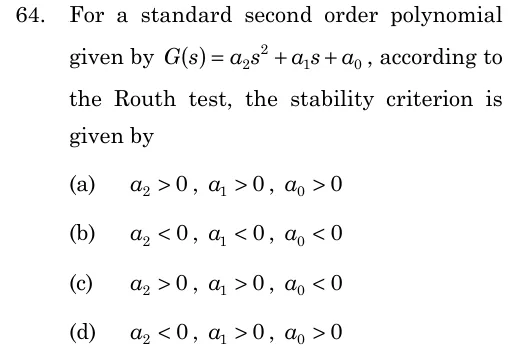
For a standard second order polynomial given by , according to the Routh test, the stability criterion is given by
- (A)
- (B)
- (C)
- (D)

For a standard second order polynomial given by , according to the Routh test, the stability criterion is given by
ANSWER
The stability criterion is , option (A).
Official answer: ASource: ISRO's revised and final answer key of 16 February 2024
Treat as the characteristic polynomial and build the Routh array. Row : . Row : . Row : .
The first column is . The Routh criterion says all roots lie in the left half plane only if every first-column element has the same sign, with no sign change.
In the standard form the leading coefficient is positive, . The first column then forces and .
Option (A) has all three coefficients positive, so there is no sign change and both roots lie in the left half plane.
Option (B) has all three coefficients negative. Multiplying the polynomial by gives the same roots and the form in option (A). It does not have the standard positive leading coefficient, so it is not the stated criterion.
Option (C) has . The first column is , which has one sign change, so one root is in the right half plane. Option (D) has with . The first column is , which has a sign change, so the system is unstable.
Answer: (A).
KEY IDEA
For a second-order polynomial the Routh first column is . Stability needs no sign change, so all three coefficients must have the same sign, taken positive in the standard form.
WATCH OUT FOR
Checking only that the signs agree and picking the all-negative option (B), or requiring just the leading coefficient and one other to be positive. Every coefficient must share the sign of , and the standard form has .
From the ISRO EC 2023 paper. Every question of this paper · The full paper (PDF, ISRO) · All 3 ISRO Routh–Hurwitz questions, with notes