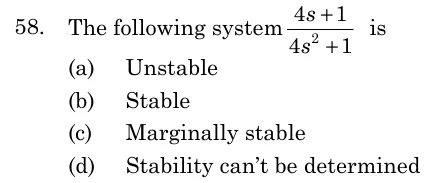
The following system (4s+1)/(4s^2+1) is
- (A)
Unstable
- (B)
Stable
- (C)
Marginally stable
- (D)
Stability can't be determined

The following system (4s+1)/(4s^2+1) is
Unstable
Stable
Marginally stable
Stability can't be determined
ANSWER
The system is marginally stable, option (C).
Official answer: CSource: ISRO's revised and final answer key of 16 February 2024
The transfer function is . The numerator has no common factor with the denominator, so the poles are the roots of .
Routh array for : the row is and the row is (an entire row of zeros), so the auxiliary polynomial is with .
Replace the zero row with the coefficient . The row is . The first column is : no sign change, so no root lies in the right half-plane.
Solve directly: , so . These are two simple, distinct poles on the imaginary axis, and they are the roots of the auxiliary polynomial.
A system whose poles are all in the left half-plane or simple on the -axis, with at least one on the axis, is marginally stable. Here the impulse response contains sustained oscillation at that neither grows nor decays. It is not asymptotically stable, and it is not unstable because the imaginary-axis poles are not repeated. Stability is fully decided by the pole locations, so the answer is marginally stable.
KEY IDEA
Simple poles on the imaginary axis with none in the right half-plane make a system marginally stable. A row of zeros in the Routh array signals roots symmetric about the origin, found from the auxiliary polynomial.
WATCH OUT FOR
Calling the system unstable because the Routh array has a zero row, or stable because there is no sign change. Imaginary-axis poles give sustained oscillation, which is marginal stability, not asymptotic stability.
From the ISRO EC 2023 paper. Every question of this paper · The full paper (PDF, ISRO) · All 3 ISRO Routh–Hurwitz questions, with notes