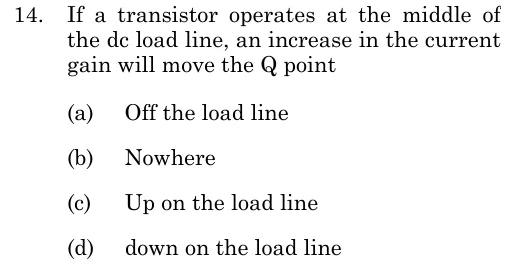
If a transistor operates at the middle of the dc load line, an increase in the current gain will move the Q point
- (A)
Off the load line
- (B)
Nowhere
- (C)
Up on the load line
- (D)
down on the load line

If a transistor operates at the middle of the dc load line, an increase in the current gain will move the Q point
Off the load line
Nowhere
Up on the load line
down on the load line
ANSWER
The Q point moves up on the load line, option (c).
Official answer: CSource: ISRO's revised and final answer key of 16 February 2024
The Q point is the dc operating point , and it always lies on the dc load line, because holds for every value of collector current. A change in can therefore only slide the point along the line, never take it off it. Option (a) is ruled out.
The question describes the standard textbook case of a transistor biased with a fixed base current, . This is set by the supply and the base resistor and does not depend on .
The collector current is , so a larger current gain gives a proportionally larger . The Q point does move, which rules out option (b).
The larger increases the drop , so falls.
Higher together with lower is a move toward the saturation end of the load line, which is the upper end when is plotted upward. The Q point moves up on the load line. Option (d) would need to fall, but rises.
KEY IDEA
With a fixed base current, grows with while falls. The Q point slides along the dc load line toward saturation, which is the upper end.
WATCH OUT FOR
Assuming the Q point leaves the load line, or that it stays put because the load line depends only on and . The load line is fixed, but the point on it is set by and so does shift with . Another slip is to read "up" as toward cut-off instead of toward saturation.
From the ISRO EC 2023 paper. Every question of this paper · The full paper (PDF, ISRO) · All 2 ISRO Biasing questions, with notes