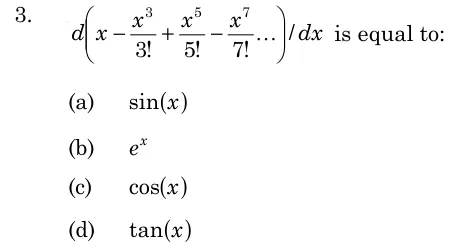
is equal to:
- (A)
- (B)
- (C)
- (D)

is equal to:
ANSWER
The expression equals , option (c).
Official answer: CSource: ISRO's revised and final answer key of 16 February 2024
The series is the Maclaurin series of , which converges for every real .
A power series may be differentiated term by term inside its radius of convergence, so
Cancel the leading factor in each term using :
This is the Maclaurin series of . It also agrees with .
The other options do not fit: has every term positive, is the original function and not its derivative, and is not given by a series of this factorial form.
Hence the result is , option (c).
KEY IDEA
The given series is the Maclaurin series of , and differentiating (or the series term by term) gives .
WATCH OUT FOR
Choosing because the series is recognised as sine, forgetting that the question asks for its derivative.
From the ISRO EC 2023 paper. Every question of this paper · The full paper (PDF, ISRO) · All 2 ISRO Calculus questions, with notes