GATE 2026 EC Q.36
Consider the two series, and , where
Which of the following statements is correct for the two given series?
- (A)
Both and converge.
- (B)
Neither nor converges.
- (C)
converges but does not converge.
- (D)
converges but does not converge.

GATE EC · EE · IN
Limits, mean value theorems, integrals, maxima and minima, series
Calculus covers limits and continuity, the mean value theorems, Taylor series, definite and improper integrals, partial derivatives, maxima and minima of functions of one and two variables, multiple integrals and (for EE) Fourier series. These notes state every result with its exact hypotheses, because a theorem used where a hypothesis fails can give a wrong answer. They also collect the properties that shorten the work: symmetry, King's property, change of order of integration and the Jacobian.
39 previous-year questions · 38 solved · 7 practice questions
The limit exists only when the left-hand limit and the right-hand limit both exist and equal the same finite . The value plays no part in the limit. Throughout these notes angles are in radians, is the natural logarithm, and is the imaginary unit, .
STANDARD LIMITS AT ZERO
in radians, . Each follows from the Maclaurin series of the function.
EXPONENTIAL AND POWER LIMITS
The last holds for any real when .
ORDERS OF GROWTH
For and : a logarithm grows more slowly than any positive power, and a power more slowly than any growing exponential. Each follows from L'Hospital's rule. Consequence: .
THE ONE-TO-THE-POWER-INFINITY RULE
Valid whenever the limit in the exponent exists; if that limit is the answer is , and if it is the answer is . It comes from when .
L'HOSPITAL'S RULE
Only for the forms or , with differentiable and near (except possibly at ), and only if exists (finite or infinite). Differentiate numerator and denominator separately, not by the quotient rule. Also valid for and for one-sided limits.
Converting the other indeterminate forms
: write (or ) to get or .
: combine into a single fraction (common denominator, or rationalise a difference of roots).
(with ): put , so is a form; find its limit , then .
For with polynomials or roots, divide by the highest power first. For , substituting Maclaurin series is often faster than repeated L'Hospital.
CONTINUITY AND DIFFERENTIABILITY AT A POINT
Continuity needs defined, the limit to exist, and the two to be equal. Differentiability needs the left derivative () and the right derivative () to be finite and equal. Differentiable continuous; the converse is false.
Functions continuous on a closed interval [a, b]
Extreme values: a function continuous on the closed, bounded interval is bounded there and attains a greatest and a least value. On an open interval this can fail: is continuous on but unbounded.
Intermediate value theorem: if is continuous on and lies between and , then for some . In particular, if and have opposite signs, has a root in .
Sums, products and compositions of continuous functions are continuous, and so is a quotient wherever its denominator is non-zero. Polynomials, , and are continuous for all , and for .
Function (with ) | Continuous at 0? | Differentiable at 0? | Reason |
|---|---|---|---|
Yes | No | Left derivative , right derivative : a corner | |
Yes | Yes, | Difference quotient | |
Yes | No | Difference quotient (vertical tangent) | |
Yes | No | Difference quotient oscillates, no limit | |
Yes | Yes, | But has no limit at 0, so is not continuous there | |
No | No | Jump from to |
WORKED EXAMPLE
Evaluate .
As , and : the form is .
By the rule, the limit is with .
From the standard limit , so .
Check by L'Hospital on (form ): . Same result.
Answer:
EXAM TIP
L'Hospital's rule gives nonsense when the form is not or : , but differentiating top and bottom gives . And when does not exist, the original limit may still exist: , although has no limit.
The mean value theorems guarantee a point strictly inside with a stated property. All three share two hypotheses: continuity on the closed interval and differentiability on the open interval . Rolle's theorem adds , and Cauchy's adds . When a hypothesis fails the conclusion is no longer guaranteed, though it may still happen to hold, so check every hypothesis before using a theorem.
ROLLE'S THEOREM
Geometrically, a horizontal tangent between two equal heights. on has but no such , because it is not differentiable at 0.
LAGRANGE'S MEAN VALUE THEOREM
Needs continuous on and differentiable on . The tangent at is parallel to the chord. Rolle's theorem is the case . Equivalent form: . Consequences on an interval: throughout is constant; is strictly increasing; strictly decreasing; .
CAUCHY'S MEAN VALUE THEOREM
Needs continuous on , differentiable on , and on (which also forces ). Lagrange's theorem is the case .
Theorem and function on | Value of |
|---|---|
Lagrange, , | (arithmetic mean) |
Lagrange, , | (geometric mean) |
Lagrange, , | |
Lagrange, | |
Cauchy, , | |
Cauchy, , , | |
Cauchy, , , | (harmonic mean) |
TAYLOR SERIES ABOUT X = A
Maclaurin series when . Needs derivatives of every order at , and the series equals exactly when the remainder ; for the standard functions below this holds throughout the stated range. A convergent Taylor series can still differ from : with has every derivative zero at 0, so its Maclaurin series is 0. A power series that equals near is its Taylor series, so series may be built by substitution, multiplication, and term-by-term differentiation or integration inside the interval of convergence.
LAGRANGE FORM OF THE REMAINDER
The error after the term in , valid when exists on an interval containing and (with continuous there). With it is exactly Lagrange's mean value theorem.
MACLAURIN SERIES VALID FOR ALL X
Odd functions have only odd powers, even functions only even powers.
MACLAURIN SERIES WITH A RESTRICTED RANGE
For a non-negative integer the binomial series stops after terms and holds for all . Replacing by gives for , and for .
RADIUS OF CONVERGENCE OF A POWER SERIES
When this limit exists (it may be ). The series converges absolutely for and diverges for ; each end point must be tested separately. Example: has ; it diverges at (harmonic series) and converges at , so the interval is , the range of , which this series equals.
WORKED EXAMPLE
Find the value of given by Lagrange's mean value theorem for on .
is a polynomial, so it is continuous on and differentiable on : the theorem applies.
Chord slope: .
.
Only a root inside counts: .
Answer:
WORKED EXAMPLE
Find the coefficient of in the Maclaurin series of .
Multiply the series and .
Products giving : , and . The terms and would need odd powers from , which has none.
Coefficient: .
Check with : , so the coefficient of is . Here , giving .
Answer:
EXAM TIP
For a limit such as , substitute the series: , so the limit is at once, where L'Hospital needs three rounds. Keep terms up to the power in the denominator.
EXAM TIP
In a mean value question, reject any root that is not strictly inside , and check the hypotheses before solving: a function with a corner or a vertical tangent inside the interval (such as on an interval containing 1, or on one containing 0) does not satisfy them.
FUNDAMENTAL THEOREM OF CALCULUS
Needs continuous on . Evaluating an antiderivative across a point where is unbounded is not justified and can give a wrong answer (see the tip at the end of this section): split the integral there and treat each piece as improper.
INTEGRATION BY PARTS
and with continuous derivatives on . Choose as the factor that simplifies when differentiated (a power of , a logarithm, an inverse trigonometric function). The last two lines come from integrating by parts twice; and is an arbitrary constant.
MEAN VALUE THEOREM FOR INTEGRALS
Needs continuous on . is the average value of over the interval.
KING'S PROPERTY
Substitute . Adding the two forms often cancels the awkward part: .
EVEN AND ODD INTEGRANDS
Even: ; odd: . Any is its even part plus its odd part , and only the even part survives a symmetric integral.
REFLECTION ABOUT THE MIDPOINT
Example: , and for odd .
PERIODIC INTEGRANDS
For and a positive integer : every full period gives the same integral. Example: has period , so .
REDUCTION FORMULA FOR POWERS OF SINE AND COSINE
a positive integer. Each product keeps only its positive factors, so it runs down to 1 or 2; a product with no factors is 1, so gives 1. Examples: gives ; gives .
PRODUCTS OF POWERS OF SINE AND COSINE
non-negative integers. Each product keeps only its positive factors, running down to 1 or 2, and a product with no factors (for or equal to 0 or 1) is 1. With it is the formula above. Examples: gives ; gives . The Beta function below gives the same values.
LEIBNIZ RULE
Needs and continuous and differentiable. If the integrand does not contain the last term is zero; if the limits are constants only the last term remains (differentiation under the integral sign).
An integral is improper when a limit of integration is infinite (first kind) or the integrand is unbounded at a point of (second kind). It is defined as a limit, for example , and it converges only if that limit is finite. An integral over , or across an interior point where blows up, must converge on each piece separately: diverges even though for every (that symmetric value is only the Cauchy principal value).
P-TEST FOR IMPROPER INTEGRALS
Both diverge at (logarithm). For non-negative and : comparison test, if then convergent convergent, and divergent divergent; limit comparison, if tends to a finite non-zero limit, both converge or both diverge. For any : if converges, so does (absolute convergence).
STANDARD IMPROPER INTEGRALS
, real and a non-negative integer; for real the second result is . The last integral converges, but not absolutely.
GAMMA FUNCTION
for non-negative integers , so . Example: .
BETA FUNCTION
and . The trigonometric form gives for .
AREA, ARC LENGTH AND VOLUME
Area between two curves and area swept by a polar curve ; arc length for , for a parametric curve, and for a polar curve. is the volume of the solid formed by revolving the region under , , about the -axis; (shell method, for and ) is the volume when the same region is revolved about the -axis.
WORKED EXAMPLE
Evaluate .
Here , so replace by : .
Add the two forms: .
Hence .
Answer:
WORKED EXAMPLE
If for , find .
The integrand does not contain , so only the two boundary terms of the Leibniz rule remain.
.
.
Answer:
EXAM TIP
is not ; a negative value for a positive integrand is the warning sign. The integrand is unbounded at and diverges (), so the whole integral diverges.
For a function of two variables, means that however approaches : along every path, not only along straight lines. Two paths that give different values prove that the limit does not exist; agreement along any number of paths proves nothing. To show that a limit at the origin exists, put , and bound by a function of alone that tends to 0. is continuous at when this limit exists and equals .
WORKED EXAMPLE
Decide whether each limit exists: (i) ; (ii) .
(i) In polar form the function is , and whatever does. The limit is .
(ii) Along the line with : . This is along the -axis () and along ().
Two paths give two different values, so the limit in (ii) does not exist.
Answer: (i) exists and equals ; (ii) does not exist.
EXAM TIP
Straight lines are not enough. For , every line gives and both axes give 0, but the parabola gives , so there is no limit at the origin. Also, unlike the one-variable case, the existence of and at a point does not make continuous there: with has but no limit at the origin.
For the partial derivative is the ordinary derivative in with held constant. Second derivatives are written , and the mixed . If and are continuous near a point, they are equal there, so the order of differentiation does not matter for the functions met in practice.
TOTAL DIFFERENTIAL AND CHAIN RULE
For with , . For , : and . The total differential also estimates small changes: .
IMPLICIT DIFFERENTIATION
Valid where . Note the minus sign.
TAYLOR SERIES IN TWO VARIABLES
All derivatives are evaluated at , and needs continuous partial derivatives of every order used. Stopping after the first bracket gives the linear approximation , the total differential again. At a stationary point the first bracket is zero and the second decides the nature of the point, which is where the test comes from.
EULER'S THEOREM ON HOMOGENEOUS FUNCTIONS
For differentiable and homogeneous of degree , meaning for all (continuous second partial derivatives are needed for the second identity). may be negative or fractional. With more variables: .
EULER'S THEOREM FOR A FUNCTION OF A HOMOGENEOUS FUNCTION
Use when itself is not homogeneous but some is; needs . Writing , the second-order form is . Example: for , is homogeneous of degree 1, so , and the second-order sum is .
WORKED EXAMPLE
For with , find .
is not homogeneous, but is homogeneous of degree .
With : .
Direct check: , so .
Answer:
EXAM TIP
Euler's theorem needs genuine homogeneity. Test by replacing with and factoring out : fails the test, and indeed is not a constant multiple of . passes with degree .
One variable: procedure
Find the critical points: interior points where and interior points where does not exist.
Second derivative test at a stationary point (): gives a local maximum, a local minimum, and is inconclusive.
If inconclusive, find the first non-zero derivative . For even there is an extremum (maximum if , minimum if ); for odd there is none. Examples: at 0 (, no extremum), at 0 (, minimum).
Where does not exist (such as at 0), use the sign change of : from to is a maximum, from to a minimum.
A point of inflection is where changes sign (the curve changes between concave up and concave down). alone is not enough: has , but on both sides and is a minimum.
Absolute extrema of a continuous on a closed interval : compare at every critical point inside and at both end points; the largest value is the maximum and the smallest the minimum.
TWO VARIABLES: SECOND DERIVATIVE TEST
Classify with the table below; needs continuous second partial derivatives near the point. When , and have the same sign, so either may be used.
Condition at a stationary point | Nature |
|---|---|
and | Local maximum |
and | Local minimum |
Saddle point (neither maximum nor minimum) | |
Test fails: examine near the point directly |
LAGRANGE MULTIPLIERS
Extremise subject to the constraint , at points where . Solve the four equations for , evaluate at each candidate and compare. The method finds candidates; it does not by itself say which is a maximum.
WORKED EXAMPLE
Find and classify the stationary points of .
; .
Substitute: or . Stationary points: and .
, , .
At : , a saddle point.
At : and , a local minimum with .
Answer: Saddle point at ; local minimum at ; no local maximum.
WORKED EXAMPLE
Find the minimum of subject to .
, . Conditions: , , .
So . The constraint gives , .
. On the plane as , so attains a least value there (and has no greatest); that least value must occur at a candidate, and is the only one.
Check: is the squared distance from the origin to the plane, .
Answer: Minimum value , at .
EXAM TIP
A stationary point need not be an extremum, and a local extremum need not be absolute: has a local minimum but no absolute minimum, since as . On a closed, bounded region, also check the boundary and the corners.
A double integral is evaluated as an iterated integral: the inner integral is taken first with the outer variable held constant, and its limits may depend on the outer variable; the outer limits must be constants. For a continuous on a bounded region the order of integration may be changed, but the limits must be re-derived from the region, never simply swapped. A triple integral is handled the same way, one variable at a time.
Changing the order of integration
Read the region from the given limits: the inner limits are the bounding curves, the outer limits the extreme values of the outer variable.
Sketch the region and mark where its boundary curves intersect.
For the new order, fix the new outer variable and draw a strip across the region in the new inner direction: the curves where the strip enters and leaves are the new inner limits.
The new outer limits are the least and greatest values of the new outer variable over the region. If the entry or exit curve changes part-way, split the region into pieces.
AREA AND VOLUME
Area of a plane region , volume under the surface over , and volume of a solid . Replacing 1 by a density gives mass.
CHANGE OF VARIABLES AND THE JACOBIAN
Valid when the map takes one-to-one onto (except possibly on the boundary), with continuous partial derivatives and a non-zero Jacobian inside. The absolute value of the Jacobian is the area scale factor. The Jacobians of a transformation and its inverse multiply to 1: .
System | Transformation | Element | Ranges |
|---|---|---|---|
Polar (plane) | |||
Cylindrical | |||
Spherical | |||
Scaled polar (ellipse) | covers |
EXAM TIP
Convention used here: in spherical coordinates is the angle from the positive -axis () and is the angle in the -plane from the positive -axis. Some texts swap the two letters; the volume element is either way. In polar work do not drop the factor in .
STANDARD RESULTS
The first follows by squaring the integral and switching to polar coordinates: (with in the others).
WORKED EXAMPLE
Evaluate .
has no elementary antiderivative, so change the order.
Region: , , the triangle with vertices , and .
For fixed , runs from to : .
With : .
Answer:
WORKED EXAMPLE
Evaluate over the disc .
Polar coordinates: , , , .
.
.
Answer:
A function given on and extended periodically with period can be written as a sum of cosines and sines. Convention used here: the constant term is written , so one formula gives both and , and is the average value of over a period. Some texts write the constant term as with ; the series itself is the same.
FOURIER SERIES ON (-L, L)
Period . For period put , giving .
FOURIER COEFFICIENTS
Any interval of length , such as , may be used. They follow from orthogonality: over one period, and integrate to if and to if , and every sine-cosine product integrates to .
Dirichlet conditions and convergence
is periodic with period and absolutely integrable over a period.
In one period has finitely many discontinuities, all finite jumps, and finitely many maxima and minima.
Then the series converges to wherever is continuous, and to the midpoint at a jump. This includes the end points: at it converges to .
Symmetry of | Series contains | Coefficients |
|---|---|---|
Even, | Constant and cosines only | , |
Odd, | Sines only | (including ), |
Half-wave, | Odd harmonics only | , and for even |
HALF-RANGE SERIES ON (0, L)
A function given only on is extended evenly (cosine series) or oddly (sine series), each with period . Both converge to at every point of where is continuous. They differ outside and can differ at its end points: the sine series is at and , while the cosine series converges to at and to at .
PARSEVAL'S IDENTITY
Written for the convention; holds whenever over a period is finite, in particular under the Dirichlet conditions above. Halving both sides: mean square value .
COMPLEX EXPONENTIAL FORM
. , for , and for real , (the complex conjugate).
WORKED EXAMPLE
Find the Fourier series of on , extended with period 2, and use it to find .
and is even, so .
, so the constant term is .
. Integrating by parts twice (the terms vanish): , so .
Series: for . The periodic extension is continuous, so equality holds at the end points too.
Put , where : , so .
Answer:
EXAM TIP
For a piecewise-smooth , the decay of the coefficients shows how smooth the periodic extension is: with a jump they fall off like ; if it is continuous but has corners (jumps in ), like . Near a jump the partial sums overshoot by about 9% of the jump however many terms are taken (Gibbs phenomenon), while at the jump itself the series converges to the midpoint.
EXAM TIP
Before integrating, check symmetry about the origin and half-wave symmetry: they can remove whole families of coefficients. Remember and for integer .
PREVIOUS-YEAR QUESTIONS
Try each question first, then open the answer. One shows the official answer only. We placed each question under a topic ourselves; the exam paper does not label topics.
See these papers in full: GATE ECE 2026 · GATE ECE 2025 · GATE ECE 2024 · GATE ECE 2023 · GATE ECE 2022 · GATE ECE 2020 · GATE ECE 2018 · GATE EE 2026 · GATE EE 2025 · GATE EE 2024 · GATE EE 2023 · GATE EE 2022 · GATE EE 2020 · GATE EE 2018 · GATE IN 2026 · GATE IN 2025 · GATE IN 2023 · GATE IN 2022 · GATE IN 2020 · GATE IN 2018
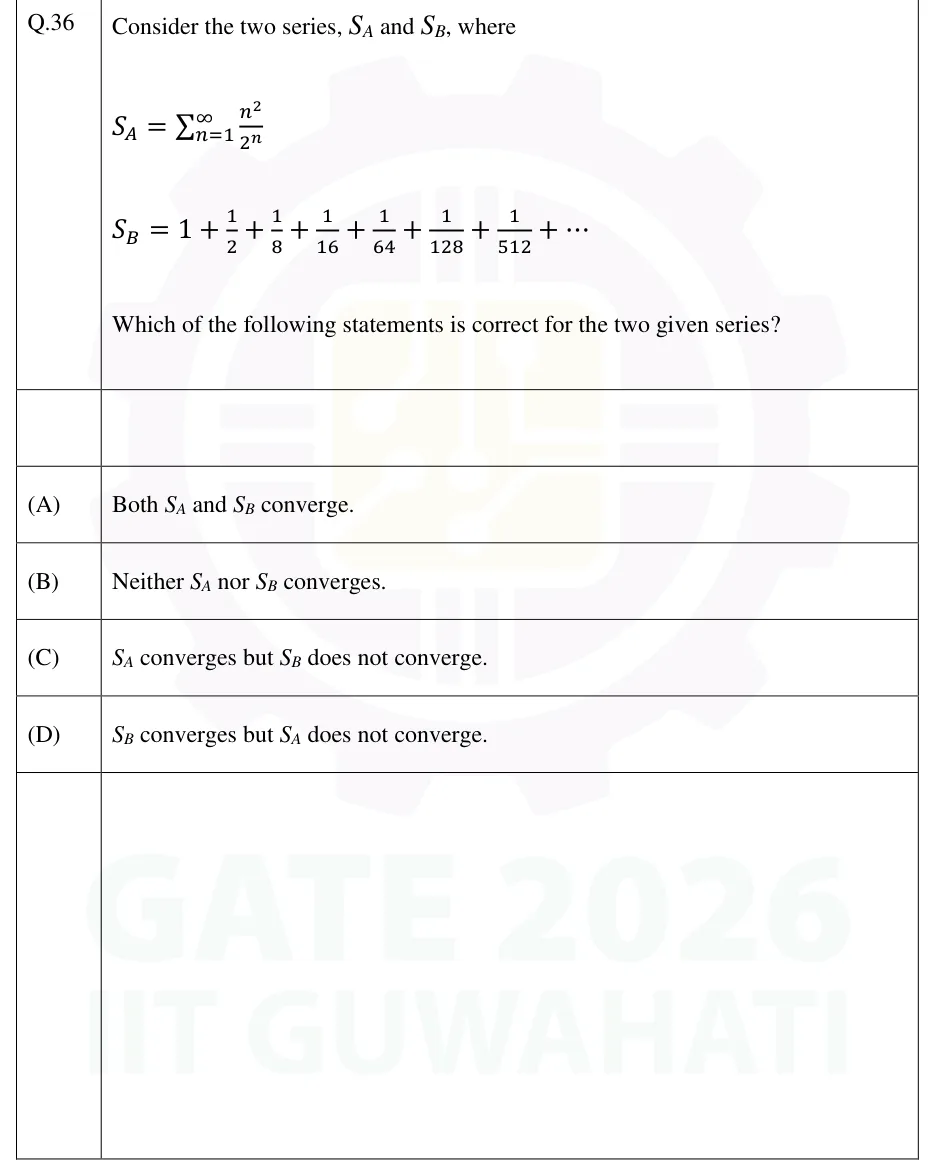
Consider the two series, and , where
Which of the following statements is correct for the two given series?
Both and converge.
Neither nor converges.
converges but does not converge.
converges but does not converge.
Consider the square region in the - plane as shown with the dark shading in the Figure. The value of is ____. (rounded off to two decimal places)
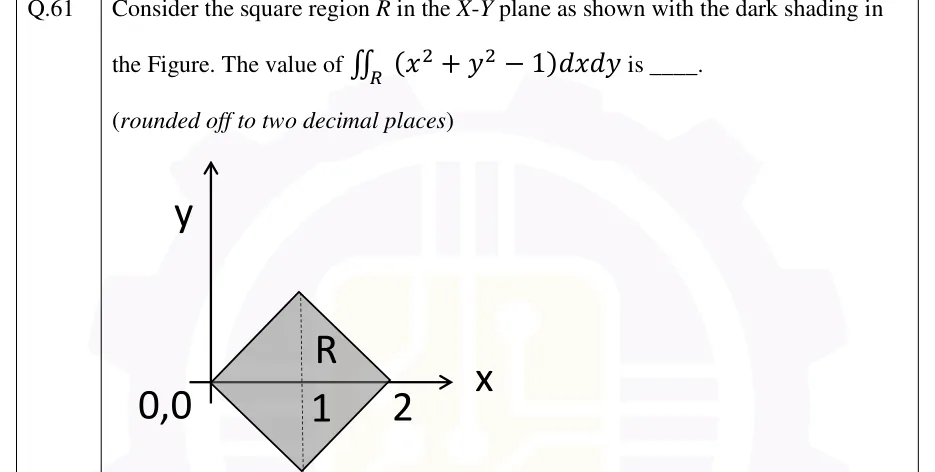 Tap to open full size
A vertical axis with an upward arrow labelled y and a horizontal axis with a rightward arrow labelled X; the origin is labelled 0,0. A dark-shaded square R stands on one corner (a diamond). Its left corner is at the origin and its right corner is on the x-axis at the point labelled 2. A dotted vertical line, the square's other diagonal, joins the top corner to the bottom corner and crosses the x-axis at the point labelled 1. The top and bottom corners are not labelled; because R is a square with its horizontal diagonal from 0 to 2, they are (1,1) and (1,-1). The label R sits in the upper half just right of the dotted line. The label 1 sits just below the x-axis beside the dotted line, and 2 sits just below the x-axis at the right corner.
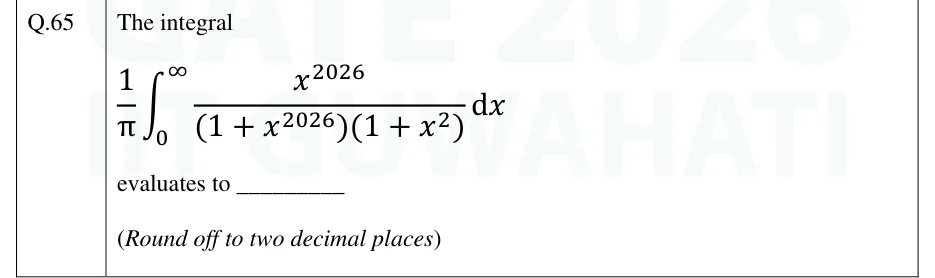
The integral
evaluates to ________ (Round off to two decimal places)
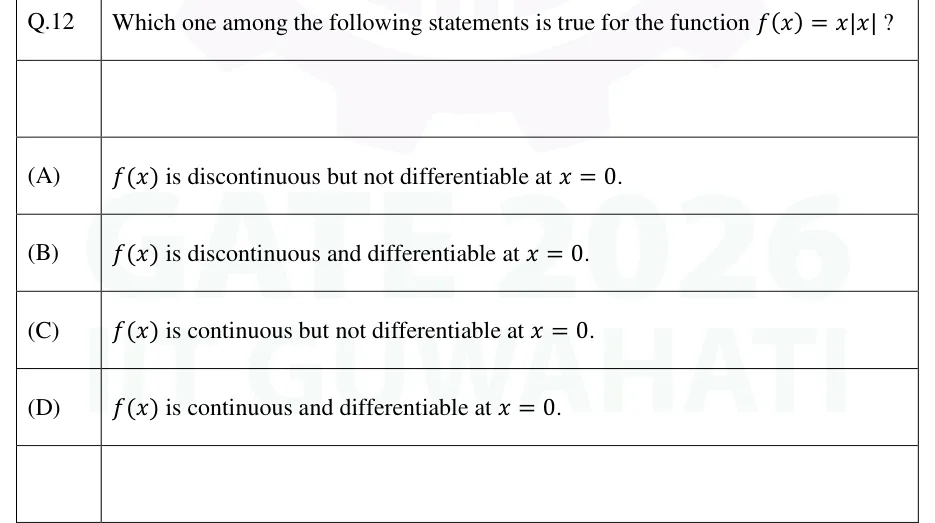
Which one among the following statements is true for the function ?
is discontinuous but not differentiable at .
is discontinuous and differentiable at .
is continuous but not differentiable at .
is continuous and differentiable at .
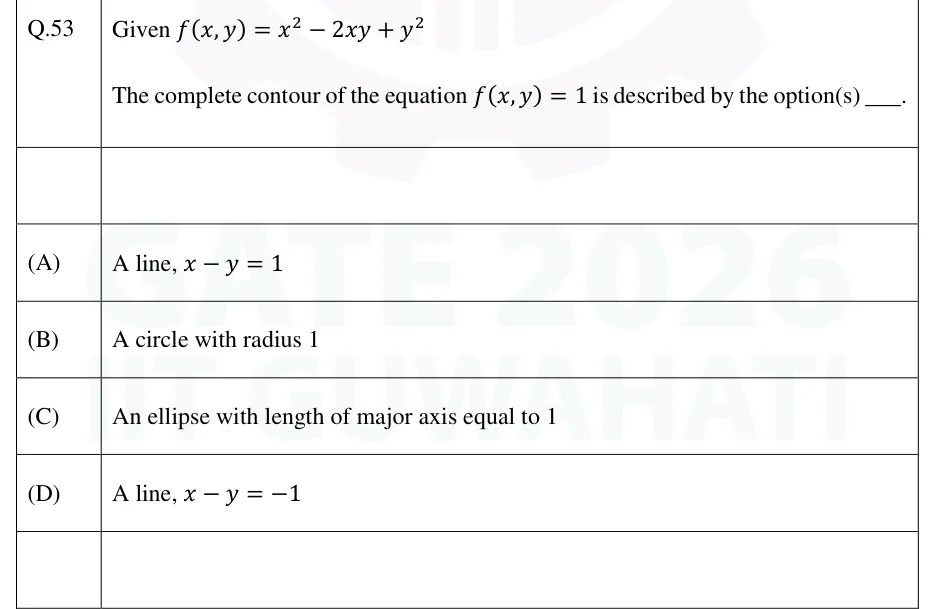
Given
The complete contour of the equation is described by the option(s) ____.
A line,
A circle with radius 1
An ellipse with length of major axis equal to 1
A line,
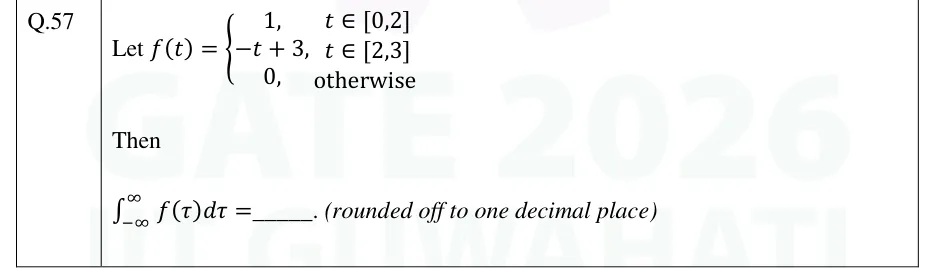
Let
Then
______. (rounded off to one decimal place)
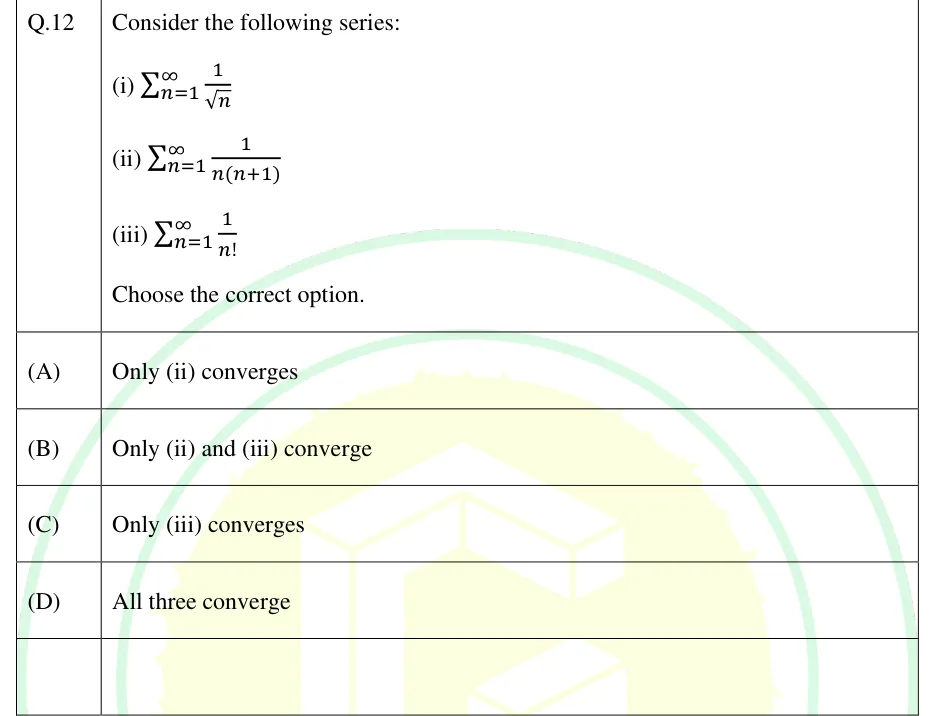
Consider the following series:
(i)
(ii)
(iii)
Choose the correct option.
Only (ii) converges
Only (ii) and (iii) converge
Only (iii) converges
All three converge
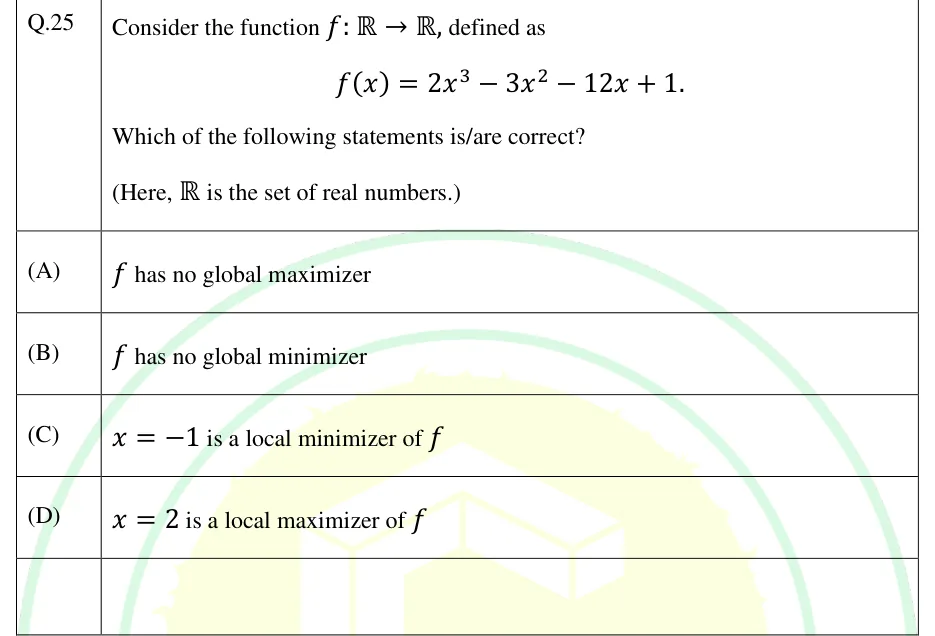
Consider the function , defined as
Which of the following statements is/are correct?
(Here, is the set of real numbers.)
has no global maximizer
has no global minimizer
is a local minimizer of
is a local maximizer of
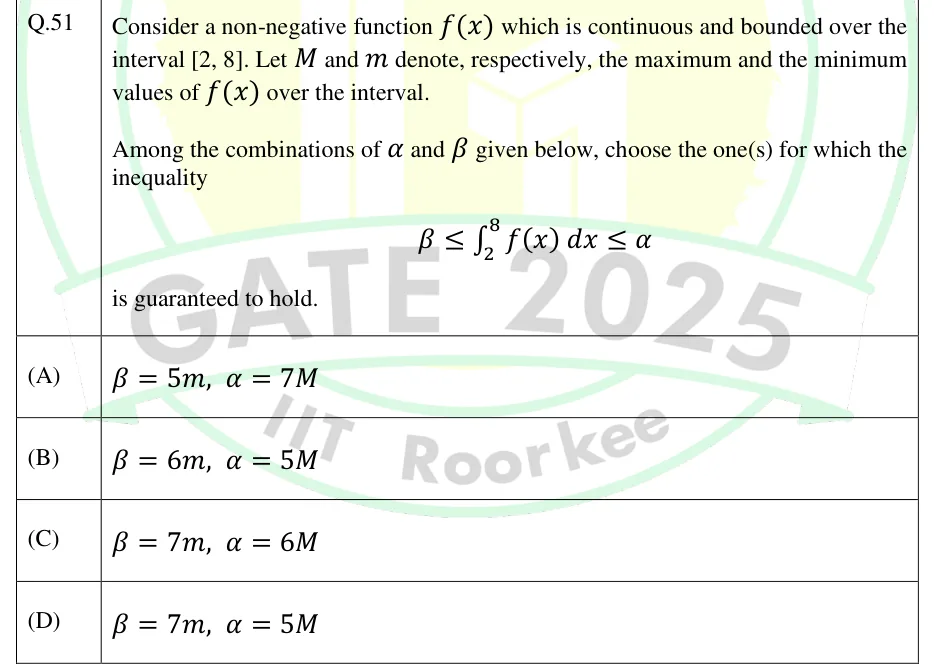
Consider a non-negative function which is continuous and bounded over the interval [2, 8]. Let and denote, respectively, the maximum and the minimum values of over the interval.
Among the combinations of and given below, choose the one(s) for which the inequality
is guaranteed to hold.
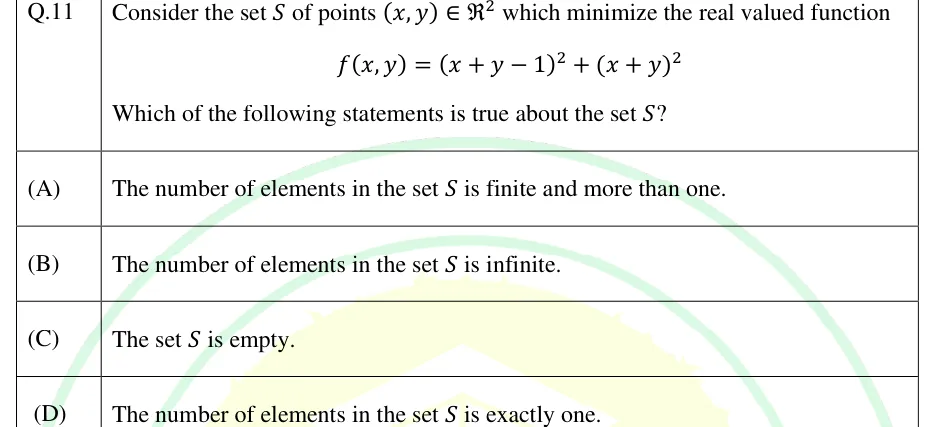
Consider the set of points which minimize the real valued function
Which of the following statements is true about the set ?
The number of elements in the set is finite and more than one.
The number of elements in the set is infinite.
The set is empty.
The number of elements in the set is exactly one.
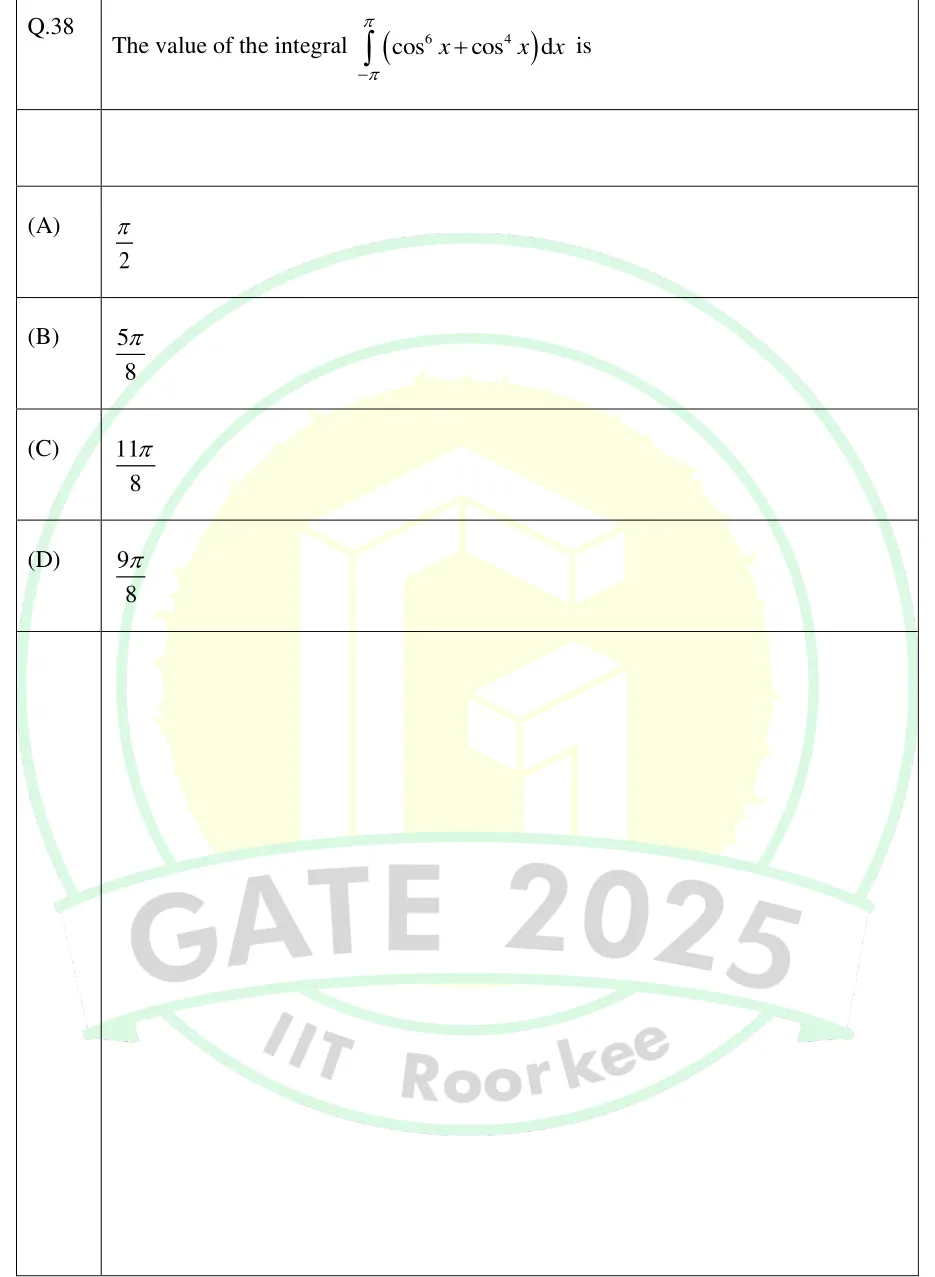
The value of the integral is
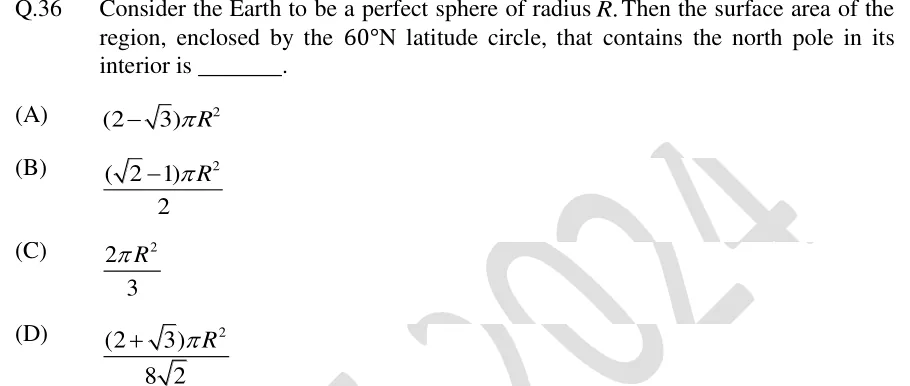
Consider the Earth to be a perfect sphere of radius . Then the surface area of the region, enclosed by the N latitude circle, that contains the north pole in its interior is ________.
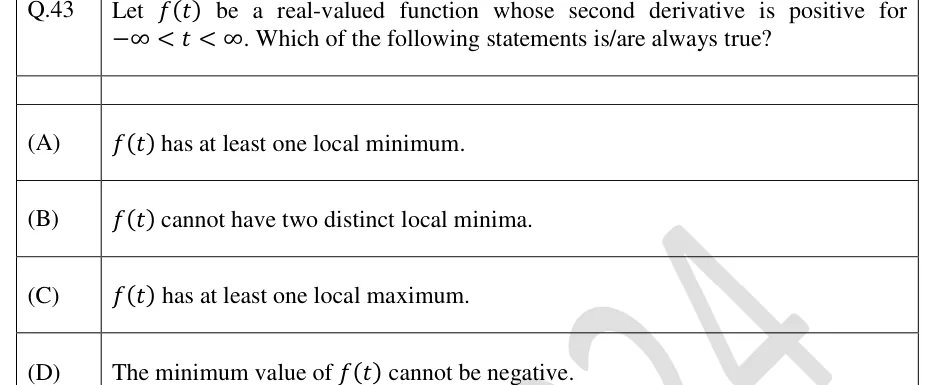
Let be a real-valued function whose second derivative is positive for . Which of the following statements is/are always true?
has at least one local minimum.
cannot have two distinct local minima.
has at least one local maximum.
The minimum value of cannot be negative.
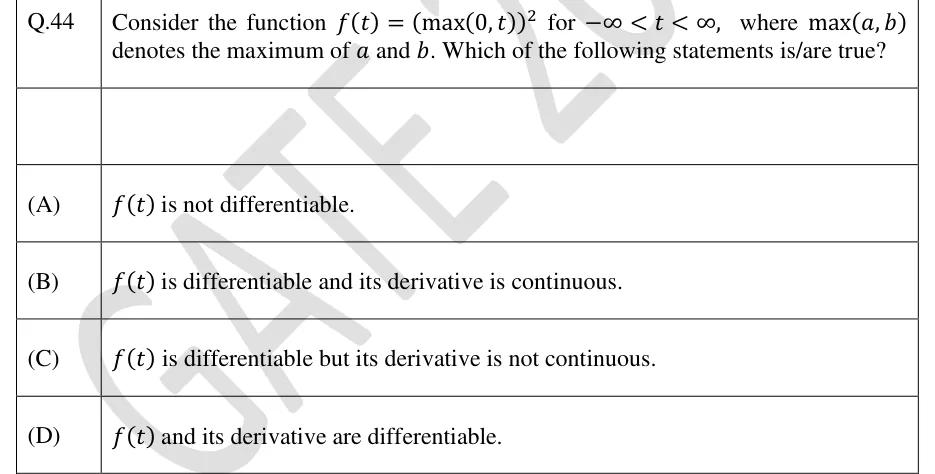
Consider the function for , where denotes the maximum of and . Which of the following statements is/are true?
is not differentiable.
is differentiable and its derivative is continuous.
is differentiable but its derivative is not continuous.
and its derivative are differentiable.
The value of the integral over the region R, given in the figure, is ________ (rounded off to the nearest integer).
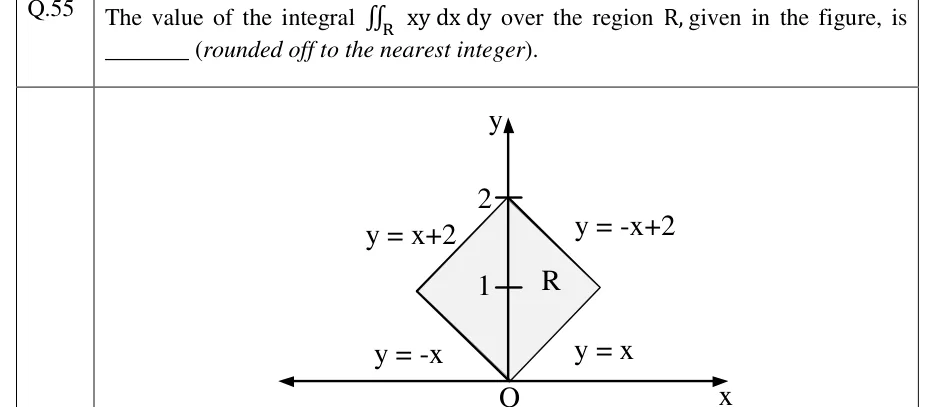 Tap to open full size
x-y axes with origin O. The shaded region R is a square (a diamond tilted 45 degrees) with vertices O(0,0), (1,1), (0,2) and (-1,1). Its four sides are labelled: lower right edge y = x (from O to (1,1)), upper right edge y = -x+2 (from (1,1) to (0,2)), upper left edge y = x+2 (from (-1,1) to (0,2)), lower left edge y = -x (from O to (-1,1)). The y-axis runs through the middle of R from O up to 2, with tick marks at y = 1 and y = 2; the label R sits in the right half of the square.
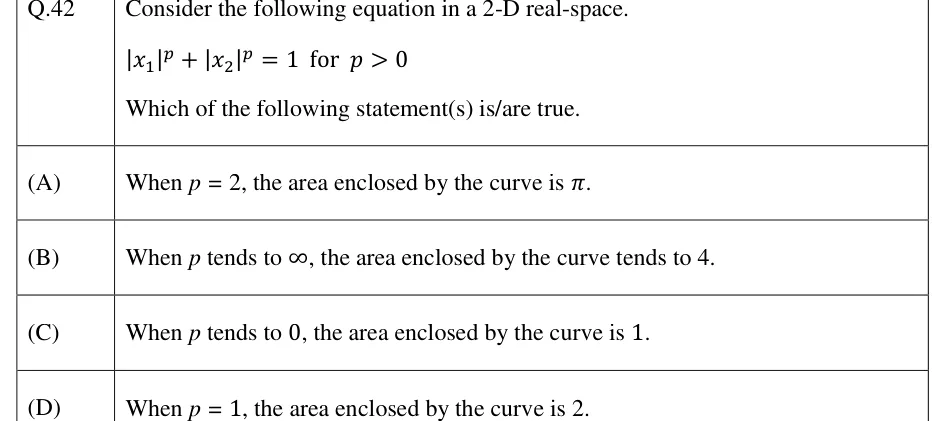
Consider the following equation in a 2-D real-space.
Which of the following statement(s) is/are true.
When , the area enclosed by the curve is .
When tends to , the area enclosed by the curve tends to 4.
When tends to , the area enclosed by the curve is 1.
When , the area enclosed by the curve is 2.
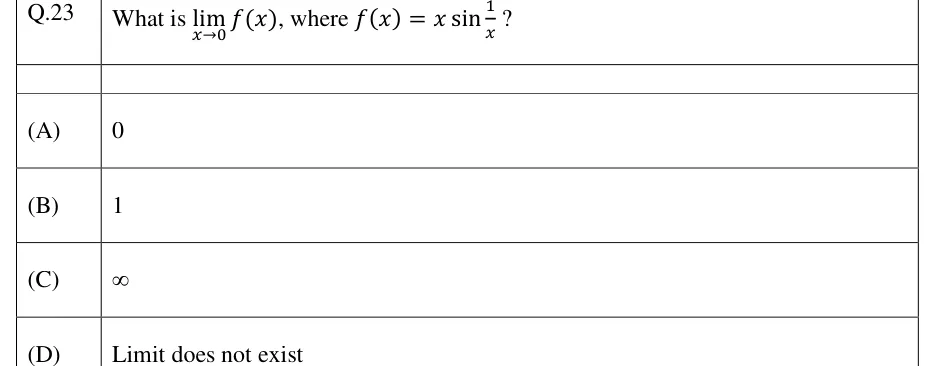
What is , where ?
0
1
Limit does not exist
Consider the real-valued function , where . The minimum value attained by is ________ (rounded off to one decimal place).
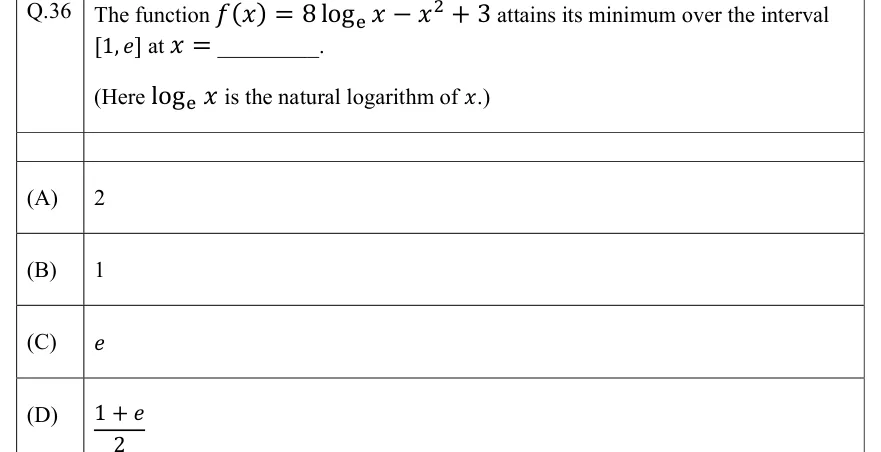
The function attains its minimum over the interval at ________.
(Here is the natural logarithm of .)
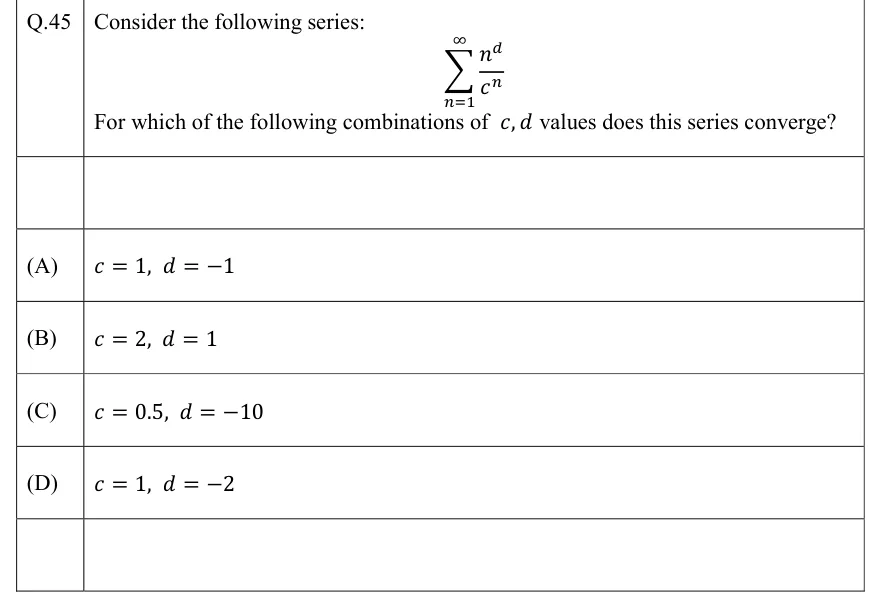
Consider the following series:
For which of the following combinations of values does this series converge?
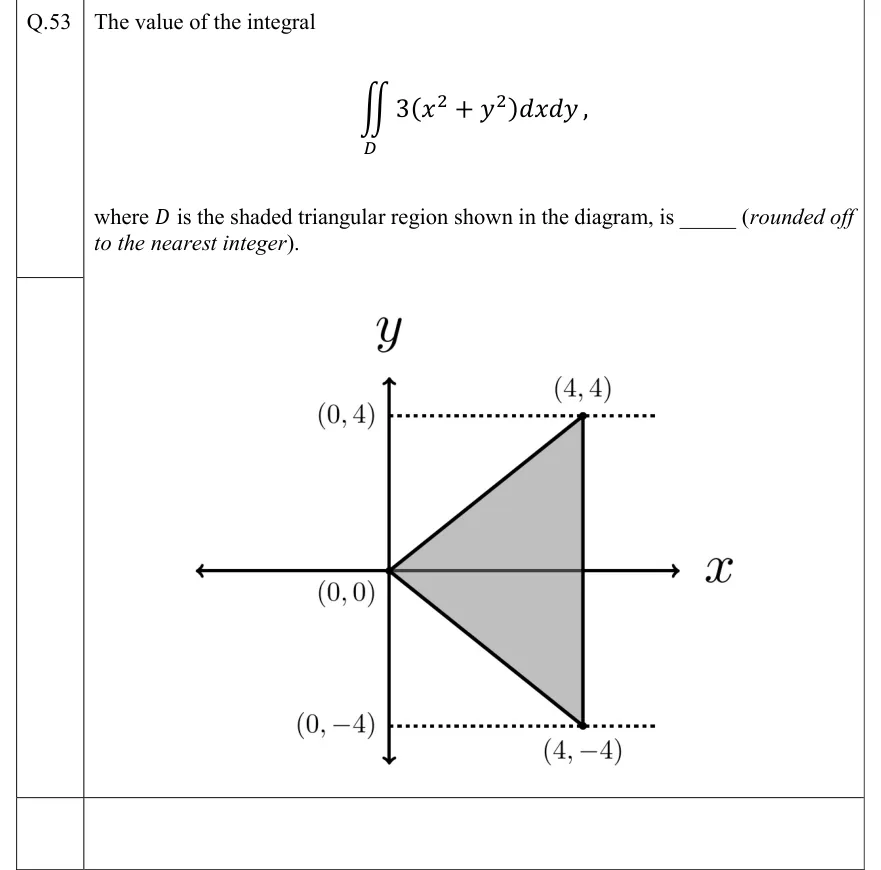
The value of the integral
where is the shaded triangular region shown in the diagram, is ______ (rounded off to the nearest integer).
 Tap to open full size
Cartesian axes: a horizontal x-axis and a vertical y-axis, each with arrows at both ends. The shaded triangle has vertices at (0, 0), (4, 4) and (4, -4). Its sides are the line from (0,0) to (4,4) (y = x), the line from (0,0) to (4,-4) (y = -x), and the vertical segment x = 4 from (4,-4) up to (4,4). The labels (0, 4) and (0, -4) sit to the left of the y-axis. A dotted horizontal line runs from each of these points on the y-axis through the vertex (4, 4) or (4, -4) and a short way past it. The origin is labelled (0, 0). The triangle lies in the right half-plane and is symmetric about the x-axis.
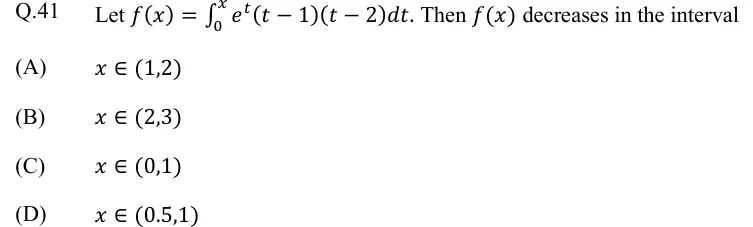
Let . Then decreases in the interval
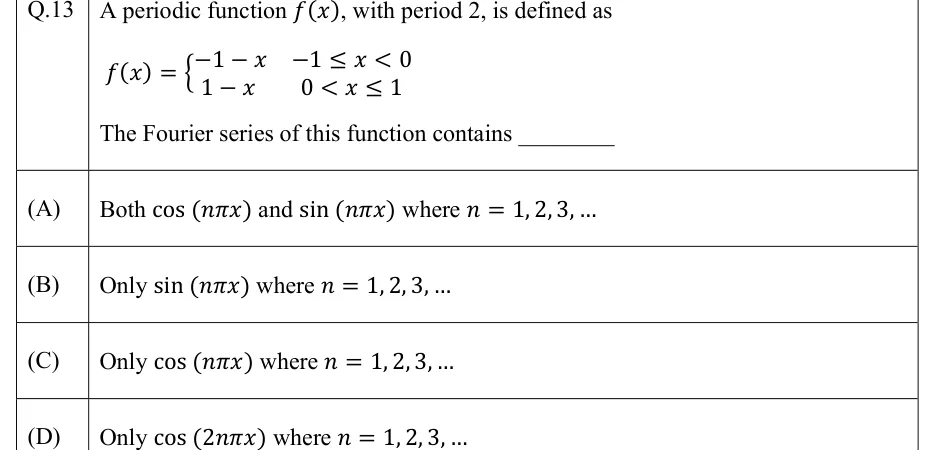
A periodic function , with period 2, is defined as
The Fourier series of this function contains ________
Both and where
Only where
Only where
Only where
The global minimum of for occurs at ________ (round off to one decimal place)
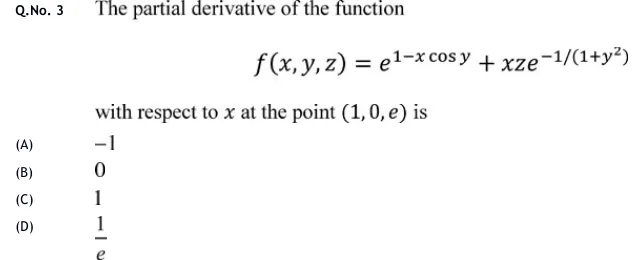
The partial derivative of the function
with respect to at the point is
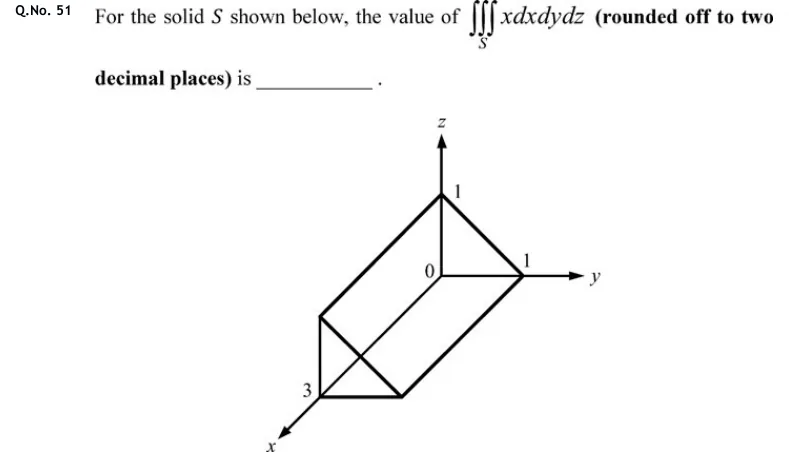
For the solid shown below, the value of (rounded off to two decimal places) is ________.
 Tap to open full size
A 3-D sketch with the z-axis pointing up, the y-axis pointing right and the x-axis coming toward the viewer at the lower left, meeting at the origin 0. The z-axis is marked 1, the y-axis is marked 1 and the x-axis is marked 3. The solid S is a right triangular prism. Its back face lies in the yz-plane (x = 0) and is the triangle with vertices (0,0,0), (0,1,0) and (0,0,1); the slanted edge from (0,0,1) to (0,1,0) is drawn. Three parallel edges run in the x-direction from x = 0 to x = 3: from (0,0,1) to (3,0,1), from (0,1,0) to (3,1,0), and along the x-axis from (0,0,0) to (3,0,0). The front face at x = 3 is the congruent triangle with vertices (3,0,0), (3,0,1) and (3,1,0). It has a vertical edge from (3,0,1) down to (3,0,0), an edge from (3,0,0) to (3,1,0) parallel to the y-axis, and a slanted edge from (3,0,1) to (3,1,0). So the solid is 0 ≤ x ≤ 3, y ≥ 0, z ≥ 0, y + z ≤ 1.
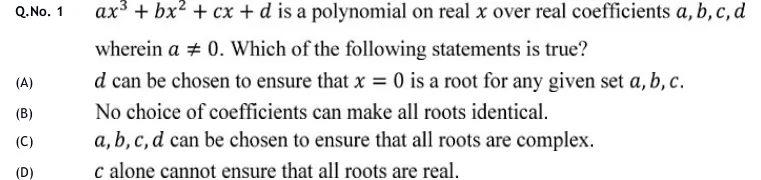
is a polynomial on real over real coefficients wherein . Which of the following statements is true?
can be chosen to ensure that is a root for any given set .
No choice of coefficients can make all roots identical.
can be chosen to ensure that all roots are complex.
alone cannot ensure that all roots are real.
Official answer: A or DSource: Official answer key, GATE 2020 EE (IIT Delhi)
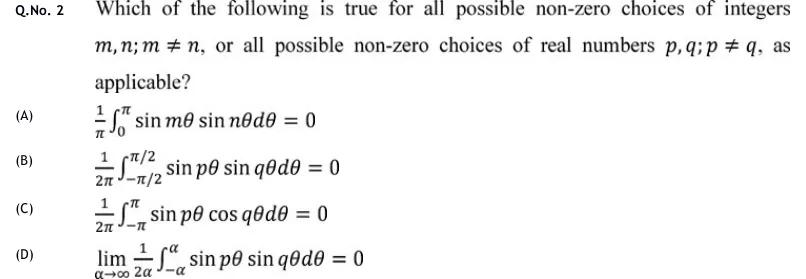
Which of the following is true for all possible non-zero choices of integers , or all possible non-zero choices of real numbers , as applicable?
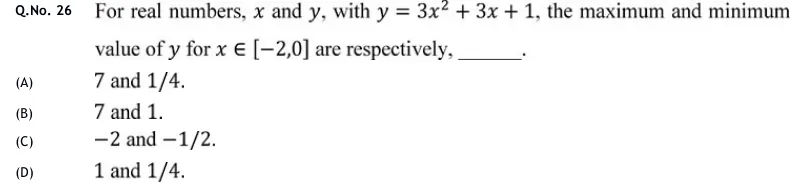
For real numbers, and , with , the maximum and minimum value of for are respectively, ______.
7 and 1/4.
7 and 1.
and .
1 and 1/4.
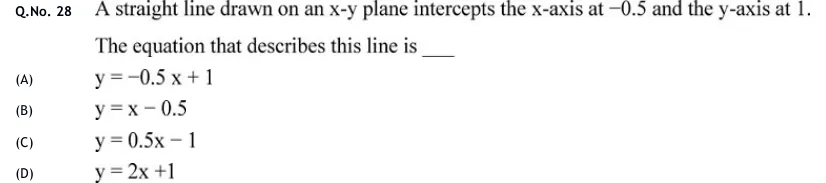
A straight line drawn on an x-y plane intercepts the x-axis at and the y-axis at . The equation that describes this line is ____
Consider the function . The minimum value the function attains on the line (rounded off to one decimal place) is ____
Let , where and are constants. If at and , then the relation between and is
Taylor series expansion of around has the form
The coefficient (correct to two decimal places) is equal to ________.
Let and . Assume that and are independent variables. At , the value (correct to two decimal places) of is ________
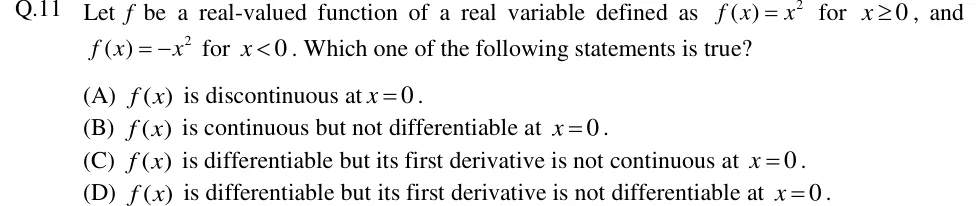
Let be a real-valued function of a real variable defined as for , and for . Which one of the following statements is true?
is discontinuous at .
is continuous but not differentiable at .
is differentiable but its first derivative is not continuous at .
is differentiable but its first derivative is not differentiable at .
Let be a real-valued function of a real variable defined as , where denotes the largest integer less than or equal to . The value of is ________ (up to 2 decimal places).
Let . The maximum value of over the interval is ________ (up to 1 decimal place).
Consider two functions and , where is real. The smallest value of for which is ______.
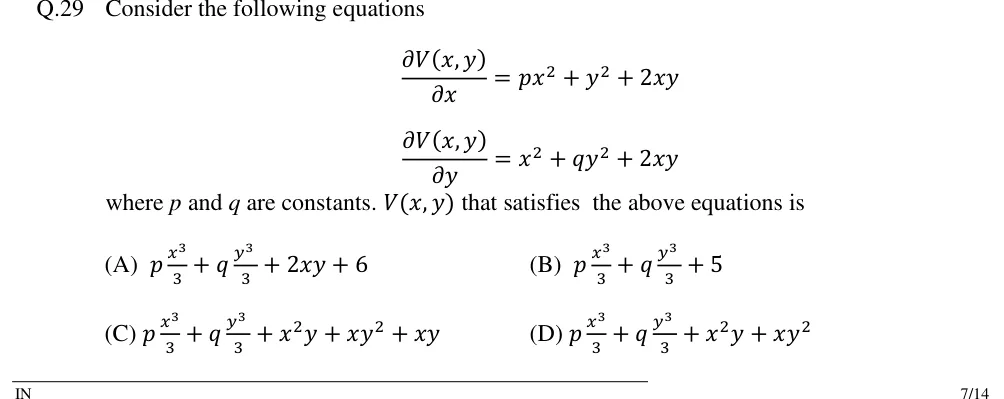
Consider the following equations
where and are constants. that satisfies the above equations is
PRACTICE
For , defined on the whole -plane, which of the following statements are TRUE?
has exactly two stationary points.
is a point of local minimum of .
is a point of local maximum of .
The local minimum value of is .
Answer: (A), (B), (D)
; . The stationary points are and , exactly two, so (A) is true.
, , .
At : and , a local minimum, so (B) is true. , so (D) is true.
At : , a saddle point, not a maximum, so (C) is false.
The value of is ________ (rounded off to three decimal places).
Answer: (accepted range )
The inner integral in has no elementary antiderivative, so change the order.
Region: and , i.e. and .
.
With , : .
Which of the following improper integrals converge?
Answer: (A), (C)
(A) at the lower limit: converges, with value .
(B) : . Diverges.
(C) Near 0 the integrand is at most (), and on it is at most , whose integral converges. It converges, and its value is .
(D) The integrand is unbounded at the interior point 0, so each piece must converge on its own. diverges (), so the integral diverges. The value 0 suggested by oddness is only the Cauchy principal value.
The value of is
Answer: (B)
As the base tends to 1 and : a form, so the limit is with .
.
From the series, , so .
, the same from both sides, so the limit is .
Which of the following functions satisfy ALL the hypotheses of Rolle's theorem on the stated interval?
on
on
on
on
Answer: (B), (C)
Hypotheses: continuous on the closed interval, differentiable on the open interval, equal values at the two end points.
(A) and is continuous, but it has a corner at (one-sided derivatives and ), so it is not differentiable there. Fails.
(B) A polynomial with and . Satisfies all; indeed .
(C) is differentiable everywhere and . Satisfies all; .
(D) , but does not exist at . Fails.
The value of is ________ (rounded off to two decimal places).
Answer: (accepted range )
Substitute : .
, so the integral is .
The function , , is extended periodically with period and expanded as . Which of the following statements are TRUE?
for every
for every
The series converges to at
Evaluating the series at gives
Answer: (A), (B), (D)
is odd on , so every cosine coefficient vanishes, including : (A) is true.
: (B) is true.
At the periodic extension jumps from to , so the series converges to the midpoint , not (indeed every term contains ): (C) is false.
is a point of continuity, so . Here is for even and for , so and the sum is : (D) is true.
OFFICIAL GATE 2027 SYLLABUS WORDING
Copied from the GATE 2027 syllabus; see all 2027 syllabi.
GATE EC
Mean value theorems, theorems of integral calculus, evaluation of definite and improper integrals, partial derivatives, maxima and minima, multiple integrals … Taylor series
GATE EE
Mean value theorems, Theorems of integral calculus, Evaluation of definite and improper integrals, Partial Derivatives, Maxima and minima, Multiple integrals, Fourier series
GATE IN
Functions, limits, continuity; differentiation, differentiability, partial derivatives, maxima and minima, integration, multiple integrals
Preparing in Kolkata? IAE Academy's course for GATE ECE, GATE EE or GATE IN.