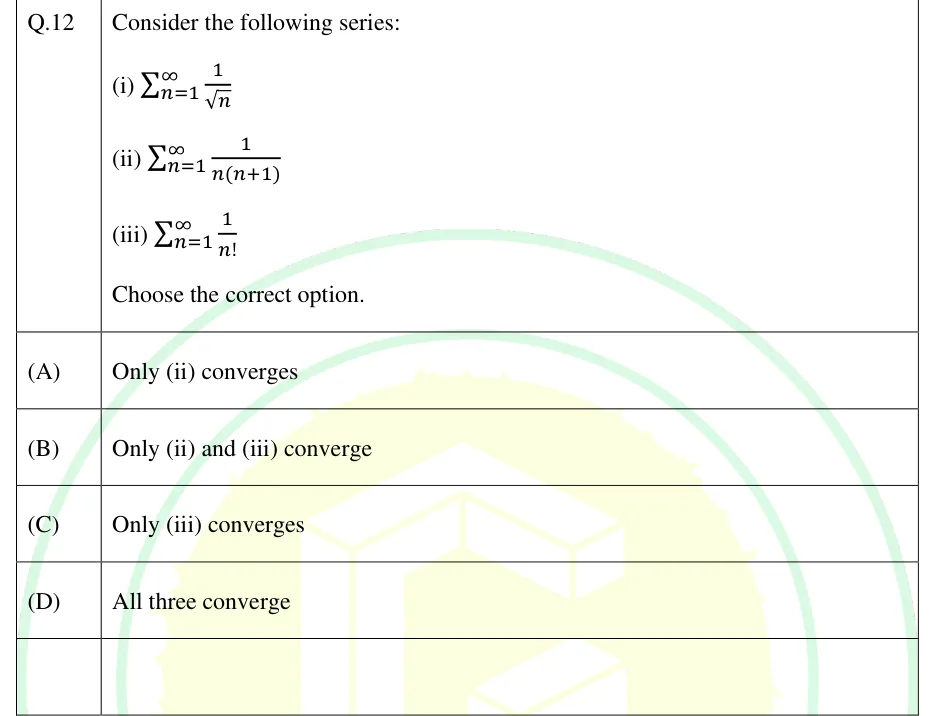
Consider the following series:
(i)
(ii)
(iii)
Choose the correct option.
- (A)
Only (ii) converges
- (B)
Only (ii) and (iii) converge
- (C)
Only (iii) converges
- (D)
All three converge

Consider the following series:
(i)
(ii)
(iii)
Choose the correct option.
Only (ii) converges
Only (ii) and (iii) converge
Only (iii) converges
All three converge
ANSWER
(B) Only (ii) and (iii) converge. Series (i) is a p-series with p = 1/2, so it diverges. Series (ii) telescopes to 1. Series (iii) passes the ratio test and sums to e − 1.
Official answer: BSource: Official answer key, GATE 2025 EC (IIT Roorkee)
Series (i), p-series test: converges only when . Here , so and (i) diverges. Its terms do go to zero, but that alone does not make a series converge.
Series (ii), partial fractions: .
Telescoping partial sum: so (ii) converges (to ). The limit comparison test with () gives the same result, since .
Series (iii), ratio test: , so (iii) converges. From the series for at (with the term, , left out), its sum is .
Only (ii) and (iii) converge, which is option (B).
KEY IDEA
Use a standard test for each series. For , check whether . For , split into partial fractions so the sum telescopes. For , the ratio test works well because consecutive factorials cancel down to .
WATCH OUT FOR
Deciding that (i) converges because . A term going to zero is necessary for convergence but not sufficient. is a p-series with , so it diverges, and choosing option (D) this way is wrong. A second slip is to confuse with the convergent case and treat every series whose terms shrink as convergent.
From the GATE 2025 EC paper. Every question of this paper · Download the full paper · All 39 Calculus questions, with notes