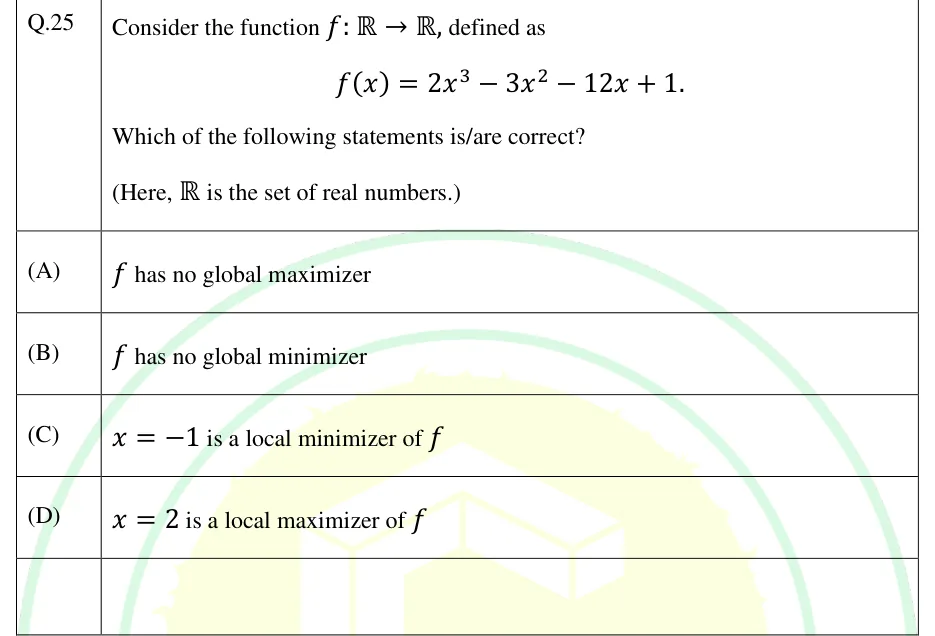
Consider the function , defined as
Which of the following statements is/are correct?
(Here, is the set of real numbers.)
- (A)
has no global maximizer
- (B)
has no global minimizer
- (C)
is a local minimizer of
- (D)
is a local maximizer of

Consider the function , defined as
Which of the following statements is/are correct?
(Here, is the set of real numbers.)
has no global maximizer
has no global minimizer
is a local minimizer of
is a local maximizer of
ANSWER
(A) and (B) are correct. has a local maximum at and a local minimum at , but as a cubic on all of it is unbounded above and below, so it has no global maximizer and no global minimizer.
Official answer: A, BSource: Official answer key, GATE 2025 EC (IIT Roorkee)
Find the stationary points. , so the critical points are and .
Second derivative: .
At : , so is a local maximizer, with . So (C) is false.
At : , so is a local minimizer, with . So (D) is false.
Behaviour on all of : is a cubic with positive leading coefficient, so as and as .
is unbounded above, so no point is a global maximizer. For example , so the local maximum at is not global. So (A) is true.
is unbounded below, so no point is a global minimizer. For example , so the local minimum at is not global. So (B) is true.
Correct options: (A) and (B).
KEY IDEA
A local extremum is global only if the function never goes past it anywhere else in the domain. A polynomial of odd degree on all of goes to at one end and at the other, so it never has a global maximizer or a global minimizer, whatever its local extrema are. To classify the stationary points of , use the sign of .
WATCH OUT FOR
Swapping the local classifications. For a cubic with positive leading coefficient the smaller critical point () is the local maximum and the larger one () is the local minimum. Another mistake is to call a local extremum global without checking the ends of the domain: on a closed interval the cubic would have global extrema, but on it has none.
From the GATE 2025 EC paper. Every question of this paper · Download the full paper · All 39 Calculus questions, with notes