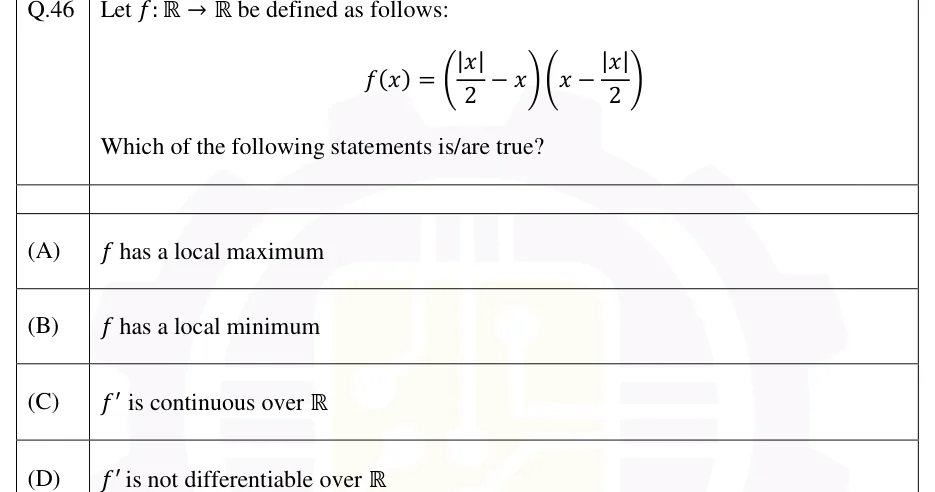
Let be defined as follows:
Which of the following statements is/are true?
- (A)
has a local maximum
- (B)
has a local minimum
- (C)
is continuous over
- (D)
is not differentiable over

Let be defined as follows:
Which of the following statements is/are true?
has a local maximum
has a local minimum
is continuous over
is not differentiable over
ANSWER
The true statements are (A), (C) and (D).
Official answer: A, C, DSource: Official answer key, GATE 2026 CS1 (IIT Guwahati)
The two factors are negatives of each other: . So for all .
For : , so and .
For : , so and .
and for every , so is a local (indeed global) maximum. (A) is true.
For , , and for , . So has no stationary point other than , and no local extremum can occur at any . At the value is a maximum, not a minimum, since nearby. So has no local minimum. (B) is false.
At : the difference quotient is for and for , and both tend to . So . Also as and as , matching . Away from , is a polynomial, hence continuous. So is continuous over . (C) is true.
Differentiability of at : for and for . The one-sided limits differ, so is not differentiable at . (D) is true.
Hence the true statements are (A), (C) and (D).
KEY IDEA
Remove the absolute value by splitting at . The function is a downward parabola piece on each side, with different curvature on the two sides, so is continuous at but has a kink there.
WATCH OUT FOR
Assuming a function with a corner-free graph is smooth. Here from both sides, but the slopes of are and , so does not exist. Another slip is treating the product as a single square with the same coefficient on both sides.
From the GATE 2026 CS1 paper. Every question of this paper · Download the full paper · All 72 Calculus questions, with notes