GATE 2026 EC Q.12
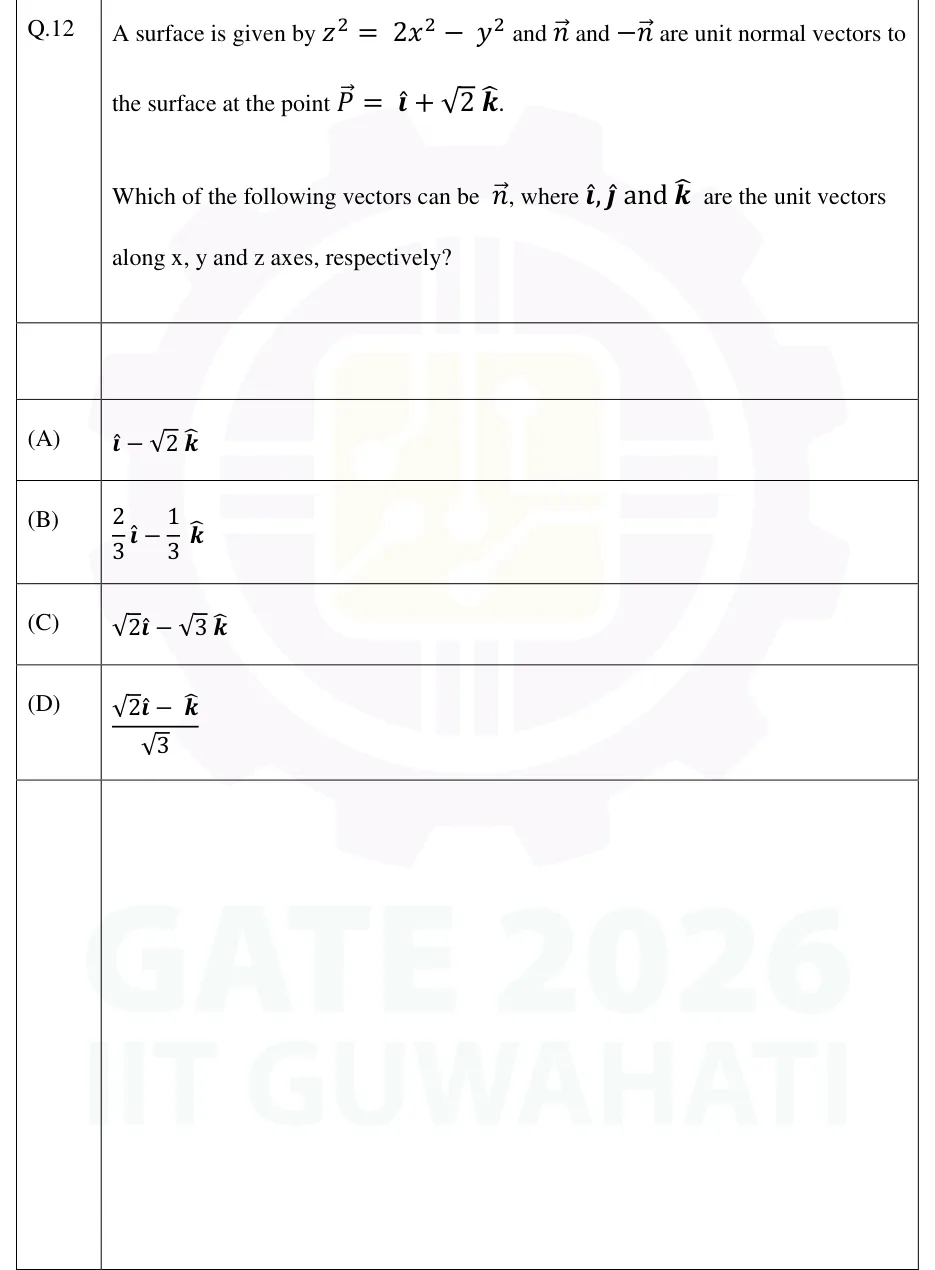
A surface is given by and and are unit normal vectors to the surface at the point .
Which of the following vectors can be , where and are the unit vectors along x, y and z axes, respectively?
- (A)
- (B)
- (C)
- (D)

GATE EC · EE · IN
Gradient, divergence, curl and the integral theorems
Vector calculus extends differentiation and integration to fields: the gradient of a scalar field and the divergence and curl of a vector field measure how a field changes from point to point, and the theorems of Green, Stokes and Gauss convert line, surface and volume integrals into one another. The working skills are three: computing , or at a point, parametrising a line or surface integral, and choosing the theorem (with the right orientation) that turns a hard integral into an easy one.
23 previous-year questions · 23 solved · 7 practice questions
Conventions used throughout. Vectors are bold (). are the unit vectors along the , , axes of a right-handed Cartesian system; the hat on separates it from the imaginary unit , which does not appear in this topic. A vector is written , with magnitude . The position vector of the point is , and .
DOT (SCALAR) PRODUCT
A scalar; is the angle between the vectors. Commutative. For non-zero vectors, means perpendicular. , .
ANGLE, COMPONENT AND PROJECTION
The scalar component of along is signed (negative when ); the vector projection lies along . The direction cosines of a non-zero are , , , and their squares add to 1.
CROSS (VECTOR) PRODUCT
A vector perpendicular to both and , direction by the right-hand rule. Anti-commutative: . is the area of the parallelogram on and . For non-zero vectors, means parallel. , , .
LAGRANGE'S IDENTITY
Follows from ; gives when only magnitudes and the dot product are known.
SCALAR TRIPLE PRODUCT
Unchanged by a cyclic shift, ; changes sign when two vectors are swapped; dot and cross may be interchanged. is the volume of the parallelepiped on the three vectors, and it is zero exactly when they are coplanar (linearly dependent).
VECTOR TRIPLE PRODUCT
The result lies in the plane of and . The cross product is not associative: , which differs in general.
EXAM TIP
Geometry shortcuts: the area of the triangle is ; the volume of the tetrahedron with edges from one vertex is ; four points are coplanar exactly when the triple product of the three edge vectors drawn from one of them is zero.
The del operator is . Applied to a differentiable scalar field it gives the gradient, a vector field. At each point where , points in the direction in which increases fastest, its magnitude is that fastest rate, and it is perpendicular to the level surface through the point. These three facts are all that directional-derivative and normal-vector questions need.
GRADIENT
Defined for a differentiable scalar field. Linear, with and .
DIRECTIONAL DERIVATIVE
Rate of change of per unit distance in the direction of . The direction must be a unit vector, so divide by first. 'From towards the point ' means . 'Along the tangent to the curve at ' means ; 'along the normal to the surface ' means at the point.
MAXIMUM AND MINIMUM RATE OF CHANGE
Because ( = angle between and ), the rate is largest along the gradient, most negative opposite to it, and zero along any direction tangent to the level surface.
UNIT NORMAL TO A SURFACE
Valid where . The sign picks a side; for a closed surface (a sphere, say) the outward normal points away from the enclosed region. For take , so , which points upward.
TANGENT PLANE AND NORMAL LINE
Tangent plane and normal line to at , with the partial derivatives evaluated at and . The plane is . If one partial derivative is zero at , the matching numerator is zero along the line (for example gives ), and the other two ratios are equated.
ANGLE BETWEEN TWO SURFACES
The angle between the surfaces and at a common point is the angle between their normals there, both gradients evaluated at that point. Each normal is fixed only up to sign, so the angle between the surfaces is usually quoted as the acute one: take the absolute value of the numerator. They cut orthogonally when .
GRADIENTS OF RADIAL FUNCTIONS
Valid for . Examples: and .
WORKED EXAMPLE
For , find at : (a) the directional derivative in the direction of ; (b) the maximum directional derivative and its direction; (c) the unit normal to the surface at .
.
At : , and .
(a) , so and . The minus sign means decreases in that direction.
(b) The maximum rate is , along .
(c) lies on the surface, since . The unit normal is .
Answer: (a) ; (b) , along ; (c) .
EXAM TIP
A directional derivative can never exceed in magnitude, so an answer larger than that means the direction vector was not normalised. The direction of fastest decrease is ; the directions of zero change are the ones perpendicular to .
For a vector field with differentiable components, the del operator gives two derivatives. The divergence is a scalar: the net outward flux per unit volume, in the limit of a small volume shrinking to the point; it is positive at a source and negative at a sink. The curl is a vector: its component along a unit vector is the circulation per unit area around a small loop in the plane perpendicular to , traversed by the right-hand rule about , in the limit as the loop shrinks to the point; so it measures local rotation. For a rigid body rotating with constant angular velocity about an axis through the origin, the velocity is and .
DIVERGENCE
A scalar field. ; a constant field has zero divergence.
CURL
A vector field. Expand the determinant along the first row; the term, written here in its cyclic form, is where sign slips happen. .
Field type | Test | Consequence |
|---|---|---|
Solenoidal | throughout the region | Zero net flux out of every closed surface whose enclosed volume lies in the region; on all of , for some vector potential |
Irrotational | throughout the region | Zero circulation around every closed curve that bounds a surface lying in the region; on a simply connected region, |
Conservative | for some scalar | on every path; |
Both solenoidal and irrotational | and | On a simply connected region, with ( harmonic) |
CONSERVATIVE FIELD: EQUIVALENT CONDITIONS
Equivalent for a continuous on any connected open region. If also has continuous first partial derivatives, each implies . The converse, curl zero implies conservative, needs to have continuous first partial derivatives on a simply connected region (every closed curve in it can be shrunk to a point without leaving it).
FUNDAMENTAL THEOREM FOR LINE INTEGRALS
For any piecewise smooth path from to on which is continuously differentiable. Sign convention: here a potential means ; electromagnetics writes , which flips the sign of the potential but not the test.
EXACTNESS TEST IN THE PLANE
On a simply connected region with , continuously differentiable. This is the component of the curl test for .
Finding a scalar potential
Check , all three components. If any component is non-zero, no potential exists.
Integrate with respect to , holding and fixed: .
Differentiate this with respect to , set it equal to , solve for and integrate: .
Differentiate with respect to , set it equal to , and find up to an additive constant.
Check that . The work from to is ; the constant cancels.
WORKED EXAMPLE
Find the constants and for which is irrotational. For these values find a scalar potential, and the work done by along any path from to .
component of the curl: , so .
component: , zero for all only if .
component: already.
Potential: . Then gives , and gives = constant.
So . The field is smooth and irrotational on all of , which is simply connected, so the work is path independent: .
Answer: , , , work .
EXAM TIP
Zero curl is not enough on a region with a hole. has zero curl everywhere except on the -axis, where it is undefined, yet its circulation counter-clockwise around the unit circle is . A region that encircles the -axis is not simply connected, so no single-valued potential exists on it.
Identities replace differentiation. They hold for scalar fields and vector fields with continuous second partial derivatives; the two 'zero' identities rest on the equality of mixed partial derivatives.
THE TWO ZERO IDENTITIES
Every gradient field is irrotational and every curl field is solenoidal. So a field with non-zero divergence cannot be the curl of anything, and a field with non-zero curl cannot be a gradient.
PRODUCT RULES
The order in matters: swapping the factors flips the sign.
DIVERGENCE OF A CROSS PRODUCT
One consequence: is always solenoidal, because both curls on the right are zero.
GRADIENT OF A DOT PRODUCT, CURL OF A CROSS PRODUCT
Here is a scalar operator, applied to each Cartesian component of the field that follows it; it is not the divergence . With the first identity gives .
LAPLACIAN
A scalar. is harmonic when (Laplace's equation). If , then .
CURL OF A CURL
Here , taking the Laplacian component by component; this componentwise rule holds for Cartesian components only. For a solenoidal field it reduces to .
RADIAL FIELDS
Valid for . Special cases: ; and away from the origin.
LAPLACIAN OF A RADIAL FUNCTION
Valid for , for a twice-differentiable function of the distance from the origin. With it gives , the result above. The functions of alone that satisfy Laplace's equation for are exactly .
DIVERGENCE OF A RADIAL FIELD (SPHERICAL COORDINATES)
For a field that points radially and depends only on (the distance from the origin), . The cylindrical analogue for , with the distance from the -axis, is for .
GRADIENT AND DIVERGENCE IN CYLINDRICAL AND SPHERICAL COORDINATES
is the distance from the -axis, the angle from the axis () and the angle around the -axis measured from the axis. (or ) are the components along the local unit vectors, which change direction from point to point; that is why the factors , and appear. Valid away from the -axis (, ). The previous block is the special case in which only or is non-zero.
WORKED EXAMPLE
(a) With and , find and evaluate it at . (b) For which is solenoidal for ?
(a) , with and .
, so .
Direct check: has divergence . At this is .
(b) , which vanishes for only when : the inverse-square field .
Answer: (a) , equal to at ; (b) .
EXAM TIP
Look for an identity before differentiating. and are zero for every and with continuous second partial derivatives, however complicated; so is the flux of out of any closed surface and the circulation of around any closed curve.
A line integral adds up a field along a curve . Parametrise the curve as , , with increasing in the direction of travel; then and the integral becomes an ordinary integral in . If is a force, is the work done along ; around a closed curve, is the circulation.
LINE INTEGRAL OF A VECTOR FIELD
Depends on orientation: reversing the direction of travel changes the sign. It does not depend on which parametrisation is used, as long as the direction is the same.
LINE INTEGRAL WITH RESPECT TO ARC LENGTH
Independent of orientation, because . With it gives the length of ; with a line density it gives the mass of a wire.
STANDARD PARAMETRISATIONS
The circle parametrisation runs counter-clockwise, which keeps the enclosed disc on the left of the direction of travel. For the ellipse use , .
A surface integral of a vector field is its flux: adds the normal component of over the surface. An open surface has two sides and the question must say which normal is meant (for example 'upward'); a closed surface is taken with the outward normal unless stated otherwise. A volume integral is an ordinary triple integral, usually set up in the coordinates that match the solid.
FLUX THROUGH A PARAMETRISED SURFACE
is a normal whose length is the area scale factor, so . If it points to the wrong side, use , which flips the sign. For a scalar , ; with this is the area of , and it does not depend on the side chosen.
SURFACE Z = G(X, Y) OVER A REGION R OF THE XY-PLANE
The flux formula is for the upward normal (); negate it for the downward normal. In general, projecting onto the -plane uses , valid where .
SPHERE AND CYLINDER SURFACE ELEMENTS
Outward normals. is measured from the axis () and around it (). Areas: for the sphere, for the curved side of a cylinder of height .
VOLUME ELEMENTS
Cartesian, cylindrical and spherical. Volumes: sphere , cylinder , cone .
WORKED EXAMPLE
Evaluate for from to (a) along the parabola and (b) along the straight line . Is conservative?
(a) , , so and on the curve.
, so the integral is .
(b) , , , so the integral is .
Two paths with the same end points give different values, so is not conservative. The curl test agrees: .
Answer: (a) ; (b) ; is not conservative.
EXAM TIP
Split a piecewise path (the sides of a triangle or square) into segments, parametrise each with its own in the direction of travel, and add. On a segment where is constant, and the term drops out; likewise for and .
Each integral theorem equates an integral over a region with an integral over its boundary, with a derivative of the field on the region side. Green's theorem links a closed curve in the -plane to the area it encloses. Its orientation convention is counter-clockwise positive: walking along , the region stays on the left. Traverse the other way and the answer changes sign.
GREEN'S THEOREM
is a piecewise smooth simple closed curve bounding , traversed counter-clockwise; , and their first partial derivatives are continuous on an open region containing . Clockwise traversal changes the sign. For a region with holes, the outer boundary runs counter-clockwise and each inner boundary clockwise.
AREA AS A LINE INTEGRAL
Green's theorem with , counter-clockwise. For the ellipse , it gives .
GREEN'S THEOREM, FLUX (NORMAL) FORM
For , with the outward normal to and counter-clockwise: the divergence theorem in two dimensions.
WORKED EXAMPLE
Verify Green's theorem for on the region between and , , with the boundary traversed counter-clockwise.
Counter-clockwise keeps on the left: go out along the lower curve from to , then back along from to .
From the line-integral example above: the parabola gives , and the line traversed backwards gives . So .
Region side: , and .
. Both sides agree.
Answer: .
EXAM TIP
Green's theorem pays off when is simple even though and are not: if it is a constant , the integral is times the enclosed area. Terms such as or (with , continuous) are exact and contribute nothing around a closed curve. To use it on an open path, close the path with a simple segment, apply the theorem to the loop, and subtract the segment's own integral.
EXAM TIP
Common slips: writing instead of ; forgetting the sign change for a clockwise curve; applying the theorem when or blows up inside (as , do at the origin).
Stokes' theorem links the circulation around a closed curve in space to the flux of the curl through any surface spanning that curve; Green's theorem is its special case in the -plane with . Gauss's divergence theorem links the outward flux through a closed surface to the volume integral of the divergence inside it. In both, the orientation is part of the statement.
STOKES' THEOREM
is a piecewise smooth oriented surface whose boundary is the closed curve ; has continuous first partial derivatives on a region containing . Right-hand rule: with the thumb along , the fingers curl in the direction of (for , runs counter-clockwise seen from above). Every surface that meets these conditions and has the same boundary and orientation gives the same value.
GAUSS'S DIVERGENCE THEOREM
is a closed piecewise smooth surface enclosing the volume , is the outward unit normal, and has continuous first partial derivatives throughout (no singularity inside).
Theorem | Converts | Orientation | Use it when |
|---|---|---|---|
Green | closed line integral in the plane double integral over the enclosed region | counter-clockwise, region on the left | the path has several pieces, or is simple (often a constant) |
Stokes | circulation around a closed space curve flux of the curl through any spanning surface | right-hand rule linking and | the curl is simple, or a curved spanning surface can be swapped for a flat one (or for the boundary curve) |
Gauss | flux through a closed surface volume integral of the divergence | outward normal | the surface has several faces (cube, cylinder) or the divergence is simple; for an open surface, close it with flat caps and subtract their flux |
WORKED EXAMPLE
Find the outward flux of (a) through the whole closed surface of the solid cylinder , , and (b) through its curved side only.
(a) , a constant, so by Gauss's theorem the flux is .
(b) Subtract the flat caps from the closed-surface total. Top (, ): over area , flux . Bottom (, ): , flux .
Curved side: .
Direct check: on , , so over area , giving .
Answer: (a) ; (b) .
WORKED EXAMPLE
Let and let be the paraboloid , , with upward normal. Find .
.
The boundary of is the circle , , and the upward normal makes it counter-clockwise seen from above. is smooth everywhere, so by Stokes' theorem every surface with this boundary and orientation carries the same flux of the curl: replace the paraboloid with the flat disc , , .
On the disc , so the flux equals the disc's area, .
Check with the circulation: gives and , so .
Answer: .
EXAM TIP
Results with no computation: the flux of a constant vector field out of any closed surface is 0; the flux of out of a closed surface is (so for a sphere of radius ); the flux of out of any closed surface is 0; and a constant divergence gives outward flux volume.
EXAM TIP
Check for singularities before applying Gauss's theorem. For , everywhere except the origin, yet the outward flux through any sphere centred at the origin is (on , over area ). The theorem does not apply to a volume containing the origin; through a closed surface that does not enclose the origin, the flux is 0.
PREVIOUS-YEAR QUESTIONS
Try each question first, then open the answer. We placed each question under a topic ourselves; the exam paper does not label topics.
See these papers in full: GATE ECE 2026 · GATE ECE 2024 · GATE ECE 2023 · GATE ECE 2022 · GATE ECE 2020 · GATE EE 2026 · GATE EE 2025 · GATE EE 2024 · GATE EE 2023 · GATE EE 2022 · GATE EE 2020 · GATE EE 2018 · GATE IN 2025 · GATE IN 2024 · GATE IN 2020 · GATE IN 2018
A surface is given by and and are unit normal vectors to the surface at the point .
Which of the following vectors can be , where and are the unit vectors along x, y and z axes, respectively?
Given that , the integral over the unit sphere centered at the origin evaluates to ________ (Round off to one decimal place)
Let . The rate of change of the real valued function,
at the origin in the direction of the point is ________ (round off to the nearest integer).
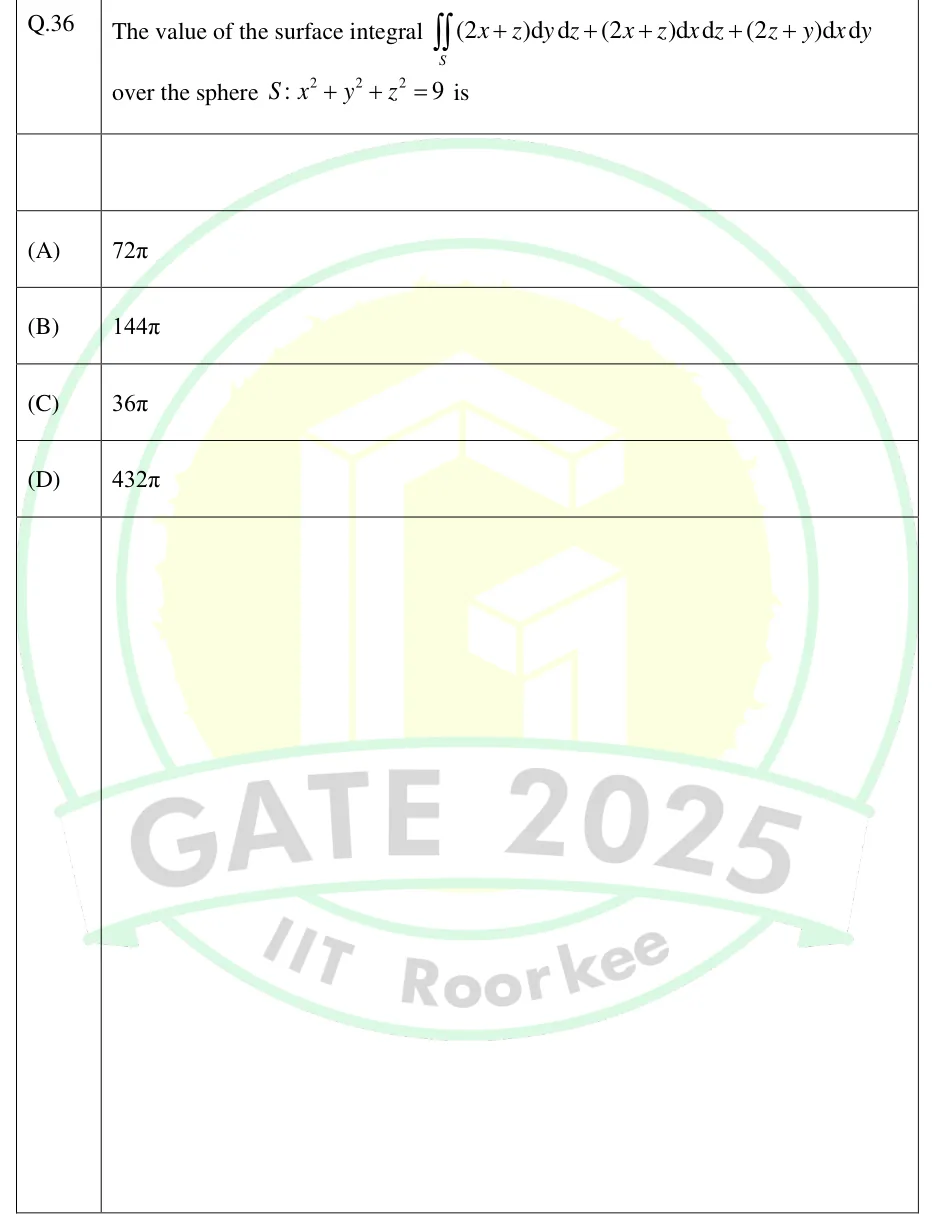
The value of the surface integral over the sphere is
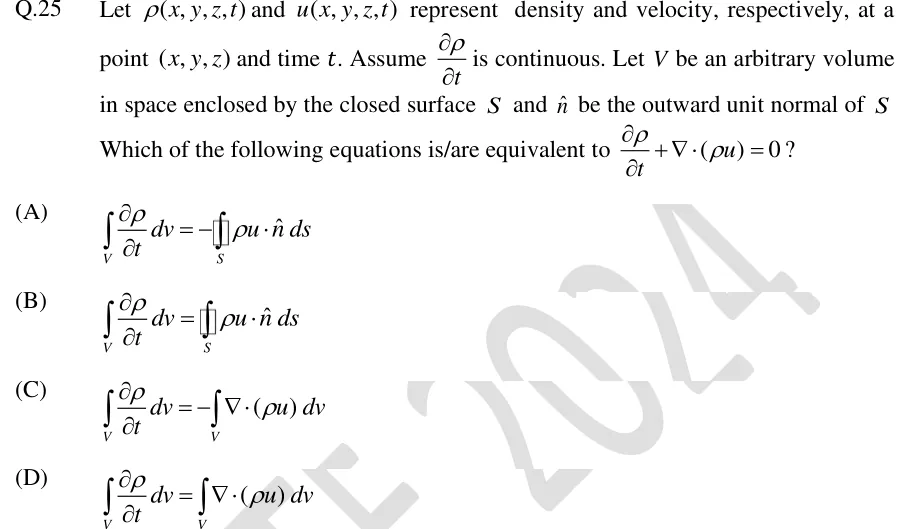
Let and represent density and velocity, respectively, at a point and time . Assume is continuous. Let be an arbitrary volume in space enclosed by the closed surface and be the outward unit normal of . Which of the following equations is/are equivalent to ?
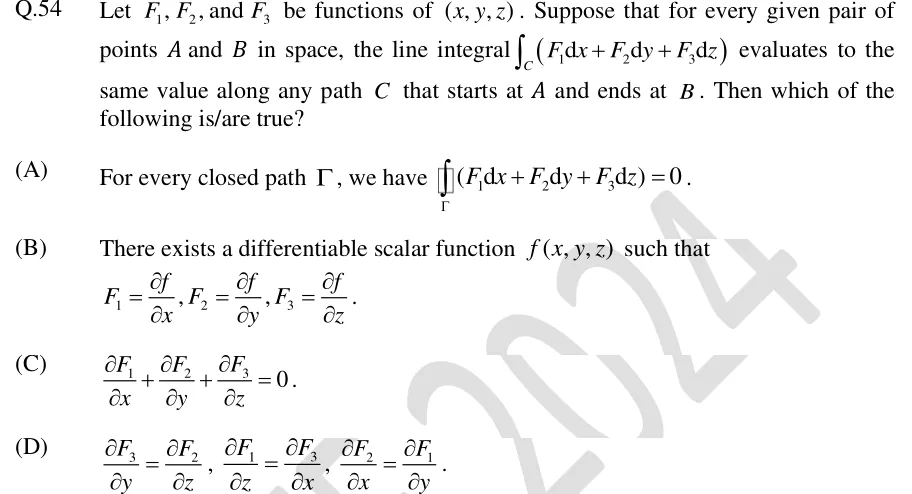
Let , , and be functions of . Suppose that for every given pair of points and in space, the line integral evaluates to the same value along any path that starts at and ends at . Then which of the following is/are true?
For every closed path , we have .
There exists a differentiable scalar function such that .
.
.
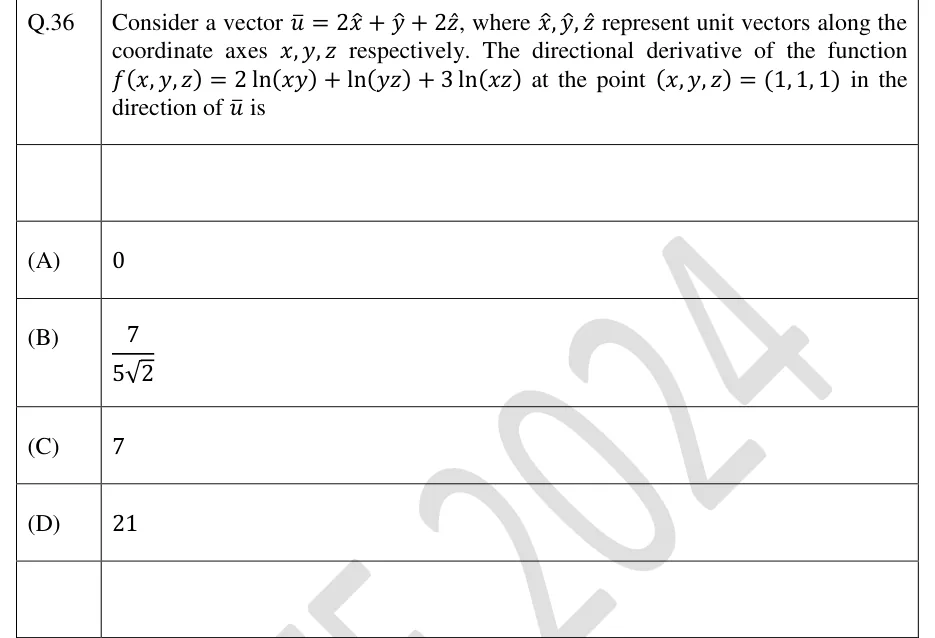
Consider a vector , where represent unit vectors along the coordinate axes respectively. The directional derivative of the function at the point in the direction of is
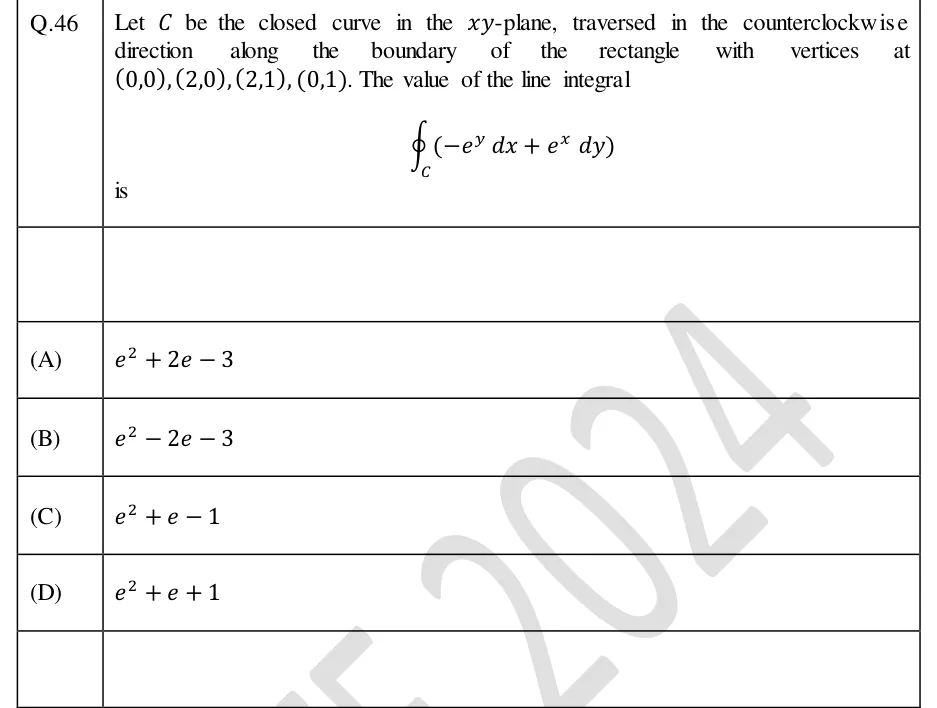
Let be the closed curve in the -plane, traversed in the counterclockwise direction along the boundary of the rectangle with vertices at . The value of the line integral
is
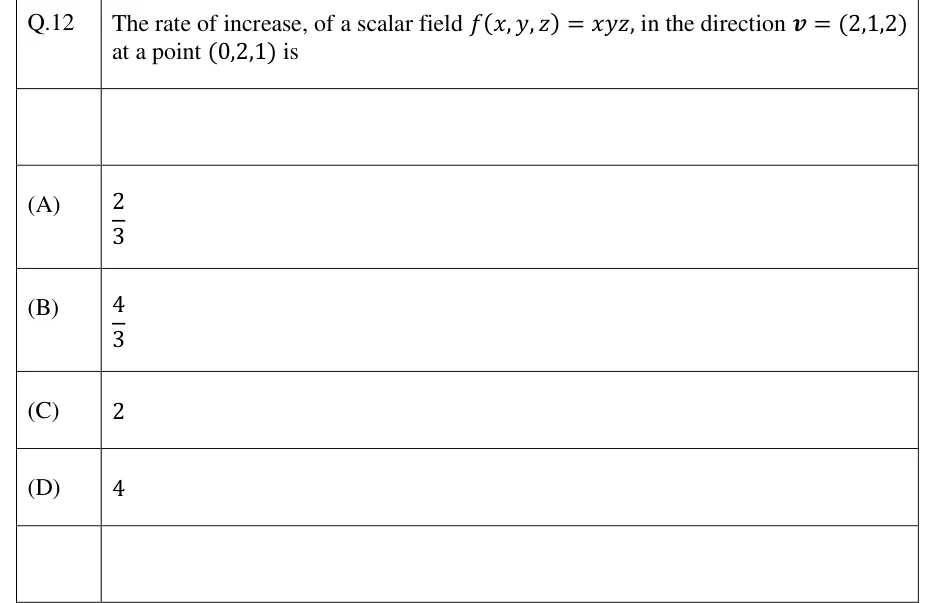
The rate of increase, of a scalar field , in the direction at a point is
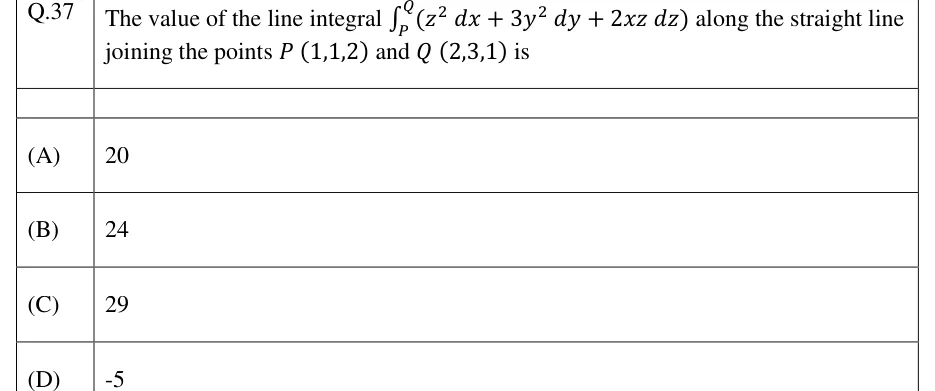
The value of the line integral along the straight line joining the points and is
20
24
29
-5
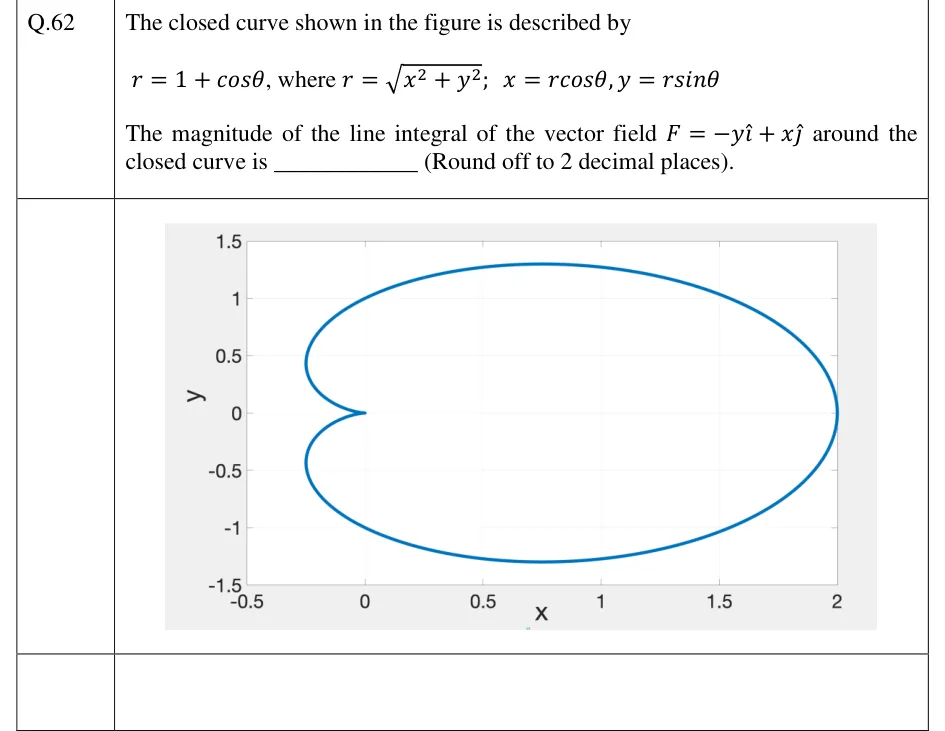
The closed curve shown in the figure is described by
, where ; ,
The magnitude of the line integral of the vector field around the closed curve is ______ (Round off to 2 decimal places).
 Tap to open full size
Plot of a cardioid on x-y axes. The horizontal axis is labelled x, with ticks at -0.5, 0, 0.5, 1, 1.5, 2. The vertical axis is labelled y, with ticks at -1.5, -1, -0.5, 0, 0.5, 1, 1.5. The closed blue curve is the cardioid r = 1 + cos(theta). It has a cusp pointing inward at the origin (0, 0), its rightmost point at (2, 0), top and bottom extremes at about y = +1.3 and y = -1.3 near x = 0.75, and leftmost bulges at about x = -0.25 near y = +0.5 and y = -0.5. The curve is symmetric about the x-axis.
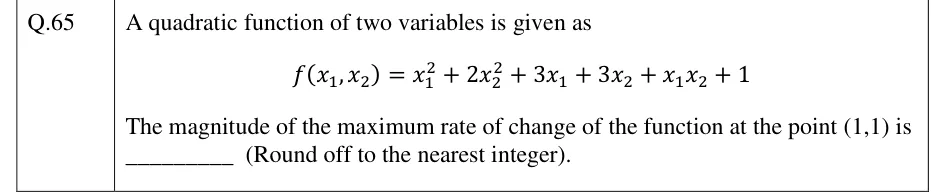
A quadratic function of two variables is given as
The magnitude of the maximum rate of change of the function at the point is ________ (Round off to the nearest integer).
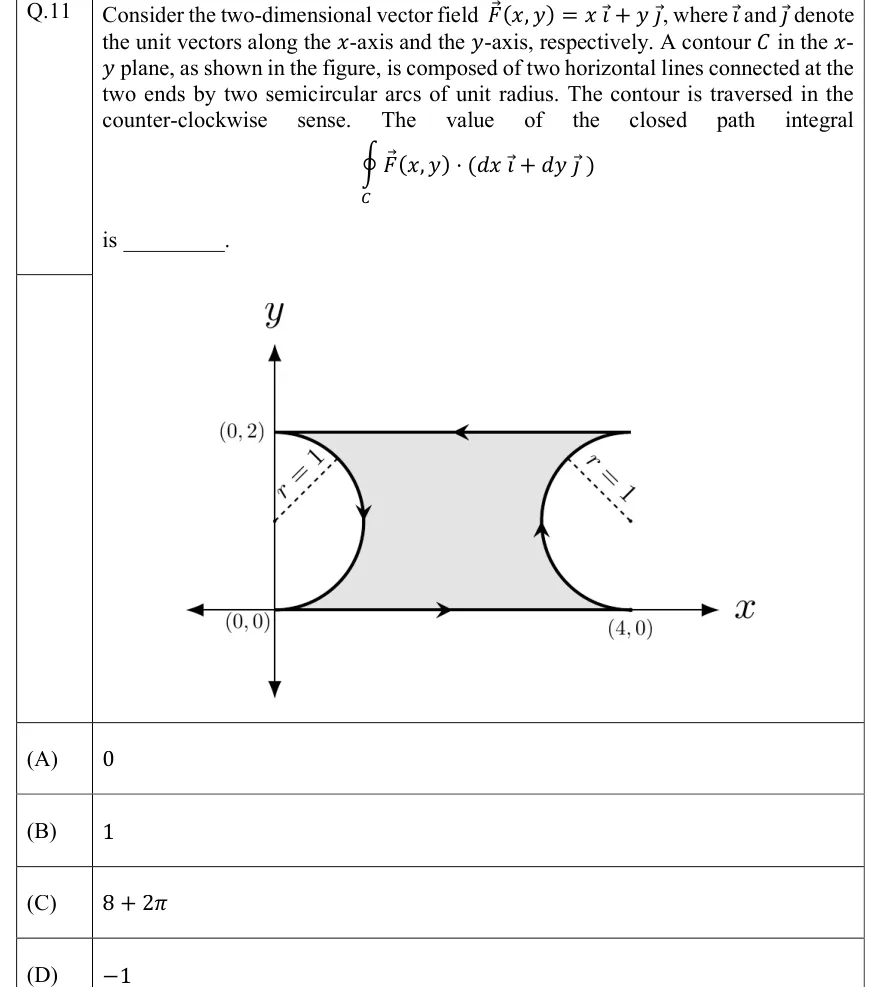
Consider the two-dimensional vector field , where and denote the unit vectors along the -axis and the -axis, respectively. A contour in the - plane, as shown in the figure, is composed of two horizontal lines connected at the two ends by two semicircular arcs of unit radius. The contour is traversed in the counter-clockwise sense. The value of the closed path integral
is ________.
 Tap to open full size
x-y axes with the origin marked (0,0). A closed contour C encloses a shaded region. Bottom edge: a straight segment along the x-axis from (0,0) to (4,0), with an arrow pointing right (+x). Right end: a semicircular arc of radius r = 1 centred at (4,1), bulging inward (to the left, towards the region), joining (4,0) to (4,2), with an arrow pointing upward. Top edge: a straight horizontal segment from (4,2) to (0,2), with an arrow pointing left (-x). Left end: a semicircular arc of radius r = 1 centred at (0,1), bulging inward (to the right), joining (0,2) to (0,0), with an arrow pointing downward. Each arc has a dashed radius line labelled r = 1. Labelled points: (0,2), (0,0), (4,0). The shaded region lies between the two horizontal lines and the two inward-bulging arcs; the overall sense of traversal is counter-clockwise.
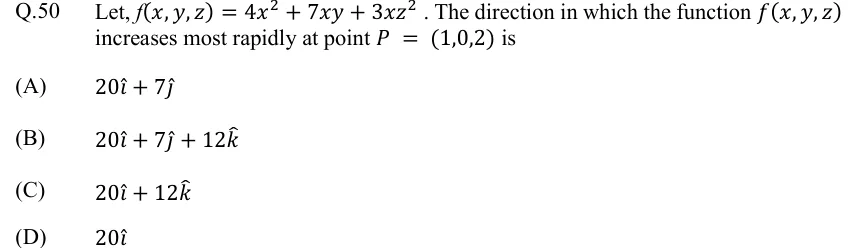
Let, . The direction in which the function increases most rapidly at point is
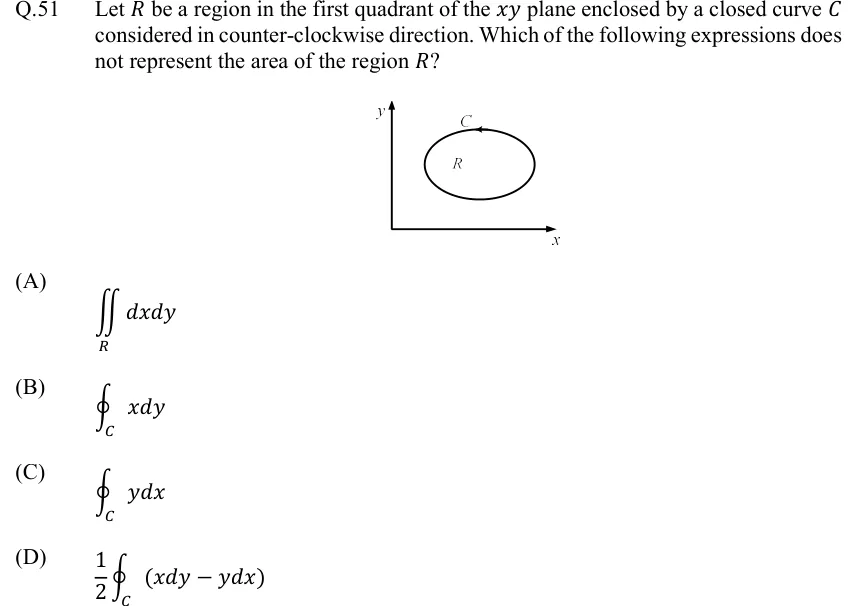
Let be a region in the first quadrant of the plane enclosed by a closed curve considered in counter-clockwise direction. Which of the following expressions does not represent the area of the region ?
 Tap to open full size
The positive x and y axes meeting at the origin (first quadrant only). In the first quadrant, away from both axes, sits a closed oval curve labelled C with an arrowhead at its top pointing left, so the curve is traversed counter-clockwise. The inside of the oval is labelled R.
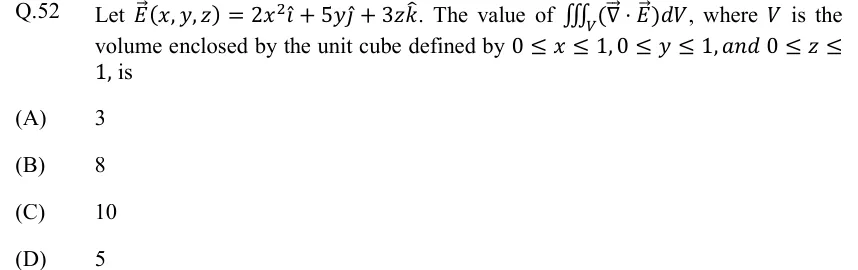
Let . The value of , where is the volume enclosed by the unit cube defined by , and , is
3
8
10
5
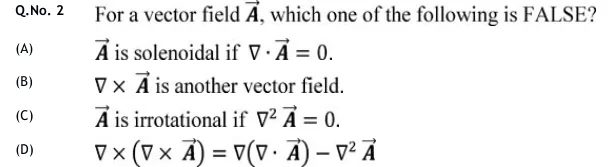
For a vector field , which one of the following is FALSE?
is solenoidal if .
is another vector field.
is irrotational if .
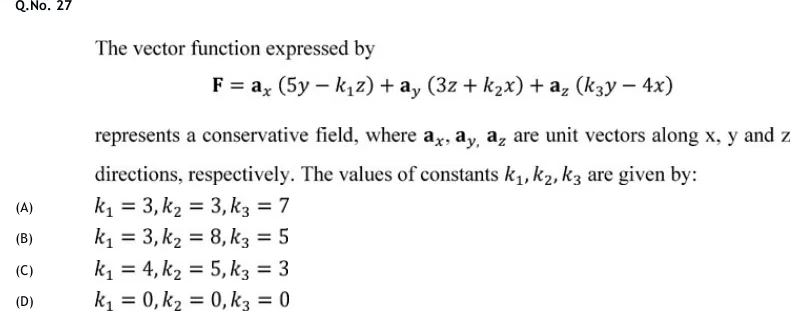
The vector function expressed by
represents a conservative field, where are unit vectors along x, y and z directions, respectively. The values of constants are given by:
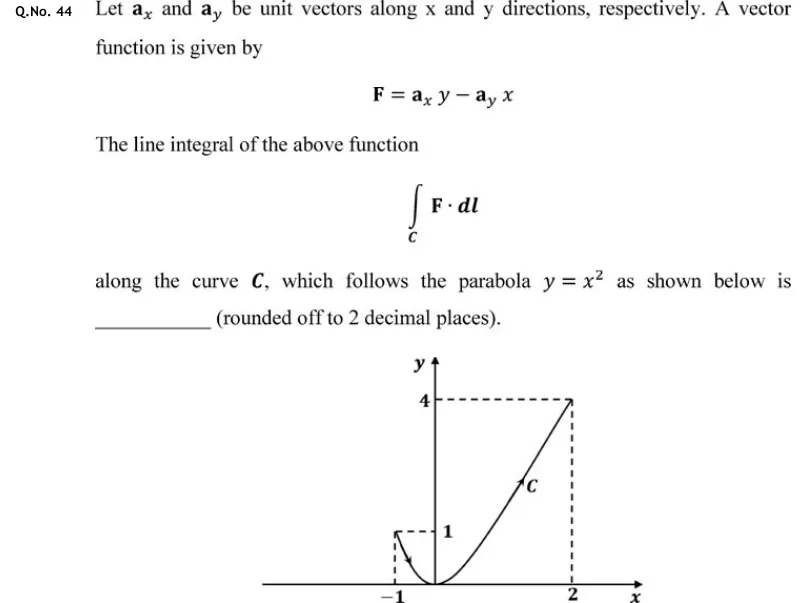
Let and be unit vectors along x and y directions, respectively. A vector function is given by
The line integral of the above function
along the curve , which follows the parabola as shown below is ________ (rounded off to 2 decimal places).
 Tap to open full size
x-y axes with the parabola y = x^2 drawn from the point (-1, 1) down through the origin (0, 0) and up to the point (2, 4). The curve is labelled C. An arrowhead near (-1, 1) points down along the curve toward the origin, and a second arrowhead on the right branch, beside the label C, points up toward (2, 4), so the curve is traversed from (-1, 1) to (2, 4). Dashed guide lines: a horizontal dashed line at y = 1 from the y-axis to x = -1 with a vertical dashed line from x = -1 on the x-axis up to it; a horizontal dashed line at y = 4 from the y-axis to x = 2 with a vertical dashed line from x = 2 on the x-axis up to (2, 4). Axis tick labels: -1 and 2 on the x-axis, 1 and 4 on the y-axis.
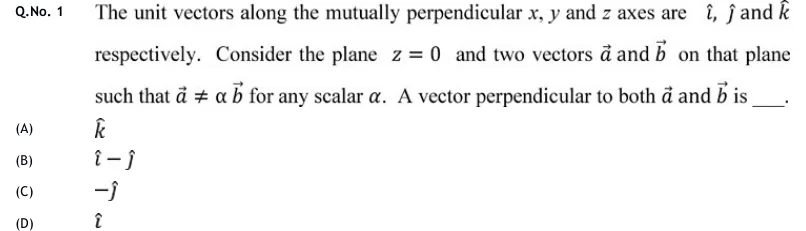
The unit vectors along the mutually perpendicular , and axes are , and respectively. Consider the plane and two vectors and on that plane such that for any scalar . A vector perpendicular to both and is ____.
The value of the directional derivative of the function at the point in the direction of the vector is
1
0.95
0.93
0.9
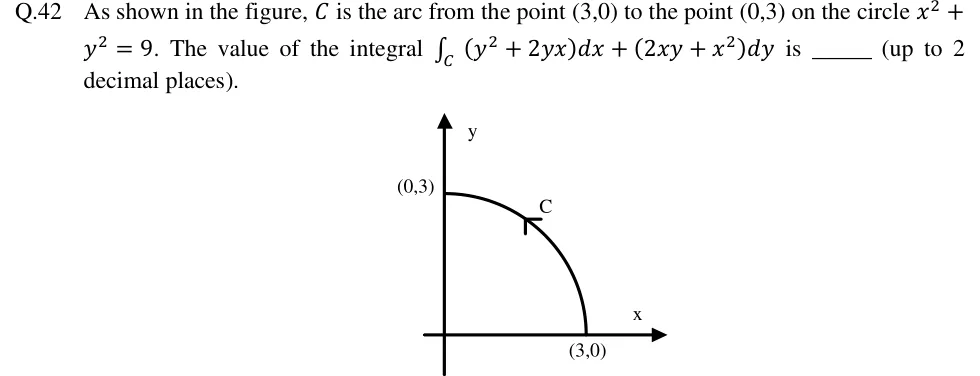
As shown in the figure, is the arc from the point to the point on the circle . The value of the integral is ______ (up to 2 decimal places).
 Tap to open full size
The first quadrant of the x-y plane, with the x-axis pointing right and the y-axis pointing up. A quarter-circle arc labelled C runs from the point (3,0) on the x-axis to the point (0,3) on the y-axis. It is the part of the circle x^2 + y^2 = 9 that lies in the first quadrant. An arrowhead on the arc points counterclockwise, from (3,0) towards (0,3).
Given , the value of the line integral along the straight line from to is
PRACTICE
The area of the triangle with vertices , and is ______ (rounded off to one decimal place).
Answer: (accepted range )
Edge vectors from : and .
.
.
Area .
Which one of the following vector fields is both solenoidal and irrotational everywhere in ? ( are the Cartesian unit vectors.)
Answer: (C)
A: divergence , curl : irrotational only.
B: divergence , curl : solenoidal only.
C: divergence and curl : both. It is , and .
D: curl , but divergence is not identically zero: irrotational only.
The directional derivative of at the point , in the direction of the vector , is ______ (rounded off to two decimal places).
Answer: (accepted range )
.
At : .
, so .
.
For the vector field , which of the following statements is/are correct?
everywhere.
everywhere.
satisfies .
along every path from to .
Answer: (A), (C)
Curl, : ; : ; : . A is correct.
Divergence: , not identically zero. B is wrong.
. C is correct.
The integral is path independent and equals , not 2. D is wrong.
Let be the curved (lateral) surface of the cylinder , , oriented by the unit normal pointing away from the -axis; the flat top and bottom discs are NOT part of . For , the flux is ______ (rounded off to two decimal places).
Answer: (accepted range )
Close with the top disc (, ) and the bottom disc (, ), and apply Gauss's theorem to the solid cylinder.
. Total outward flux .
Top: over area , flux . Bottom: , flux .
Flux through . Direct check: on , , and .
Let be the boundary of the triangle with vertices , and , traversed in that order. For , the value of is ______ (rounded off to two decimal places).
Answer: (accepted range )
.
The triangle lies in the plane . The traversal order fixes the normal by the right-hand rule: , so , and the triangle's area is .
By Stokes' theorem, .
Direct check: on the first side , , and , giving . The field and the triangle are unchanged by the cyclic swap , so each of the three sides gives : total .
Let be the ellipse traversed once CLOCKWISE. The value of is
Answer: (B)
and have continuous first partial derivatives everywhere, so Green's theorem applies. The terms and are exact and contribute nothing around a closed curve.
.
Counter-clockwise, the integral would be .
is clockwise, so the sign flips: . (The options come from the slip .)
OFFICIAL GATE 2027 SYLLABUS WORDING
Copied from the GATE 2027 syllabus; see all 2027 syllabi.
GATE EC
line, surface and volume integrals … Vector Analysis: Vectors in plane and space, vector operations, gradient, divergence and curl, Gauss's, Green's and Stokes’ theorems
GATE EE
Vector identities, Directional derivatives, Line integral, Surface integral, Volume integral, Stokes’s theorem, Gauss’s theorem, Divergence theorem, Green’s theorem
GATE IN
vector algebra, line, surface and volume integrals, Stokes, Gauss and Green’s theorems
Preparing in Kolkata? IAE Academy's course for GATE ECE, GATE EE or GATE IN.