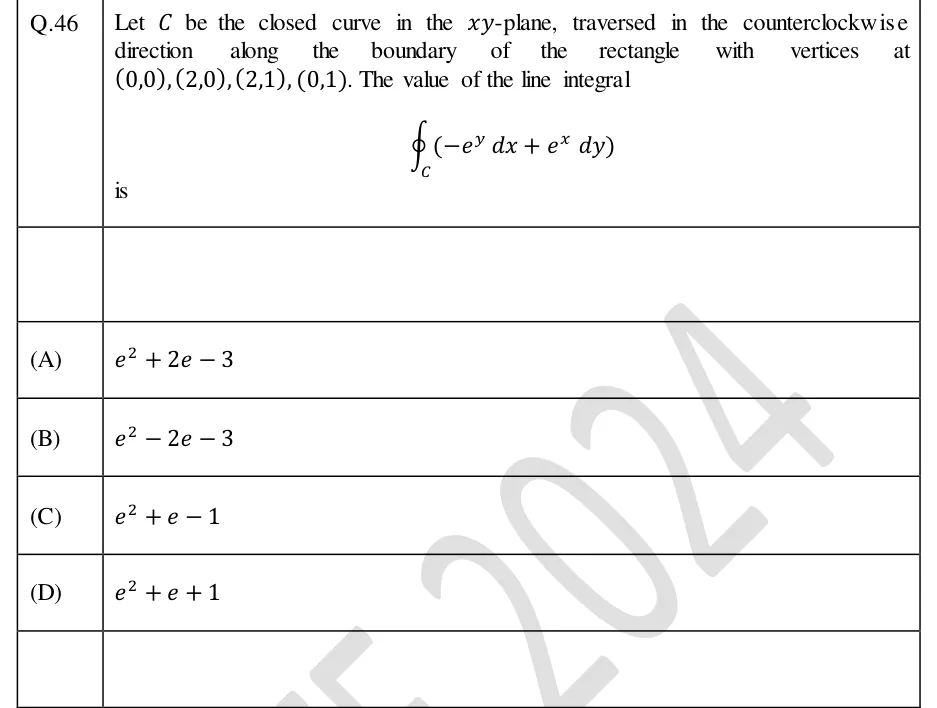
Let be the closed curve in the -plane, traversed in the counterclockwise direction along the boundary of the rectangle with vertices at . The value of the line integral
is
- (A)
- (B)
- (C)
- (D)

Let be the closed curve in the -plane, traversed in the counterclockwise direction along the boundary of the rectangle with vertices at . The value of the line integral
is
ANSWER
The line integral equals , which is option (A).
Official answer: ASource: Official answer key, GATE 2024 IN (IISc Bengaluru)
Write the integral as with and . is the boundary of the rectangle, a simple closed curve traversed counterclockwise, and , have continuous partial derivatives everywhere, so Green's theorem applies:
Partial derivatives: and , so the integrand is .
The region is the rectangle . Split the double integral into two parts:
First term: .
Second term: .
Add them: . This is option (A).
Check with the direct line integral. On the bottom edge (, : , ) the integral is . On the right edge (, : , ) it is . On the top edge (, : , ) it is . On the left edge (, : , ) it is . The total is , which agrees.
KEY IDEA
Green's theorem turns a counterclockwise line integral around a closed curve into the double integral of over the region inside it. Here the integrand splits into two parts, and over a rectangle each part is a product of two one-variable integrals.
WATCH OUT FOR
Losing the minus sign on . Doing so gives the integrand and the value , which is not among the options. A second mistake is using the wrong side lengths: the term has to be multiplied by the -width (2), and the term by the -height (1). Swapping them gives .
From the GATE 2024 IN paper. Every question of this paper · Download the full paper · All 23 Vector calculus questions, with notes