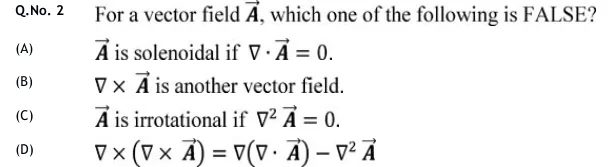
For a vector field , which one of the following is FALSE?
- (A)
is solenoidal if .
- (B)
is another vector field.
- (C)
is irrotational if .
- (D)

For a vector field , which one of the following is FALSE?
is solenoidal if .
is another vector field.
is irrotational if .
ANSWER
Option (C) is FALSE. A field is irrotational when , not when .
Official answer: CSource: Official answer key, GATE 2020 EC (IIT Delhi)
Check each statement against its definition. We want the one that is FALSE.
(A) By definition, a field is solenoidal (divergence-free) when . TRUE.
(B) The curl has three components, so it is itself a vector field. TRUE.
(C) By definition, a field is irrotational when its curl vanishes: . The condition is Laplace's equation, which makes each component harmonic. It is not the irrotationality condition. FALSE.
Counter-example for (C): take . Every second derivative of is zero, so . But the component of the curl is , so and the field is not irrotational.
It fails the other way too. has , since depends only on and . So it is irrotational, but . The Laplacian condition is neither sufficient nor necessary for irrotationality.
(D) This is the standard curl-of-curl identity, , where is the vector Laplacian. TRUE.
The only false statement is (C).
KEY IDEA
Each field condition belongs to one operator. Solenoidal means (divergence). Irrotational means (curl). Harmonic means (Laplacian). The curl-of-curl identity is standard. Neither of the last two conditions implies the other: is harmonic but not irrotational, and is irrotational but not harmonic.
WATCH OUT FOR
Taking for the irrotational condition because it looks like it involves the curl through the identity in (D). It doesn't: is Laplace's equation, and is what makes a field irrotational. Another trap is picking (D) because of its sign. The minus sign in front of is correct.
From the GATE 2020 EC paper. Every question of this paper · Download the full paper · All 23 Vector calculus questions, with notes