IAE Academy

GATE EC · EE · IN

Differential equations

A differential equation relates an unknown function to its derivatives. In a GATE question you usually have to classify the equation, choose the method that fits it, and fix the constants from initial or boundary conditions. These notes cover first-order methods (separable, homogeneous, exact, linear, Bernoulli, Clairaut), linear equations with constant coefficients (complementary function, particular integral, variation of parameters, reduction of order), Cauchy-Euler equations, IVPs and BVPs with their existence and uniqueness conditions, and separation-of-variables solutions of first-order PDEs and of the heat, wave and Laplace equations.

19 previous-year questions · 19 solved · 6 practice questions

Classifying an ODE: order, degree, linearity

Conventions used throughout. , , is the imaginary unit, and is the natural logarithm. An ordinary differential equation (ODE) has one independent variable. A partial differential equation (PDE) has two or more. Wherever appears, take unless stated otherwise (for , replace by ). All coefficients are real unless stated otherwise.

The order of an ODE is the order of the highest derivative in it. The degree is the power of that highest-order derivative after the equation has been cleared of radicals and fractions in the derivatives, so that it is a polynomial in . If the equation cannot be made a polynomial in the derivatives (for example ), the degree is not defined.

LINEAR ODE OF ORDER N

Linear means and every derivative appear only to the first power, are never multiplied together, and never sit inside another function. The coefficients may depend on only, and the equation has order wherever . The equation is homogeneous when and non-homogeneous otherwise.

Equation

Order

Degree

Linear?

3

1

Yes (variable coefficients are allowed)

2

1

No:

2

1

No: the product

1

2

No:

1

2 (multiply by : )

No

2

2 (square both sides)

No

2

Not defined

No

  1. The general solution of an th-order ODE contains exactly independent (essential) arbitrary constants. A particular solution fixes them from given conditions. Conversely, eliminating essential constants from a family gives an th-order ODE. For example, gives .

  2. A singular solution satisfies the ODE but no choice of constants produces it from the general solution. For a linear ODE whose coefficients and are continuous and whose leading coefficient is non-zero on an interval, the general solution contains every solution on that interval, so singular solutions are met with nonlinear equations (for example Clairaut's equation, in the next section).

  3. Superposition: if and solve a linear homogeneous ODE, so does . It fails for non-homogeneous and nonlinear equations.

  4. For a linear non-homogeneous ODE, the general solution is the complementary function (the general solution of the homogeneous equation) plus any one particular integral: .

EXAM TIP

Two traps. (1) A nonlinear equation can still have degree 1. Degree looks only at the highest derivative, while linearity looks at every term: has degree 1 and is nonlinear. (2) 'Homogeneous' has two meanings. A first-order equation is homogeneous in the sense of homogeneous functions. A linear equation is homogeneous when . Check which meaning the question uses.

First-order equations

A first-order equation is written or . Test the standard forms roughly in this order: separable, homogeneous, exact, linear, Bernoulli. Use the first one that fits. The general solution has one arbitrary constant, which one initial condition fixes.

VARIABLES SEPARABLE

Valid where . Each root of is a separate constant solution, and dividing by can lose it (sometimes it reappears for a particular value of the constant). For , substitute to get the separable equation .

HOMOGENEOUS FIRST-ORDER EQUATION

Applies when is unchanged by , that is, when and are homogeneous functions of the same degree. It uses . Valid where ; each root of gives the straight-line solution .

EQUATIONS REDUCIBLE TO HOMOGENEOUS FORM

If , put , , where solves and . The equation becomes , which is homogeneous. If , the two linear expressions are proportional apart from their constants, so the right-hand side is a function of one combination . Substitute as in the separable case above.

EXACT EQUATION

The test holds on a simply connected region where , and their first partial derivatives are continuous. The solution is , where and . The shortcut on the right needs written without hidden -free parts (write , not ). The safe route is with .

INTEGRATING FACTORS FOR A NON-EXACT EQUATION

Multiply the whole equation by to make it exact. Two more rules: if and are homogeneous of the same degree and , then ; if and with , then .

LINEAR FIRST-ORDER EQUATION

First divide by the coefficient of so that it becomes 1. keeps its sign. If the equation is linear in instead, , use IF and .

BERNOULLI EQUATION

Divide by first. The substitution turns the equation into a linear one in . When , is also a solution, which the division by loses.

CLAIRAUT'S EQUATION

Differentiating gives . The factor gives the general solution, the family of straight lines (replace by ). The factor , with eliminated between it and the equation, gives the singular solution, which is the envelope of those lines. Example: has general solution ; gives the singular solution .

ORTHOGONAL TRAJECTORIES

Form the family's ODE with the parameter eliminated, make the replacement, then solve. Example: gives . The trajectories satisfy , which gives the ellipses .

WORKED EXAMPLE

Solve for .

Solution
  1. and , so and . The equation is not exact.

  2. depends on alone, so .

  3. Multiplying by gives . Now , so it is exact.

  4. (with constant) . has no terms free of .

  5. So . Multiply by 12 and rename the constant.

Answer: , where is an arbitrary constant.

WORKED EXAMPLE

Solve , , with , and find .

Solution
  1. This is Bernoulli with , and . Put .

  2. The linear equation is , that is, .

  3. IF , so and .

  4. gives , so . Hence and .

  5. .

Answer: (valid for ), so .

EXAM TIP

Three checks. (1) Put a linear equation in standard form before reading off . For , and IF , not . (2) For , and . (3) If you divide by to separate variables, check whether the given initial condition needs one of the constant solutions .

Linear ODEs with constant coefficients: complementary function and Wronskian

Write the equation as with real constant coefficients . The complementary function solves . Trying turns the ODE into the auxiliary (characteristic) equation . An th-order equation has roots, counted with multiplicity, and has arbitrary constants. Because the coefficients are real, complex roots occur in conjugate pairs .

STRUCTURE OF THE SOLUTION

comes from the roots of and is the general solution of . is any one solution of the full equation.

Roots of the auxiliary equation

Contribution to

Real and distinct:

Real , repeated times

Complex pair

Complex pair , repeated twice

WRONSKIAN

For functions, use the determinant whose rows are the functions and their derivatives up to order . If at some point of an interval, the functions are linearly independent on that interval.

ABEL'S FORMULA

Divide by the coefficient of first so that it is 1. Holds for two solutions of a linear homogeneous ODE with continuous on an interval. There is either identically zero (the solutions are dependent) or never zero (they are independent and form a fundamental set).

REDUCTION OF ORDER

Gives a second, independent solution on an interval where . It follows from Abel's formula, because . Example: () has . Dividing by gives , so and .

Pair of functions

Wronskian

WORKED EXAMPLE

A linear homogeneous ODE with constant coefficients has the general solution . Find the ODE.

Solution
  1. There are three constants, so the order is 3. The constant gives the root , and , give .

  2. The quadratic with roots is .

  3. The auxiliary equation is .

  4. Replace each by the th derivative of .

Answer: .

EXAM TIP

(1) Every solution tends to 0 as exactly when every root has a negative real part. A simple root with zero real part gives a bounded solution (a constant or a pure oscillation). A repeated root with zero real part gives an unbounded one, such as or , and any root with a positive real part gives an unbounded one. (2) For arbitrary functions the Wronskian test works in one direction only. somewhere proves independence, but proves dependence only for solutions of one linear ODE. For example, and have yet are independent on . (3) For , the roots add to and multiply to , which quickly checks a factorisation.

Particular integral: operator method, undetermined coefficients, variation of parameters

The particular integral is , where is the inverse of . means integrate (with no constant), and . The shortcuts below cover the standard right-hand sides. Use variation of parameters for any other (such as , , or ) and for variable coefficients once two independent solutions are known.

PI FOR AN EXPONENTIAL

Replace by . This also covers a constant () and or written as exponentials.

PI FOR AN EXPONENTIAL WHEN A IS A ROOT

Differentiate with respect to times. For a simple root this gives , and for a double root .

PI FOR SIN AX AND COS AX

Replace by . Never replace itself. If odd powers of remain, as in , multiply numerator and denominator by so that appears. Replace it by again, then apply the now in the numerator as a derivative.

PI FOR SIN AX AND COS AX AT RESONANCE (D^2 + A^2 = 0)

Used when are roots of the auxiliary equation, so that . Note the minus sign in the sine case.

PI FOR A POLYNOMIAL

Take out any factor first. Then write the rest as , expand in ascending powers of , and stop at , because higher derivatives of vanish. Example: .

EXPONENTIAL SHIFT

Move to the left and replace by . Then handle (a polynomial, sine or cosine) with the rules above. This covers and .

PI FOR X TIMES V

Use for or . Alternatively, write as the imaginary part of and use the exponential shift.

Term in

Trial (before the modification rule)

A polynomial of degree

or

or

or

  1. Undetermined coefficients, sum rule: for , find a particular integral for each term and add them.

  2. Modification rule: if any term of the trial form already appears in (it solves the homogeneous equation), multiply the trial form by . Use if the corresponding root is double, and for multiplicity .

  3. Substitute the trial form into the ODE and equate the coefficients of like terms to find the constants.

  4. The method needs constant coefficients and an built only from the forms in the table.

VARIATION OF PARAMETERS

For with the coefficient of equal to 1, so divide through first. and are independent solutions of the homogeneous equation. It works for any continuous on an interval where and are continuous.

WORKED EXAMPLE

Find the general solution of .

Solution
  1. The auxiliary equation is , with double root , so .

  2. For , use the exponential shift (): .

  3. For , put in to get . Then .

  4. Check: for , .

Answer: .

WORKED EXAMPLE

Use variation of parameters to find a particular integral of on .

Solution
  1. , and . The coefficient of is already 1, so , which is continuous on the interval because there.

  2. First term: .

  3. , so the first term is .

  4. Second term: .

  5. Adding, the terms cancel.

Answer: , so on any interval where .

EXAM TIP

(1) A particular integral is not unique. Two answers that differ by a term of are both correct, so remove any terms before comparing with the options. (2) Before variation of parameters, make the coefficient of equal to 1. For , the in the formula is . (3) Check for resonance first. If the or on the right already appears in , the ordinary formula divides by zero and the answer needs an extra factor of (or ).

Cauchy-Euler (equidimensional) equations

In this equation each derivative is multiplied by a constant times . It goes by several names for the same form: Cauchy's (homogeneous linear) equation, Euler's equation, and the Euler-Cauchy or equidimensional equation. The substitution turns it into an equation with constant coefficients in , so all the methods of the previous two sections apply.

CAUCHY-EULER EQUATION AND SUBSTITUTION

and are constants. For use . This amounts to replacing by and by .

OPERATOR REPLACEMENTS

Here and . Rewrite the right-hand side in as well: and .

AUXILIARY EQUATION FROM Y = X^M

Obtained by trying directly (equivalently, ). The term contributes , not .

Roots of

Complementary function ()

Real and distinct:

Real, repeated:

Complex:

LEGENDRE'S LINEAR EQUATION

The same idea, with replaced by the linear expression (taken positive).

WORKED EXAMPLE

Find the general solution of , .

Solution
  1. With : . The right-hand side becomes .

  2. The root is double, so .

  3. , using the exponential shift.

  4. Back in : .

Answer: .

EXAM TIP

Shortcut for a power on the right. Write and let . If , then , from trying . If is a simple root, with . If is a double root, . These are the constant-coefficient rules for with : the extra factor there becomes here.

Initial and boundary value problems

An initial value problem (IVP) gives all conditions at one point: . Take a linear ODE whose coefficients and are continuous, with a non-zero leading coefficient, on an interval containing . Its IVP has exactly one solution on that interval. A boundary value problem (BVP) gives conditions at two or more points. It can have one solution, none, or infinitely many.

First-order IVPs in general. For with : if and are continuous on a rectangle containing , the IVP has exactly one solution on some interval around . Continuity of alone guarantees at least one solution, but not uniqueness. Example: , has , which is not continuous at , and for it has two solutions, and .

  1. Find the general solution first.

  2. Apply the conditions to the full , not to alone, and solve the resulting linear equations for the constants.

  3. For a linear BVP, there is a unique solution for every choice of boundary values exactly when the determinant of that linear system is non-zero. When it is zero, there is either no solution or infinitely many, depending on the boundary values.

WORKED EXAMPLE

Solve with and , and find .

Solution
  1. , so .

  2. .

  3. , so and .

  4. . At , and .

Answer: .

  1. The three BVP outcomes for , whose general solution is :

  2. , : and . One solution, .

  3. , : , and holds for every . Infinitely many solutions, .

  4. , : , so , which cannot equal 2. No solution.

EIGENVALUE BVP (FIXED ENDS)

For , only satisfies both conditions. With instead, and for (, that is , gives a constant). These are the spatial modes in the PDE solutions below.

LAPLACE TRANSFORM METHOD FOR AN IVP

One-sided (unilateral) transform, , with the independent variable. In general, . Transform the constant-coefficient ODE, solve for with the initial conditions already included, then invert by partial fractions. Example: , gives , so and .

EXAM TIP

Differentiate a product like carefully before using . In the example, the that comes from differentiating is easy to drop. Also fix the constants only after adding . Using alone gives wrong constants whenever or .

Partial differential equations: classification and separation of variables

A second-order linear PDE in two variables is classified by its second-order terms only. Write it as , where is the whole coefficient of . Some texts write for that coefficient, and the test then becomes . If , and depend on and , the type is decided point by point and can change across the plane.

CLASSIFICATION OF SECOND-ORDER LINEAR PDES

For . Lower-order terms and the right-hand side do not affect the type.

Equation

Name and typical model

Type

Heat (diffusion): temperature in a rod; is the diffusivity

(in )

Parabolic ()

Wave: vibrating string; is the wave speed

Hyperbolic ()

Laplace: steady-state temperature, electrostatic potential

Elliptic ()

  1. Assume . Substitute and divide by , so that a function of equals a function of . Both must equal the same constant.

  2. Choose the constant as for the variable with the two homogeneous boundary conditions, so that . For insulated ends, also keep the case , which gives the constant mode.

  3. Apply the boundary conditions to . This gives the allowed values and the modes (see the eigenvalue BVP above).

  4. Solve the (or ) equation for each and superpose: .

  5. Fit the initial condition (or the remaining boundary condition) with a Fourier sine or cosine series.

HEAT EQUATION, ENDS HELD AT ZERO

For , , with and . Every mode decays, and higher modes decay faster.

HEAT EQUATION, INSULATED ENDS

For . As , , the average initial temperature.

WAVE EQUATION, STRING FIXED AT BOTH ENDS

For with , and . Mode oscillates at rad/s, that is, Hz.

WAVE EQUATION COEFFICIENTS

A string released from rest () has every .

D'ALEMBERT'S SOLUTION

For the wave equation on an infinite string with and . It shows two waves travelling at speed in opposite directions.

LAPLACE EQUATION IN A RECTANGLE

For on , , with on , and , and . The sine in comes from the two zero side conditions, and is the combination in that vanishes at .

WORKED EXAMPLE

Solve , , , with and . Find .

Solution
  1. Here and , so the modes are .

  2. The initial condition is already a sine series: , , and all other . No integration is needed.

  3. .

  4. At , : and , so .

Answer: .

WORKED EXAMPLE

Separation of variables also solves first-order linear PDEs. Solve with .

Solution
  1. Put : . Dividing by gives , a constant.

  2. gives (up to a constant factor). gives . So .

  3. gives and , so the exponent of is .

  4. Check: has and , and .

Answer: .

EXAM TIP

(1) If the initial condition is already a finite sum of modes, such as , the solution is those same terms, each multiplied by its own time factor. No Fourier integrals are needed. (2) The steady state of the heat equation solves . With end temperatures and , it is the straight line . Solve for , which is zero at both ends and starts from . (3) Take the separation constant negative () for the variable with two homogeneous boundary conditions. A positive constant gives , which can vanish at both ends only if it is identically zero.

PREVIOUS-YEAR QUESTIONS

19 questions from the EC, EE and IN papers

Try each question first, then open the answer. We placed each question under a topic ourselves; the exam paper does not label topics.

See these papers in full: GATE ECE 2026 · GATE ECE 2025 · GATE ECE 2024 · GATE ECE 2022 · GATE ECE 2020 · GATE ECE 2018 · GATE EE 2026 · GATE EE 2025 · GATE EE 2024 · GATE EE 2020 · GATE IN 2026 · GATE IN 2025 · GATE IN 2024 · GATE IN 2023 · GATE IN 2022 · GATE IN 2020

GATE 2026 EC Q.11

GATE 2026 · ECQ.11 · 1 mark · MCQ

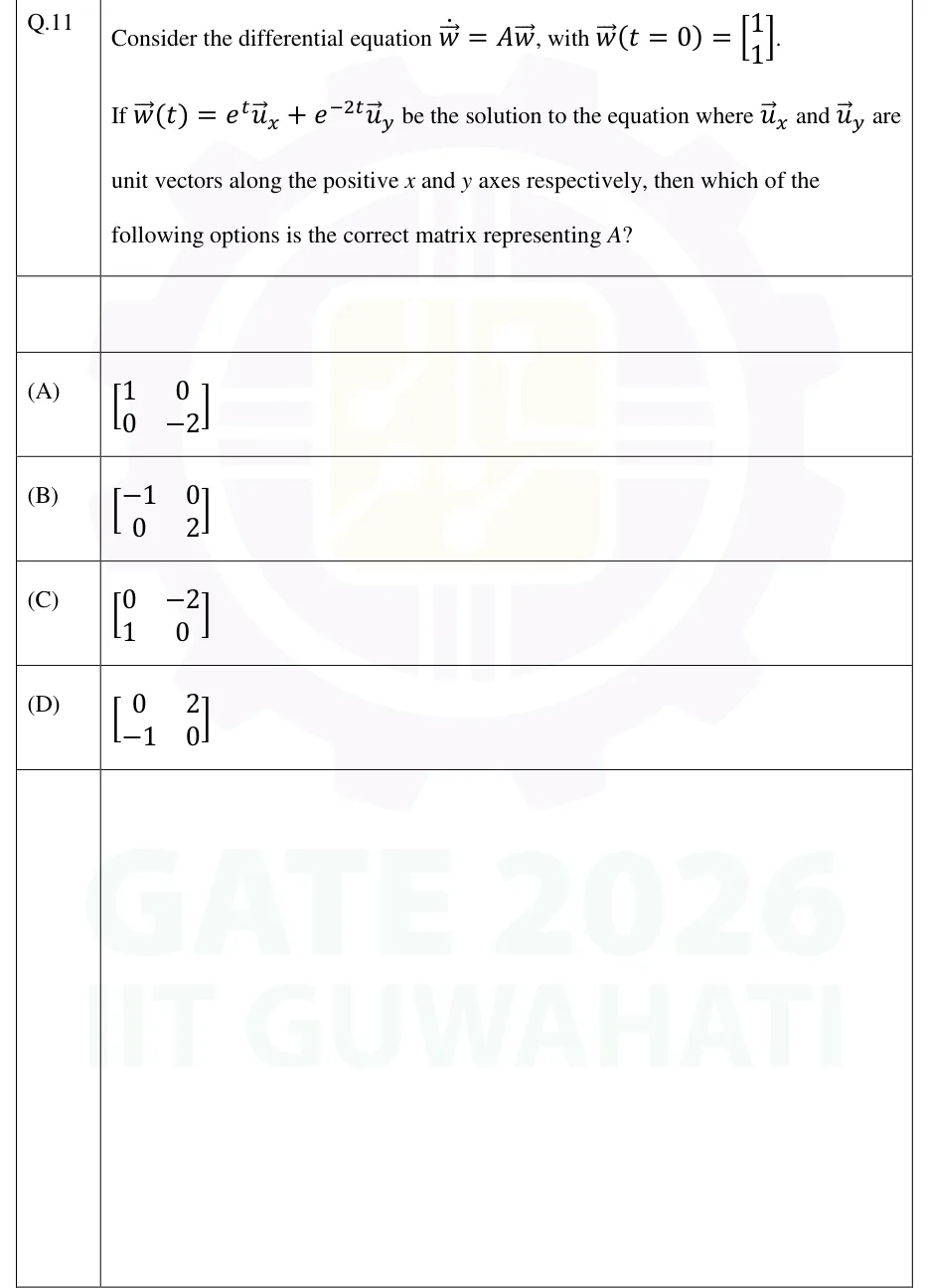
Consider the differential equation , with .

If be the solution to the equation where and are unit vectors along the positive and axes respectively, then which of the following options is the correct matrix representing ?

  1. (A)

  2. (B)

  3. (C)

  4. (D)

Answer and solution
See the question in the paper
GATE 2026 EC Q.11: answer and solution

GATE 2026 EE Q.50

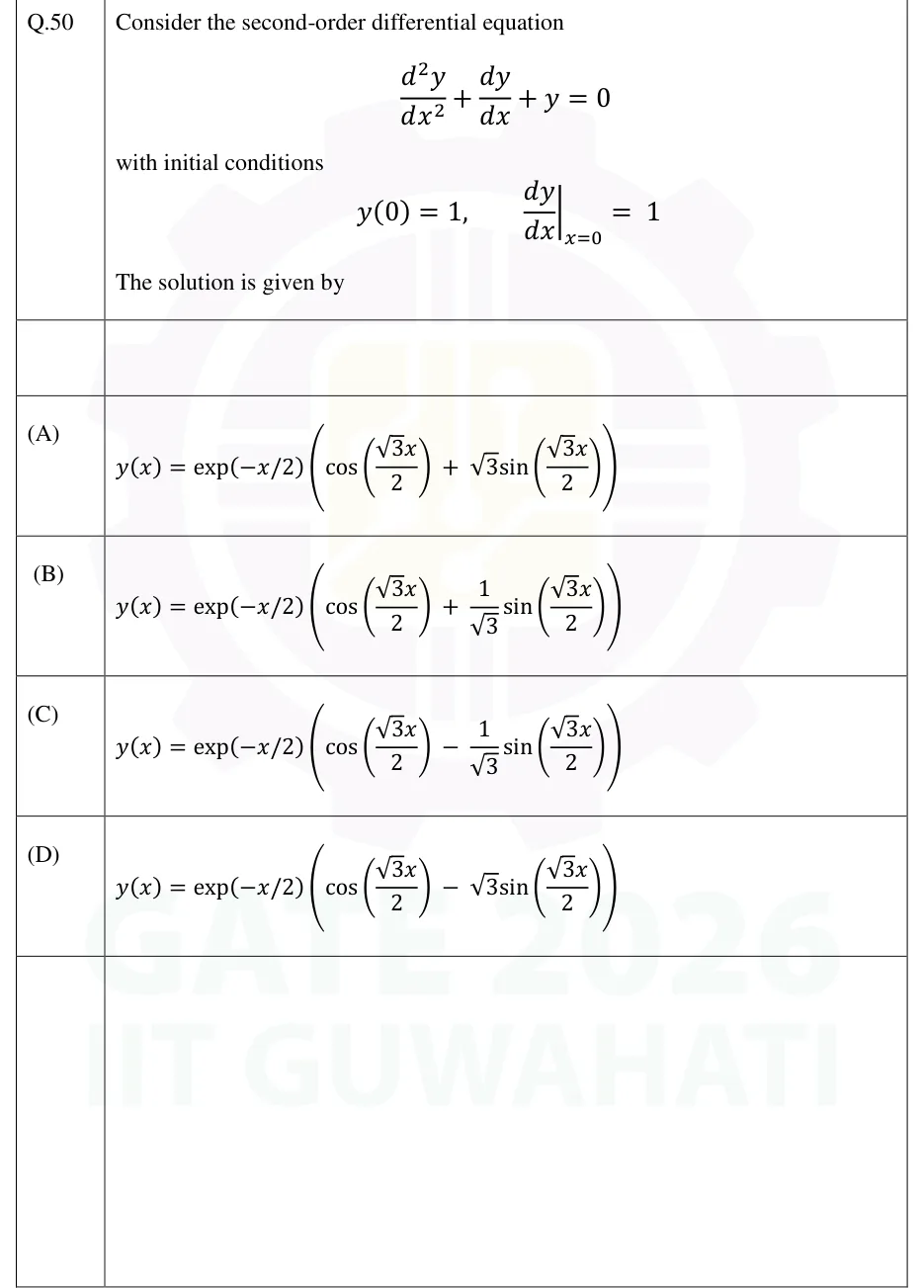
GATE 2026 · EEQ.50 · 2 marks · MCQ

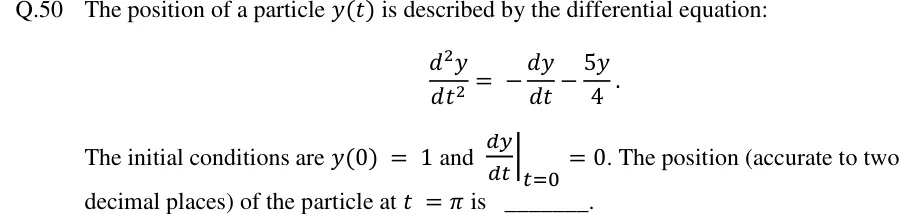
Consider the second-order differential equation

with initial conditions

The solution is given by

  1. (A)

  2. (B)

  3. (C)

  4. (D)

Answer and solution
See the question in the paper
GATE 2026 EE Q.50: answer and solution

GATE 2026 IN Q.54

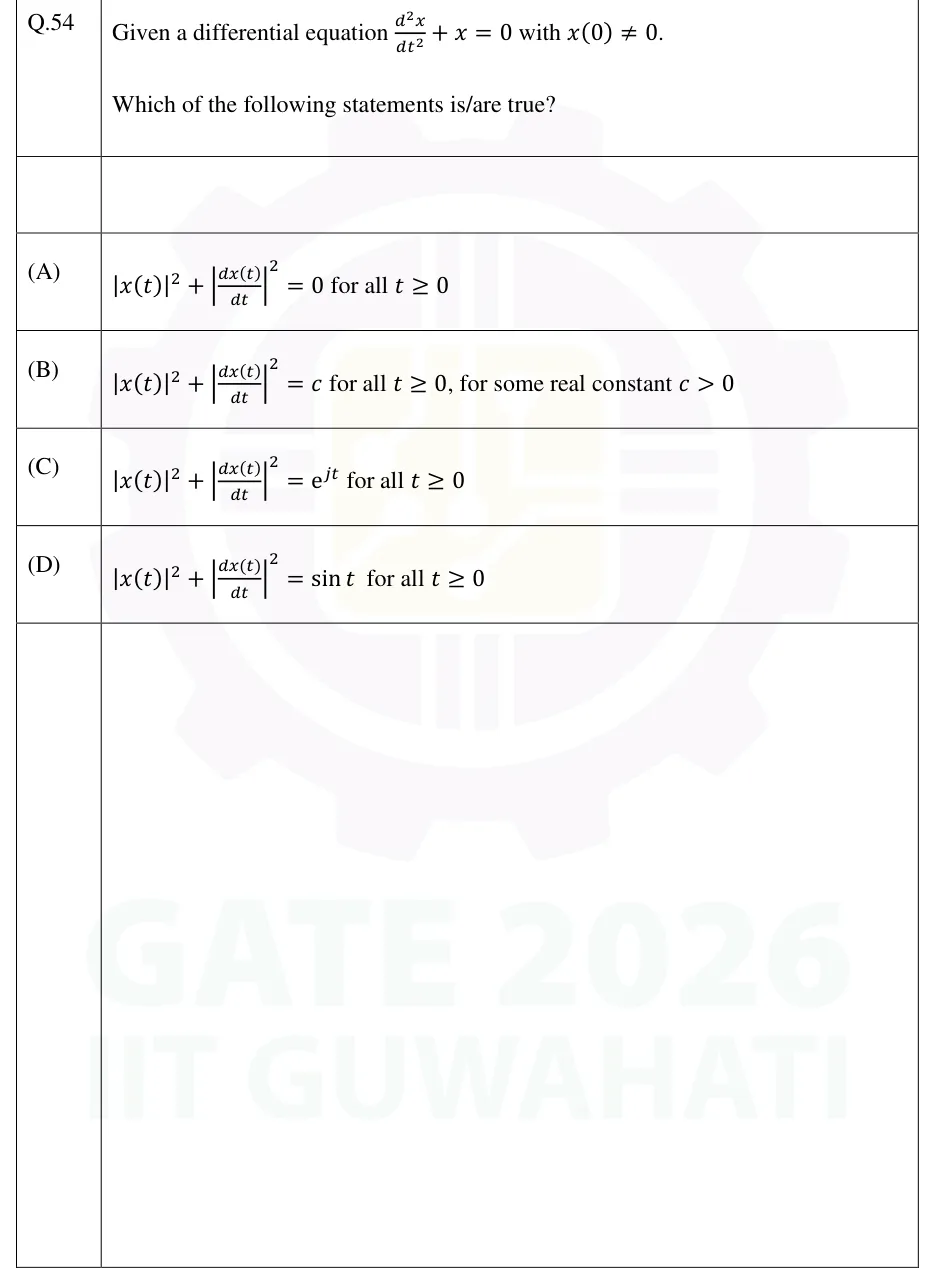
GATE 2026 · INQ.54 · 2 marks · MSQ

Given a differential equation with .

Which of the following statements is/are true?

  1. (A)

    for all

  2. (B)

    for all , for some real constant

  3. (C)

    for all

  4. (D)

    for all

Answer and solution
See the question in the paper
GATE 2026 IN Q.54: answer and solution

GATE 2024 EC Q.11

GATE 2024 · ECQ.11 · 1 mark · MCQ

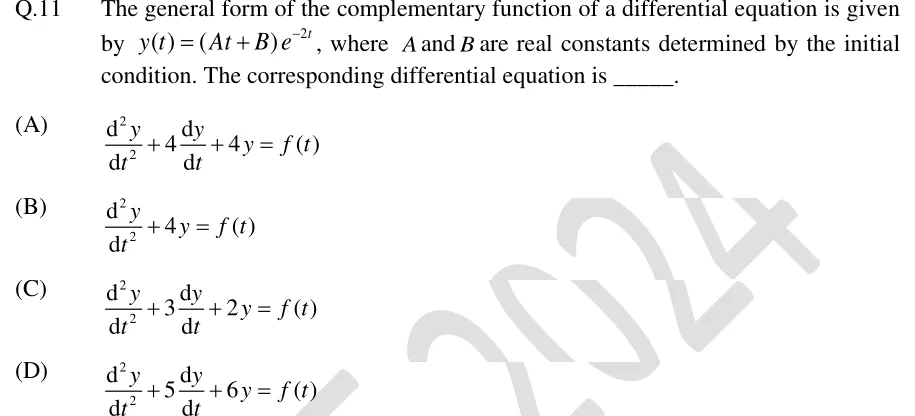
The general form of the complementary function of a differential equation is given by , where and are real constants determined by the initial condition. The corresponding differential equation is ______.

  1. (A)

  2. (B)

  3. (C)

  4. (D)

Answer and solution
See the question in the paper
GATE 2024 EC Q.11: answer and solution

GATE 2024 IN Q.64

GATE 2024 · INQ.64 · 2 marks · NAT

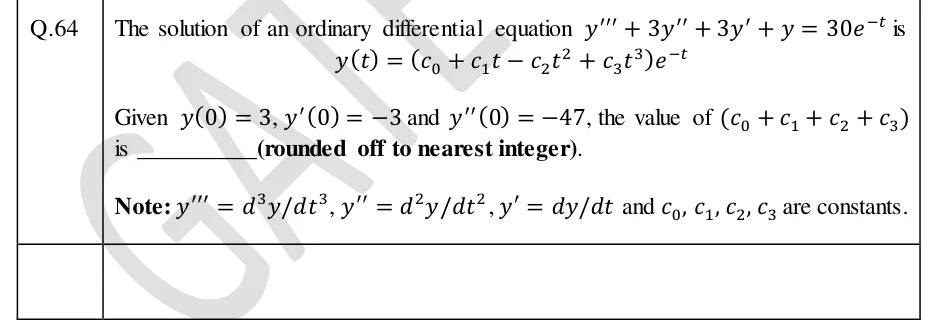
The solution of an ordinary differential equation is

Given , and , the value of is ________ (rounded off to nearest integer).

Note: , , and are constants.

Answer and solution
See the question in the paper
GATE 2024 IN Q.64: answer and solution

GATE 2022 EC Q.25

GATE 2022 · ECQ.25 · 1 mark · MSQ

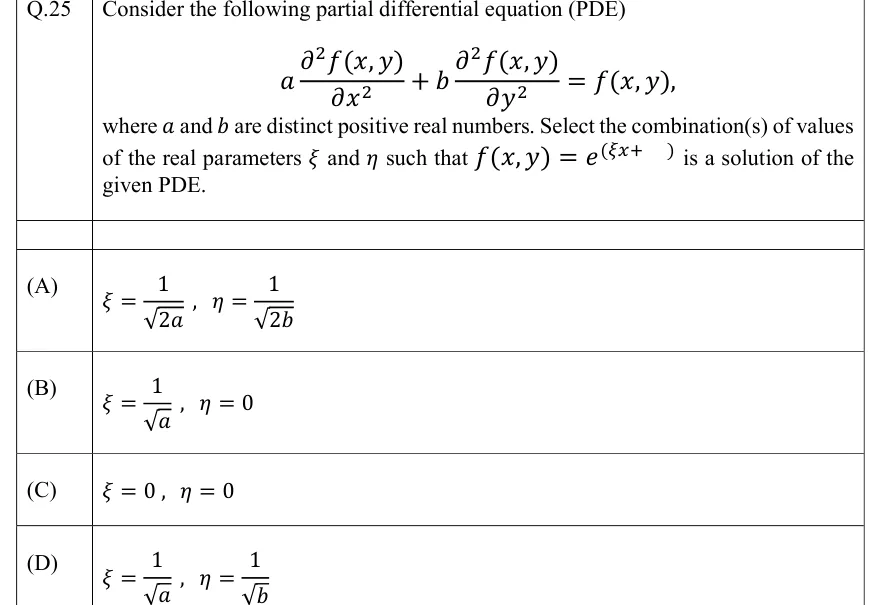
Consider the following partial differential equation (PDE)

where and are distinct positive real numbers. Select the combination(s) of values of the real parameters and such that is a solution of the given PDE.

[As printed, the second term of the exponent is blank in the paper. Since the options give values for , the intended function is .]

  1. (A)

  2. (B)

  3. (C)

  4. (D)

Answer and solution
See the question in the paper
GATE 2022 EC Q.25: answer and solution

GATE 2022 EC Q.30

GATE 2022 · ECQ.30 · 1 mark · MSQ

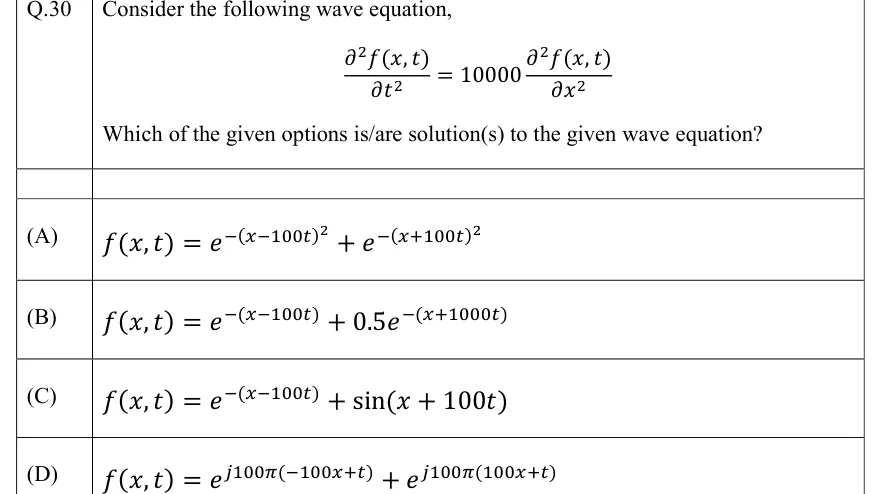
Consider the following wave equation,

Which of the given options is/are solution(s) to the given wave equation?

  1. (A)

  2. (B)

  3. (C)

  4. (D)

Answer and solution
See the question in the paper
GATE 2022 EC Q.30: answer and solution

PRACTICE

6 questions to test yourself

PRACTICE 11 mark · MSQ

Which of the following statements are TRUE? (Classify a second-order PDE written as by .)

  1. (A)

    is hyperbolic.

  2. (B)

    is parabolic.

  3. (C)

    is hyperbolic at the point .

  4. (D)

    The solution of , , , with and satisfies .

Answer and solution

Answer: (B), (C), (D)

  1. (A) and give , so the equation is elliptic. False.

  2. (B) In the variables : , , give , so it is parabolic. True.

  3. (C) At : , , give , so it is hyperbolic. True.

  4. (D) The initial condition is a single mode, so . At , . True.

PRACTICE 22 marks · NAT

For , the function satisfies with and . The value of is ______.

Answer and solution

Answer: (accepted range )

  1. Trying gives , so .

  2. is not a root, so .

  3. gives . gives , that is, .

  4. Subtracting, , so and .

  5. .

PRACTICE 32 marks · MSQ

Consider on , with the Wronskian defined as . Which of the following statements are TRUE?

  1. (A)

    and form a fundamental set of solutions.

  2. (B)

    .

  3. (C)

    Every solution tends to 0 as .

  4. (D)

    The solution with and satisfies .

Answer and solution

Answer: (A), (B), (D)

  1. has the double root , so and are solutions.

  2. , so the two are independent. (A) and (B) are true. This agrees with Abel's formula, .

  3. (C) The root is positive, so . False.

  4. (D) : and , so . Then and . True.

PRACTICE 41 mark · NAT

For , the function satisfies with . The value of is ______.

Answer and solution

Answer: (accepted range )

  1. Standard form: , so and IF .

  2. , so .

  3. gives , so and .

  4. .

PRACTICE 51 mark · NAT

The function satisfies with for all . The value of is ______ (rounded to two decimal places).

Answer and solution

Answer: (accepted range )

  1. Separate: gives , so , a constant.

  2. and , so .

  3. gives and , so . Check: and , so .

  4. This is the only solution: every solution of has the form , and fixes .

  5. .

PRACTICE 62 marks · MCQ

The solution of with and is

  1. (A)

  2. (B)

  3. (C)

  4. (D)

Answer and solution

Answer: (C)

  1. , so .

  2. is in (resonance), so .

  3. , and .

  4. , so and .

  5. , which is option (C). Option (A) satisfies the ODE but gives . Options (B) and (D) do not satisfy the ODE: their terms produce and respectively.

OFFICIAL GATE 2027 SYLLABUS WORDING

Copied from the GATE 2027 syllabus; see all 2027 syllabi.

GATE EC

Linear differential equations, Euler-Cauchy equation, Nonhomogeneous equations, methods of solution using variation of parameters, complementary function and particular integral, partial differential equations, variable separable method, initial and boundary value problems

GATE EE

First order equations (linear and nonlinear), Higher order linear differential equations with constant coefficients, Method of variation of parameters, Cauchy’s equation, Euler’s equation, Initial and boundary value problems, Partial Differential Equations, Method of separation of variables

GATE IN

Ordinary differential equations, first order linear differential equations, second order linear differential equations with constant coefficients, method of variation of parameters, Cauchy’s and Euler’s equations, initial and boundary value problems, solution of partial differential equations: variable separable method

Preparing in Kolkata? IAE Academy's course for GATE ECE, GATE EE or GATE IN.