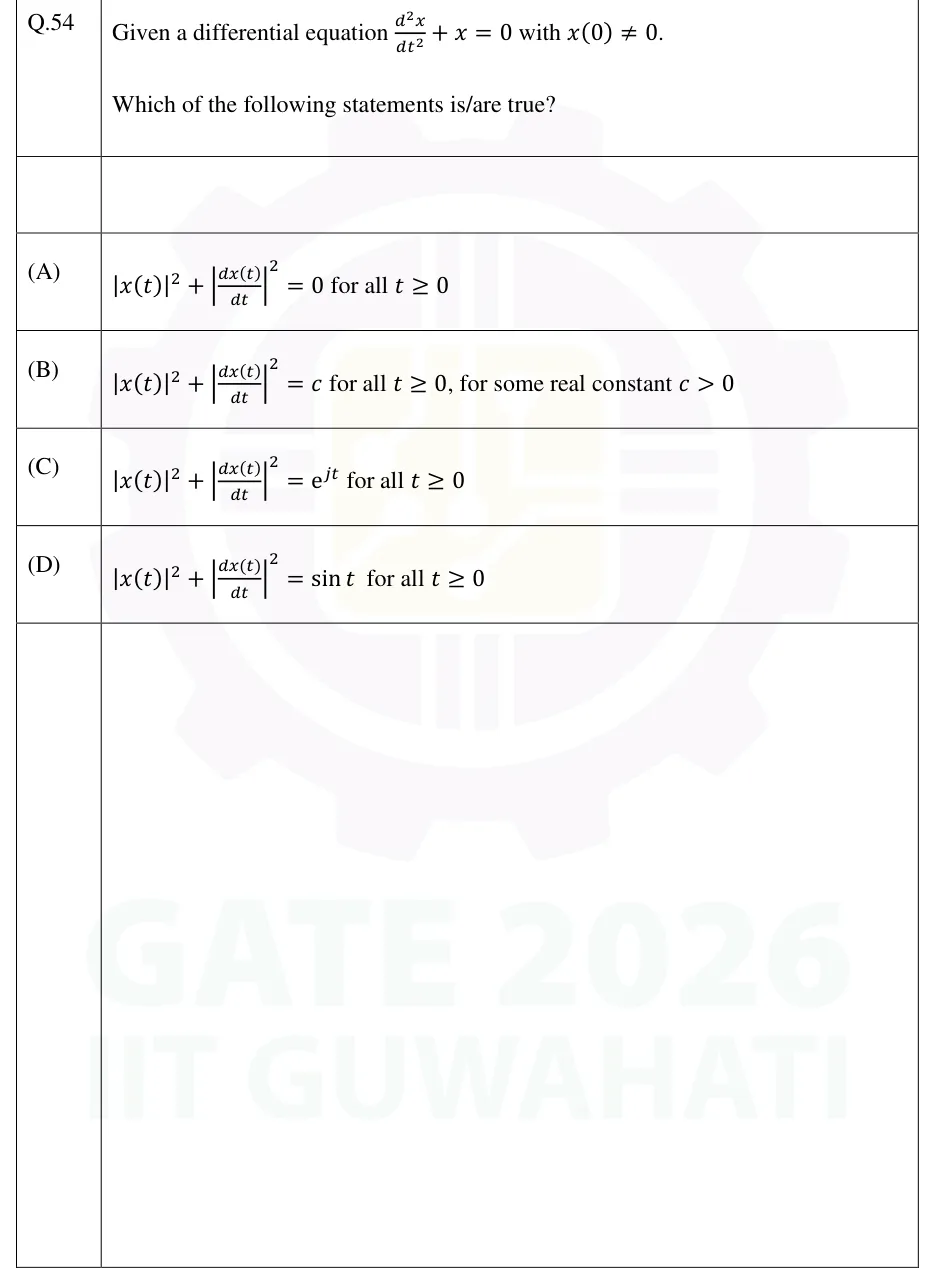
Given a differential equation with .
Which of the following statements is/are true?
- (A)
for all
- (B)
for all , for some real constant
- (C)
for all
- (D)
for all

Given a differential equation with .
Which of the following statements is/are true?
for all
for all , for some real constant
for all
for all
ANSWER
Only (B) is true: is a real constant for all .
Official answer: BSource: Official answer key, GATE 2026 IN (IIT Guwahati)
Solve the ODE. The auxiliary equation gives , so the general real solution is , with and .
Differentiate: .
Add the squares: The cross terms and cancel.
Quick check without solving (energy argument): , because . So the sum does not change with time. The modulus signs in the options change nothing: if were allowed to be complex, as well.
So the sum is a constant, fixed by its value at : (for the real solution, ). The constant is real and strictly positive, so (B) is true.
(A) is false: the sum equals at every , so it is never . It could only be for the trivial solution , which rules out.
(C) is false: the left side is a real constant, but changes with and is not even real in general (at it equals ).
(D) is false: changes with , and at it gives , but the left side is . Only (B) is true.
KEY IDEA
is simple harmonic motion, and is its conserved energy. Multiply the equation by and you get . In the phase plane the trajectory is a circle of radius , and means that radius cannot be zero.
WATCH OUT FOR
Picking (C) because the characteristic roots are and the solutions contain . That mixes up the form of with the value of , which is a real constant. Another slip is choosing (A) because the equation is homogeneous and has no forcing. The sum is zero only for the trivial solution, and rules that out. Some students also expand the squares, forget that the cross terms cancel, and wrongly decide the sum depends on .
From the GATE 2026 IN paper. Every question of this paper · Download the full paper · All 19 Differential equations questions, with notes