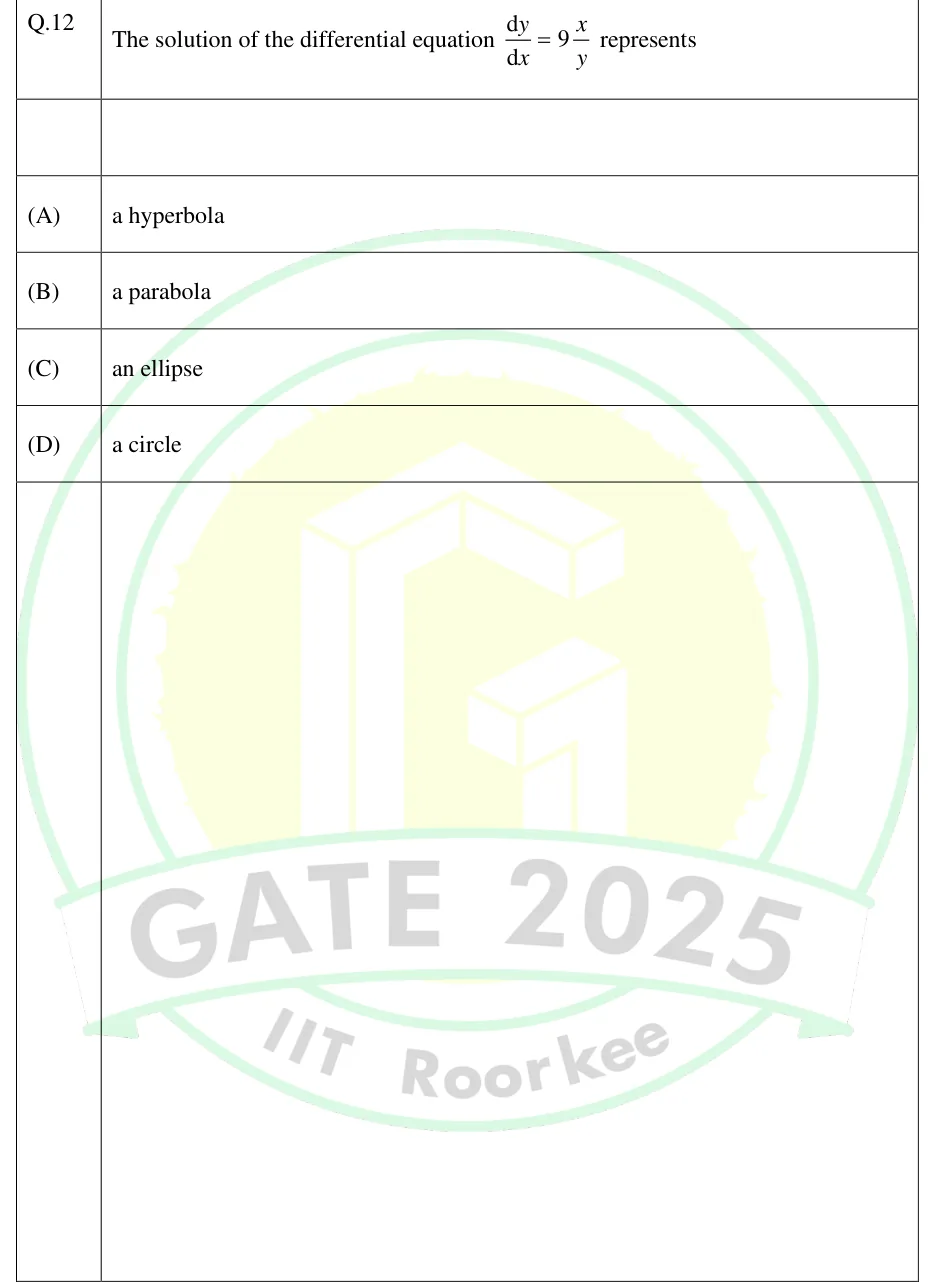
The solution of the differential equation represents
- (A)
a hyperbola
- (B)
a parabola
- (C)
an ellipse
- (D)
a circle

The solution of the differential equation represents
a hyperbola
a parabola
an ellipse
a circle
ANSWER
The general solution is . The squared terms have opposite signs, so the family of solution curves is a family of hyperbolas with asymptotes . The answer is (A).
Official answer: ASource: Official answer key, GATE 2025 IN (IIT Roorkee)
The variables separate. Multiply both sides by (with ) to get .
Integrate both sides: .
Multiply by 2 and rearrange:
Identify the conic. The squares and have opposite signs, so the curve is a hyperbola. The discriminant test for gives the same answer: here , , , so , which means a hyperbola. For the curve is , which opens along the -axis. For it is , which opens along the -axis. In both cases the asymptotes are . The case is the degenerate hyperbola made of that pair of lines.
Rule out the other options. A circle needs equal coefficients with the same sign, as in . An ellipse needs both squares to have the same sign. A parabola has only one of the variables squared. So the answer is (A), a hyperbola.
KEY IDEA
Separate the variables and integrate, then read the conic from the signs of the squared terms. The same signs give an ellipse (a circle if the coefficients are also equal). Opposite signs give a hyperbola. Only one squared variable gives a parabola.
WATCH OUT FOR
Losing or flipping the sign. gives , which is an ellipse, and students who mix up the two equations pick (C). Some also see only the and terms and answer "circle" without checking the signs and coefficients.
From the GATE 2025 IN paper. Every question of this paper · Download the full paper · All 19 Differential equations questions, with notes