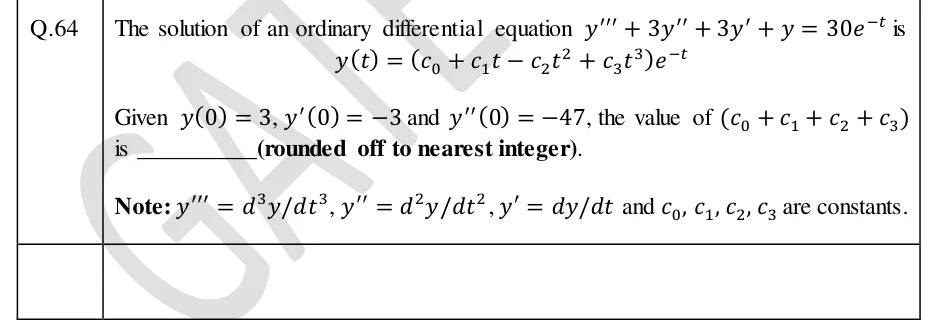
The solution of an ordinary differential equation is
Given , and , the value of is ________ (rounded off to nearest integer).
Note: , , and are constants.

The solution of an ordinary differential equation is
Given , and , the value of is ________ (rounded off to nearest integer).
Note: , , and are constants.
ANSWER
Official answer: 33Source: Official answer key, GATE 2024 IN (IISc Bengaluru)
Characteristic equation: , so is a triple root. The complementary function is . This gives the , and terms of the given form, with .
Particular integral: the forcing term corresponds to a root of multiplicity 3, so try . The exponential shift rule gives So the ODE alone fixes . The initial conditions cannot change it, because of is zero.
Write with . Then and . At : , , .
.
.
. Note that the question prints a minus sign in front of .
Check: gives , so the left side is . Also , and .
Sum: .
KEY IDEA
The operator is , so substituting turns the ODE into . That fixes straight away. The three initial conditions, taken through and at , then give , and one after another.
WATCH OUT FOR
Missing the printed minus sign in front of . With it, and . If you drop the sign you get and a sum of . Another error is to try to find from the initial conditions: they only fix , and , while comes from the forcing term.
From the GATE 2024 IN paper. Every question of this paper · Download the full paper · All 19 Differential equations questions, with notes