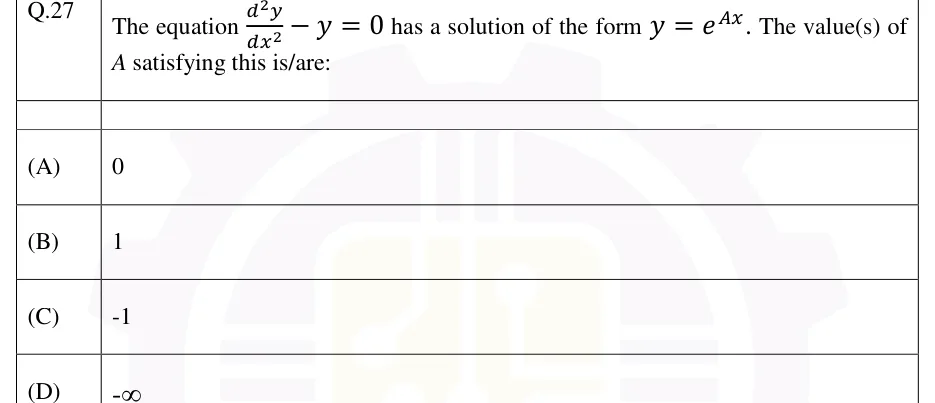
The equation has a solution of the form . The value(s) of satisfying this is/are:
- (A)
0
- (B)
1
- (C)
-1
- (D)
-∞

The equation has a solution of the form . The value(s) of satisfying this is/are:
0
1
-1
-∞
ANSWER
Options (B) and (C): A = 1 and A = -1.
Official answer: B, CSource: Official answer key, GATE 2026 BT (IIT Guwahati)
Substitute the trial solution into the equation. Then and .
The equation becomes , so .
For to be a solution it must satisfy this for all . Since for every finite and , this requires .
This gives or , so the general solution is .
Check the other options. gives , and then . is not a finite number, so is not a valid solution form for it.
The correct options are (B) and (C).
KEY IDEA
Put the trial solution into the equation. Because is never zero, you are left with the auxiliary equation , whose roots are the allowed values of .
WATCH OUT FOR
Choosing only one root, usually , on an MSQ. A second-order equation has two roots, and both and are solutions. Another slip is accepting without substituting it back.
From the GATE 2026 BT paper. Every question of this paper · Download the full paper · All 29 Differential equations questions, with notes