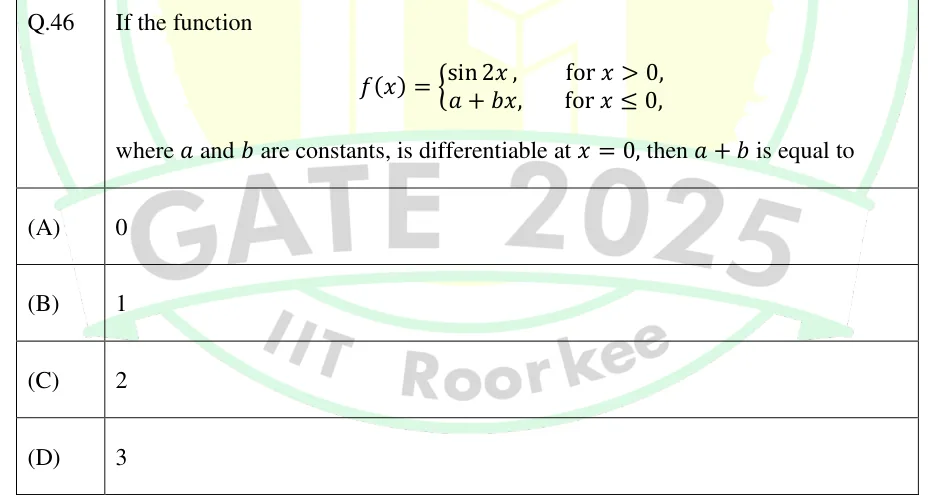
If the function f(x) = { sin 2x, for x > 0; a + bx, for x ≤ 0 }, where a and b are constants, is differentiable at x = 0, then a + b is equal to
- (A)
0
- (B)
1
- (C)
2
- (D)
3

If the function f(x) = { sin 2x, for x > 0; a + bx, for x ≤ 0 }, where a and b are constants, is differentiable at x = 0, then a + b is equal to
0
1
2
3
ANSWER
, option (C).
Official answer: CSource: Official answer key, GATE 2025 BT (IIT Roorkee)
A function that is differentiable at must first be continuous there, so .
Right-hand limit: . Since , , and the left-hand limit is also . Continuity gives .
Right-hand derivative: for , , so . (Equivalently, .)
Left-hand derivative: for , , so .
Differentiability at requires , so .
Hence , which is option (C).
KEY IDEA
For a piecewise function to be differentiable at the join, it must be continuous there and the one-sided derivatives must be equal. These two conditions give two equations for the two constants.
WATCH OUT FOR
Imposing only continuity, which gives but leaves undetermined. Another slip is to match the function values but not the slopes, or to take the derivative of as and so get (option B).
From the GATE 2025 BT paper. Every question of this paper · Download the full paper · All 72 Calculus questions, with notes