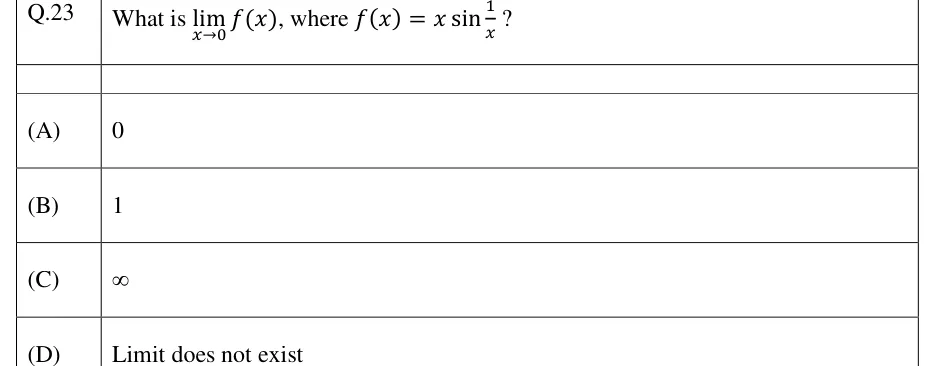
What is , where ?
- (A)
0
- (B)
1
- (C)
- (D)
Limit does not exist

What is , where ?
0
1
Limit does not exist
ANSWER
, which is option (A).
Official answer: ASource: Official answer key, GATE 2023 IN (IIT Kanpur)
As , keeps swinging between and , so it has no limit of its own. It is still bounded: for every .
Multiply by to get a bound on :
Squeeze (sandwich) theorem: both bounds tend to 0, because and . So .
Since and both outer terms tend to 0, the squeeze theorem gives as well:
Put another way, a function that tends to 0 (here ) multiplied by a bounded function (here ) tends to 0. The answer is (A).
KEY IDEA
A function that tends to zero, multiplied by a bounded function, tends to zero. Here , and the squeeze theorem finishes it. The oscillation of does not matter, because its amplitude is being shrunk to zero by the factor .
WATCH OUT FOR
Picking (D) because oscillates and has no limit. That is true of by itself, but not of , whose swings are held inside . Picking (B) by rewriting the function as and applying the standard limit . That standard limit needs , but here , and as . ( is correct only as .)
From the GATE 2023 IN paper. Every question of this paper · Download the full paper · All 39 Calculus questions, with notes