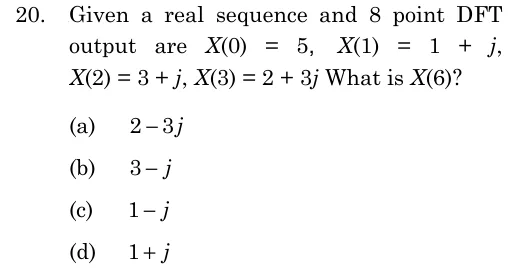
Given a real sequence and 8 point DFT output are X(0) = 5, X(1) = 1 + j, X(2) = 3 + j, X(3) = 2 + 3j. What is X(6)?
- (A)
2 − 3j
- (B)
3 − j
- (C)
1 − j
- (D)
1 + j

Given a real sequence and 8 point DFT output are X(0) = 5, X(1) = 1 + j, X(2) = 3 + j, X(3) = 2 + 3j. What is X(6)?
2 − 3j
3 − j
1 − j
1 + j
ANSWER
, which is option (b).
Official answer: BSource: ISRO's revised and final answer key of 16 February 2024
The sequence is real, so its -point DFT has conjugate symmetry: . This follows from for real .
Here , so .
Given , its conjugate is .
Hence . The other given values are not needed: pairs with , and with .
The other options are the wrong partners: , , and itself. None of them is .
KEY IDEA
For a real sequence, the -point DFT is conjugate-symmetric: . With , bin 6 is the mirror of bin 2.
WATCH OUT FOR
Pairing the wrong bins, for example taking as the conjugate of (that gives ) or of (that gives ), or forgetting to conjugate and answering .
From the ISRO EC 2023 paper. Every question of this paper · The full paper (PDF, ISRO) · All 3 ISRO DTFT & DFT questions, with notes