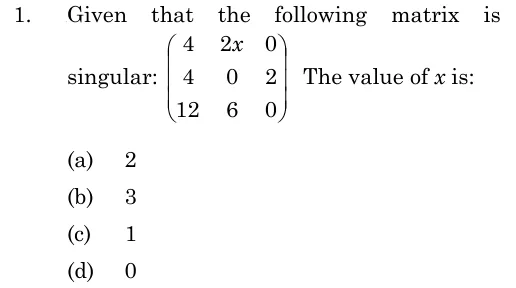
Given that the following matrix is singular: [[4, 2x, 0],[4, 0, 2],[12, 6, 0]]. The value of x is:
- (A)
2
- (B)
3
- (C)
1
- (D)
0

Given that the following matrix is singular: [[4, 2x, 0],[4, 0, 2],[12, 6, 0]]. The value of x is:
2
3
1
0
ANSWER
, which is option (c).
Official answer: CSource: ISRO's revised and final answer key of 16 February 2024
A square matrix is singular exactly when its determinant is .
Expand along the first row of : .
The first term is .
The second term is .
So .
Setting gives , hence .
Check: with the first row is and the third row is , so the rows are linearly dependent and the matrix is singular. This is option (c).
KEY IDEA
A square matrix is singular when its determinant is zero. Expand the determinant along a row, then solve the resulting linear equation for the unknown.
WATCH OUT FOR
Sign slips in the cofactor expansion, especially the minus sign on the middle term, give . Treating the zero entry in the first row as if it contributed a term is another error.
From the ISRO EC 2023 paper. Every question of this paper · The full paper (PDF, ISRO) · All 3 ISRO Linear algebra questions, with notes