
IAE Academy

ISRO EC 2025 Q.43: solution and answer

ISRO 2025 · ECQ.43 · 1 mark · MCQ

For a given diode circuit as shown in figure what will be the biasing modes of diodes D1, D2, D3? (FB = Forward Bias, RB = Reverse Bias) Assume diodes are ideal.
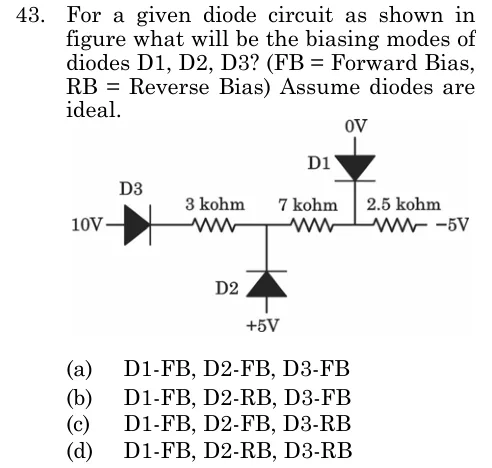
ISRO EC 2025 question 43: A 10 V source feeds the anode of diode D3 (arrow pointing right).Tap to open full size
Figure from the ISRO EC 2025 paper. It is part of the question.
Figure description

A 10 V source feeds the anode of diode D3 (arrow pointing right). D3's cathode connects through a 3 kohm resistor to node X. From node X, a diode D2 goes downward with its arrow pointing up (anode at the bottom terminal, which is held at +5 V; cathode at X). From node X, a 7 kohm resistor runs right to node Y. At node Y, a 2.5 kohm resistor goes to a -5 V supply, and diode D1 goes upward with its arrow pointing down (anode at the top terminal, which is at 0 V; cathode at Y).

  1. (A)

    D1-FB, D2-FB, D3-FB

  2. (B)

    D1-FB, D2-RB, D3-FB

  3. (C)

    D1-FB, D2-FB, D3-RB

  4. (D)

    D1-FB, D2-RB, D3-RB

Answer and solution

ANSWER

D1 is forward biased, D2 is reverse biased and D3 is forward biased, which is option (b).

Official answer: BSource: ISRO's final answer key of 15 May 2026

  1. Terminals: D3 has its anode at and its cathode through at node X. D2 has its anode at and its cathode at X. D1 has its anode at and its cathode at node Y, where the from X and the to meet.

  2. Trial 1: assume all three diodes conduct (ideal, drop). Then (through D2) and (through D1).

  3. Current into X from D3: . Current leaving X through the : .

  4. KCL at X, taking as the current D2 delivers into X: , so . A forward diode cannot carry negative current, so D2 cannot conduct and is reverse biased.

  5. Trial 2: D2 off; assume D1 and D3 on. Then and are in series from to , giving into Y.

  6. The resistor to draws from Y. By KCL at Y, D1 must supply from its anode into Y. This is positive, so D1 is forward biased, and D3 carries , so it is forward biased too.

  7. Consistency check on D2: . D2 has anode at and cathode at , so it is reverse biased, as assumed.

  8. Result: D1 forward, D2 reverse, D3 forward, which is option (b).

KEY IDEA

For ideal diodes, assume a set of on/off states, solve the circuit, and keep the assumption only if every conducting diode carries positive current and every off diode has reverse voltage across it.

WATCH OUT FOR

Assuming all diodes conduct because the sources look large, or stopping after Trial 1 without checking the sign of the D2 current. D2 would then need negative current, which is impossible, so the guess must be revised.

From the ISRO EC 2025 paper. Every question of this paper · The full paper (PDF, ISRO) · All 1 ISRO Diode circuits question, with notes