IAE Academy

ISRO EC 2025 Q.51: solution and answer

ISRO 2025 · ECQ.51 · 1 mark · MCQ

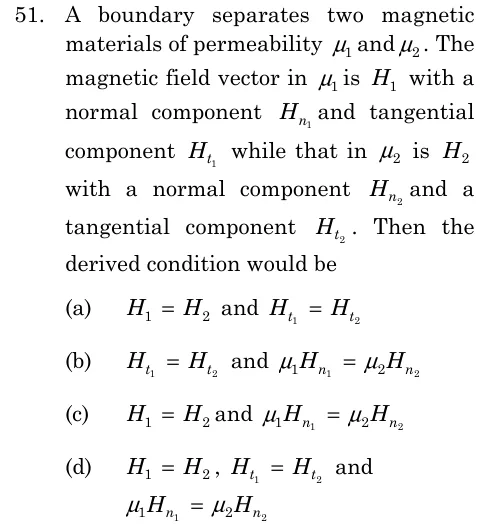
A boundary separates two magnetic materials of permeability and . The magnetic field vector in is with a normal component and tangential component while that in is with a normal component and a tangential component . Then the derived condition would be

  1. (A)

    and

  2. (B)

    and

  3. (C)

    and

  4. (D)

    , and

See the question in the paper

Answer and solution

ANSWER

The conditions are and , so the answer is option (b).

Official answer: BSource: ISRO's final answer key of 15 May 2026

  1. The boundary conditions at an interface come from Maxwell's equations applied to a thin loop and a thin pillbox straddling the boundary.

  2. Tangential : take Ampere's law on a thin rectangular loop with its long sides parallel to the boundary, one in each medium. As the loop height shrinks to zero, and with no free surface current, , so .

  3. Normal : take Gauss's law for magnetism on a thin pillbox with its flat faces on either side of the boundary. As the height shrinks to zero, , so .

  4. With in each medium, this becomes .

  5. The two derived conditions are and , which is option (b).

  6. Options (a), (c) and (d) state as a whole vector. That would need as well, which contradicts unless . Option (a) also leaves out the normal-component condition.

KEY IDEA

Across a boundary with no surface current, tangential is continuous (Ampere's law) and normal is continuous (Gauss's law for magnetism), so normal jumps by the ratio of permeabilities.

WATCH OUT FOR

Assuming the whole field vector is continuous, or that normal is continuous. Only the tangential part of and the normal part of are continuous.

From the ISRO EC 2025 paper. Every question of this paper · The full paper (PDF, ISRO) · All 2 ISRO Maxwell's equations questions, with notes