
IAE Academy

ISRO EC 2025 Q.2: solution and answer

ISRO 2025 · ECQ.2 · 1 mark · MCQ

A source with internal resistance Rs = 50 Ω is to be matched to a load RL = 200 Ω using a lossless LC network at a frequency of 10 MHz. Which of the following configurations will provide proper impedance matching and high-pass filtering?

  1. (A)

    A series inductor followed by a parallel capacitor

  2. (B)

    A parallel inductor followed by a series capacitor

  3. (C)

    A series capacitor followed by a parallel inductor

  4. (D)

    A parallel capacitor followed by a series inductor
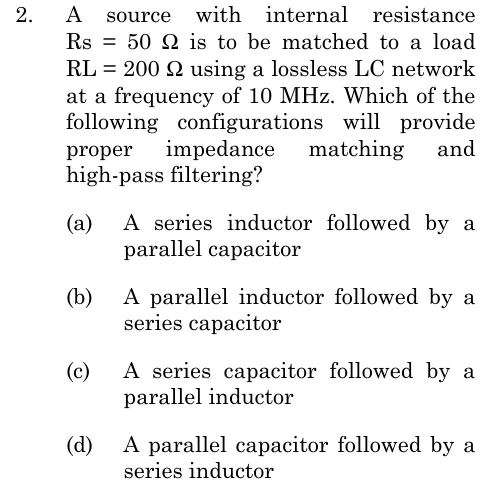
See the question in the paper

Answer and solution

ANSWER

The correct choice is (C): a series capacitor followed by a parallel inductor.

Official answer: CSource: ISRO's final answer key of 15 May 2026

  1. Read the options from the source towards the load. A two-element L-match has one series element and one shunt element, and the shunt element must sit across the larger resistance. Here , so the shunt element goes on the load side and the series element on the source side.

  2. Options (B) and (D) put a shunt element on the source side, across the smaller resistance. A shunt element across can only lower the resistance seen from the source, so it cannot match to . Only (A) and (C) have the series element first and the shunt element second.

  3. Quality factor of the match: .

  4. Between (A) and (C), decide by the filtering requirement. A series capacitor blocks low frequencies, and a shunt inductor shorts low frequencies to ground, so series C with shunt L is high-pass. Series L with shunt C, as in (A), passes low frequencies and attenuates high ones, so it is low-pass.

  5. Element values at (): the shunt inductor has , so . The series capacitor has , so .

  6. Verify the match. The load in parallel with has and . Its equivalent series resistance is , and its series reactance is (inductive). The series capacitor contributes and cancels it, so the source sees a purely resistive .

  7. Hence a series capacitor followed by a parallel inductor gives both the impedance match and the high-pass response: option (C).

KEY IDEA

In an L-match the shunt element goes across the larger resistance and the series element on the smaller side, with . For a high-pass match, use a series capacitor and a shunt inductor.

WATCH OUT FOR

Putting the shunt element on the source (low-resistance) side, as in (B) and (D), or choosing series L with shunt C in (A), which matches but is a low-pass section.

From the ISRO EC 2025 paper. Every question of this paper · The full paper (PDF, ISRO) · All 4 ISRO AC, power & resonance questions, with notes

More ISRO AC, power & resonance questions