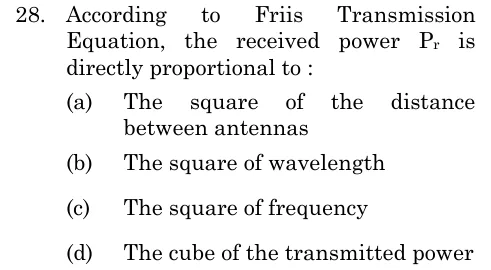
According to Friis Transmission Equation, the received power P_r is directly proportional to :
- (A)
The square of the distance between antennas
- (B)
The square of wavelength
- (C)
The square of frequency
- (D)
The cube of the transmitted power

According to Friis Transmission Equation, the received power P_r is directly proportional to :
The square of the distance between antennas
The square of wavelength
The square of frequency
The cube of the transmitted power
ANSWER
The received power is directly proportional to the square of the wavelength, option (b).
Official answer: BSource: ISRO's final answer key of 15 May 2026
The Friis transmission equation for free space is , where and are the antenna gains and is the separation.
Reading off the dependence: (first power), , and .
(a) Wrong: is inversely proportional to , so it falls as the distance grows.
(b) Correct: , which is direct proportionality to the square of the wavelength.
(c) Wrong: with , , so received power decreases with the square of frequency (for fixed antenna gains).
(d) Wrong: is linear in , not cubic.
Hence the received power is directly proportional to the square of the wavelength.
KEY IDEA
Friis equation: . Only the factor is a direct (positive) power-law dependence among the options; distance and frequency appear in the denominator, and transmitted power appears to the first power.
WATCH OUT FOR
Confusing "proportional to the square" with "inversely proportional to the square": the distance term sits in the denominator, so option (a) is the inverse relation. Also forgetting that turns the wavelength dependence into an inverse dependence on frequency.
From the ISRO EC 2025 paper. Every question of this paper · The full paper (PDF, ISRO) · All 4 ISRO Antennas questions, with notes