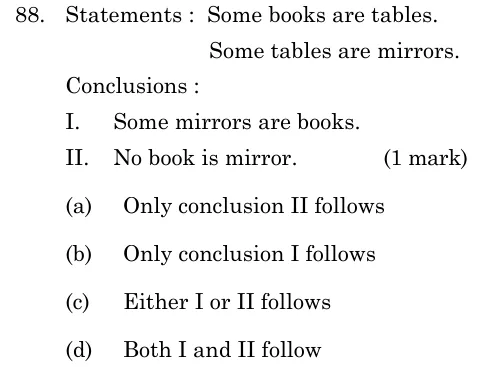
Statements: Some books are tables. Some tables are mirrors. Conclusions: I. Some mirrors are books. II. No book is mirror. (1 mark)
- (A)
Only conclusion II follows
- (B)
Only conclusion I follows
- (C)
Either I or II follows
- (D)
Both I and II follow

Statements: Some books are tables. Some tables are mirrors. Conclusions: I. Some mirrors are books. II. No book is mirror. (1 mark)
Only conclusion II follows
Only conclusion I follows
Either I or II follows
Both I and II follow
ANSWER
Option (c): either conclusion I or conclusion II follows.
Official answer: CSource: ISRO's final answer key of 15 May 2026
Both statements are particular affirmatives: 'Some books are tables' and 'Some tables are mirrors'. The middle term 'tables' is not distributed in either premise, so the premises do not link books to mirrors. Two particular premises give no definite conclusion.
Conclusion I, 'Some mirrors are books', is not forced. The tables that are books may be different tables from the tables that are mirrors, so I does not follow definitely.
Conclusion II, 'No book is mirror', is not forced either. Nothing in the statements rules out some book also being a mirror, so II does not follow definitely.
Compare I and II. They use the same two terms, books and mirrors. 'Some mirrors are books' is equivalent to 'Some books are mirrors' (a particular affirmative), and 'No book is mirror' is a universal negative on the same terms. These two are contradictories: exactly one of them must be true, and they cannot both be true or both be false.
Neither conclusion follows on its own, and together they form a complementary pair covering every possibility. By the either-or rule, either I or II follows, which is option (c).
KEY IDEA
When neither conclusion follows by itself but the two are contradictories (a particular affirmative and a universal negative on the same two terms), one of them must be true, so the answer is 'Either I or II follows'.
WATCH OUT FOR
Concluding that 'Some mirrors are books' follows by chaining the two 'some' statements. Two particular premises prove nothing, so the answer then wrongly becomes 'Only conclusion I follows' or 'Both follow'. Also forgetting to test whether the two conclusions are a contradictory pair before choosing 'neither follows'.
From the ISRO EC 2025 paper. Also Q.88 of the ISRO Scientist/Engineer Computer Science 2025 paper. Every question of this paper · The full paper (PDF, ISRO) · All 11 ISRO Reasoning questions, with notes