IAE Academy

ISRO EC 2025 Q.29: solution and answer

ISRO 2025 · ECQ.29 · 1 mark · MCQ

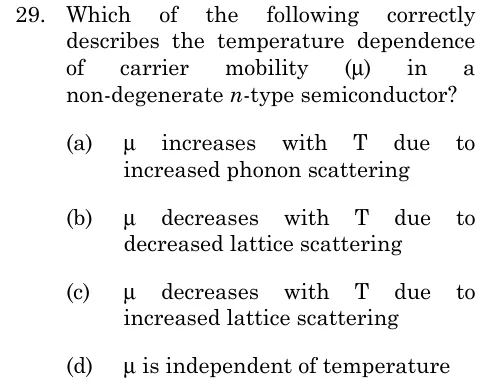
Which of the following correctly describes the temperature dependence of carrier mobility (μ) in a non-degenerate n-type semiconductor?

  1. (A)

    μ increases with T due to increased phonon scattering

  2. (B)

    μ decreases with T due to decreased lattice scattering

  3. (C)

    μ decreases with T due to increased lattice scattering

  4. (D)

    μ is independent of temperature

See the question in the paper

Answer and solution

ANSWER

Option (c): mobility decreases with temperature because lattice scattering increases.

Official answer: CSource: ISRO's final answer key of 15 May 2026

  1. Mobility is , so it falls whenever the mean scattering time falls.

  2. In a non-degenerate semiconductor at ordinary temperatures, the dominant scattering is by lattice vibrations (phonons). This is lattice (phonon) scattering.

  3. As rises, lattice vibrations become stronger, so scattering increases. The mean free time shrinks and .

  4. Ionized-impurity scattering goes the other way (), but it matters only at low temperature or high doping. Lattice scattering dominates above about room temperature.

  5. So decreases with because lattice scattering increases. This is option (c).

  6. Option (a) is wrong because more phonon scattering lowers mobility. Option (b) is wrong because lattice scattering increases with , not decreases. Option (d) is wrong because mobility depends on temperature.

KEY IDEA

Mobility is . At and above room temperature, phonon (lattice) scattering dominates and grows with , giving .

WATCH OUT FOR

Confusing the two scattering mechanisms: ionized-impurity scattering makes mobility rise with (at low temperature or high doping), but lattice scattering, which dominates at ordinary temperatures, makes it fall. Reading "more phonons" as "more mobility" is the usual slip.

From the ISRO EC 2025 paper. Every question of this paper · The full paper (PDF, ISRO) · All 2 ISRO Carrier transport questions, with notes