IAE Academy

ISRO EC 2025 Q.41: solution and answer

ISRO 2025 · ECQ.41 · 1 mark · MCQ

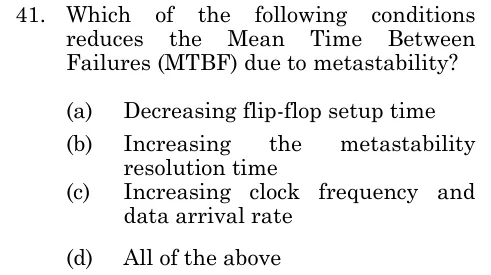
Which of the following conditions reduces the Mean Time Between Failures (MTBF) due to metastability?

  1. (A)

    Decreasing flip-flop setup time

  2. (B)

    Increasing the metastability resolution time

  3. (C)

    Increasing clock frequency and data arrival rate

  4. (D)

    All of the above

See the question in the paper

Answer and solution

ANSWER

The correct option is (C): increasing the clock frequency and the data arrival rate reduces the MTBF due to metastability.

Official answer: CSource: ISRO's final answer key of 15 May 2026

  1. A synchroniser fails when a flip-flop stays metastable for longer than the resolution time allowed before the next stage samples it. The standard result is where is the flip-flop's regeneration time constant, is proportional to the width of the metastability window (setup plus hold aperture), is the sampling clock frequency and is the rate at which the data input changes.

  2. (a) Decreasing the setup time narrows the window, so falls and MTBF rises. This does not reduce MTBF.

  3. (b) Increasing the resolution time raises the exponent , so MTBF rises exponentially. This does not reduce MTBF.

  4. (c) MTBF is inversely proportional to the product . A faster clock and a higher data arrival rate give more chances per second for a data edge to fall inside the window, so MTBF falls. This option reduces MTBF.

  5. (d) 'All of the above' would need (a) and (b) to reduce MTBF as well, and they do not. So only (c) is correct.

KEY IDEA

: anything that adds more sampling events or data edges per second lowers MTBF, while a smaller window or more resolution time raises it.

WATCH OUT FOR

Reading 'decreasing setup time' as making the flip-flop less reliable. A smaller setup time shrinks the metastability window and improves MTBF. Another slip is forgetting that resolution time sits in the exponent, so extra time helps enormously.

From the ISRO EC 2025 paper. Every question of this paper · The full paper (PDF, ISRO) · All 6 ISRO Sequential questions, with notes

More ISRO Sequential questions