IAE Academy

GATE IN

Optical sources, detectors, interferometry and spectroscopy

This topic covers the optical devices behind many industrial measurements: LED and laser sources, photodiode, LDR and square-law detectors, Michelson-type interferometers and their use in metrology, fibre-optic sensing, NIR and UV-Vis analysis, and the mass spectrometer. The key working relations are photon energy and cut-off wavelength, responsivity, fringe count to displacement, numerical aperture, the Beer-Lambert law and the magnetic-sector ion radius, together with the main differences between the devices.

11 previous-year questions · 11 solved · 6 practice questions

Optical sources: LED and laser

An optical source converts electrical energy into light. The two sources in the syllabus differ mainly in spectral width and coherence. An LED emits by spontaneous recombination in a forward-biased p-n junction, so the light is incoherent, spread over a wide band and emitted in a broad cone. A laser needs a population inversion so that stimulated emission dominates, and an optical cavity (mirrors or cleaved facets) for feedback; the result is a narrow line, high coherence and a narrow beam. In a laser diode the inversion is produced by the forward current above a threshold. The He-Ne gas laser (632.8 nm) is the usual source in metrology interferometers.

PHOTON ENERGY AND WAVELENGTH

The emitted wavelength of an LED is set by the band gap, so . SI: J s, m/s, J.

COHERENCE LENGTH AND COHERENCE TIME

is the spectral width of the source (order-of-magnitude relation). Clear interference fringes need the path difference to be smaller than .

Property

LED

Laser diode

Emission process

Spontaneous

Stimulated (above threshold)

Spectral width

Wide (tens of nm)

Narrow (a few nm or less; far narrower for a single-mode laser)

Coherence

Low, short

High, long

Beam

Broad, divergent

Narrow, directional

Output vs current

Roughly linear at low and moderate current, saturating at high current

Little light below threshold, then a steep linear rise

Typical use in instruments

Indicators, simple optical switches, low-cost sensors

Interferometers, precise fibre sensors

EXAM TIP

Interferometry needs a source whose coherence length exceeds the path difference being measured. A laser works for long displacements; a broad-band source gives fringes only near zero path difference.

Optical detectors

A photodiode is a p-n (or p-i-n) junction. Absorbed photons with energy above the band gap create electron-hole pairs, which the junction field separates. In the photoconductive mode the diode is reverse biased: the reverse photocurrent is proportional to the incident optical power over a wide range and the response is fast. In the photovoltaic mode (zero bias) the diode generates a voltage, as a solar cell does, with very low dark current but a slower response. A small dark current flows even with no light. A light-dependent resistor (LDR) is a photoconductor, usually CdS or CdSe, whose resistance falls as illumination rises; it is cheap but slow, non-linear and temperature dependent. A phototransistor gives current gain on top of the photodiode action, at the cost of speed.

CUT-OFF WAVELENGTH

Light of wavelength longer than is not absorbed and gives no photocurrent. Silicon ( eV): m.

QUANTUM EFFICIENCY

For a detector without internal gain, . Avalanche gain is counted separately.

RESPONSIVITY

is the photocurrent and the incident optical power. Applies for ; responsivity falls to zero beyond the cut-off. is the multiplication factor of an avalanche photodiode ( for an ordinary photodiode).

LDR RESISTANCE (POWER-LAW MODEL)

is the illuminance; and are positive constants of the device. Resistance falls as illumination rises; the dark resistance is very high.

A square-law detector gives an output proportional to the square of the input amplitude, i.e. to the input power. Photodiodes and thermal detectors (bolometers, thermopiles) are square-law with respect to the optical field, because they respond to optical power. A semiconductor diode used on a small electrical signal is also square-law: its output varies as the square of the signal voltage. Because the detector squares the field, mixing two optical fields on it produces a beat at their difference frequency; this is the basis of heterodyne detection.

SQUARE-LAW DETECTION

The photocurrent follows optical power, not field amplitude, so the electrical power in the load varies as the square of the optical power. The bar denotes an average over many optical cycles.

BEAT TERM FROM TWO FIELDS (HETERODYNE)

The detector cannot follow optical frequencies, so the terms at , and average out; only the difference-frequency term remains. Fields assumed parallel in polarisation.

WORKED EXAMPLE

A photodiode with quantum efficiency 0.6 receives 20 µW of light at 850 nm. Find the responsivity and the photocurrent.

Solution
  1. A/W.

  2. A.

Answer: A/W and A.

Detector

Strength

Limitation

Photodiode (reverse biased)

Fast, linear in power

Small signal, needs an amplifier

p-i-n photodiode

Faster, higher efficiency (wide depletion region)

Needs reverse bias

Avalanche photodiode (APD)

Internal gain

Needs a high reverse bias; gain adds noise and depends on temperature

Phototransistor

Built-in gain

Slower, less linear

LDR

Cheap, large resistance change

Slow, non-linear, temperature dependent

Interferometry in metrology

In a Michelson interferometer a beam splitter sends light to a fixed mirror and a movable mirror, and the returning beams recombine. The light travels to the mirror and back, so moving the mirror by changes the path difference by . Each time the path difference changes by one wavelength, one bright fringe passes the detector. Counting fringes therefore measures displacement with a resolution of a fraction of a wavelength. Metrology uses include calibrating gauge blocks and machine-tool slides, and measuring refractive index or thickness. With an optical flat laid on a surface, adjacent fringes mark a change of in the air gap, so straight, evenly spaced fringes show a flat surface.

FRINGE COUNTING FOR DISPLACEMENT

fringes counted; is the wavelength in the medium of the path; the mirror moves along the beam (Michelson, light passes twice).

PLATE OR GAS CELL IN ONE ARM

A transparent plate of index and thickness (or a gas cell of length whose index changes from 1 to ) placed normal to the beam in one arm shifts fringes. Michelson double pass, surrounding medium of index 1, the vacuum wavelength.

BRIGHT-FRINGE CONDITION

is the optical path difference and an integer; assumes no extra phase shift between the two arms.

FABRY-PEROT PEAKS AND FREE SPECTRAL RANGE

Transmission peaks of a cavity with mirror spacing and index ; is the angle inside the cavity. The FSR expression is for normal incidence and ignores dispersion.

WORKED EXAMPLE

A Michelson interferometer uses a 632.8 nm laser. A target mirror moves and 1200 fringes are counted. Find the displacement.

Solution
  1. .

  2. nm.

Answer: About 379.7 µm.

EXAM TIP

Counting fringes alone gives the size of the move, not its direction. Practical instruments use two detectors a quarter fringe apart to get the direction. Changes in the refractive index of air alter the wavelength and are a source of error.

Fibre-optic sensing and near-infrared sensing

A fibre guides light by total internal reflection at the core-cladding boundary, which needs . Light entering from air is guided only within the acceptance cone set by the numerical aperture. A measurand (strain, temperature, pressure, displacement) can change the guided light in intensity, phase, wavelength or polarisation, which gives the sensor types below. In an intrinsic sensor the fibre itself is the sensing element; in an extrinsic sensor the fibre only carries light to and from a separate sensing element.

NUMERICAL APERTURE AND CRITICAL ANGLE

Step-index fibre. core index, cladding index, index of the outside medium (1 for air); is the acceptance half-angle measured from the fibre axis; is the critical angle at the core-cladding boundary.

V-NUMBER (NORMALISED FREQUENCY)

is the core radius. Step-index fibre.

FIBRE BRAGG GRATING

is the effective index of the guided mode and the grating period. Strain or temperature changes and , which shifts the reflected wavelength .

Sensor type

What changes

Example

Intensity-modulated

Amount of light reaching the detector

Reflective displacement probe, microbend sensor

Phase / interferometric

Optical phase of the guided light

Mach-Zehnder or Michelson fibre strain sensor

Wavelength-modulated

Reflected wavelength

Fibre Bragg grating for strain or temperature

Near-infrared (NIR) sensing uses roughly the 0.78 to 2.5 µm band. Absorption there comes from overtones and combinations of the fundamental vibrations of C-H, O-H and N-H bonds. NIR absorption is weak, so thick or scattering samples can be measured, often by diffuse reflectance with a fibre probe. A tungsten-halogen lamp is the usual source, with InGaAs or PbS detectors. NIR is used for moisture, fat or protein content in grain, food and similar materials, and it needs calibration against a reference method.

UV-visible spectrophotometry

A UV-Vis spectrophotometer measures how much light a sample absorbs between about 200 and 800 nm. The convention used here is absorbance , with the incident intensity and the transmitted intensity. The concentration of a dissolved species follows from the Beer-Lambert law.

BEER-LAMBERT LAW

is the molar absorptivity at the chosen wavelength (usually L mol cm), the concentration (mol/L) and the path length (cm). Holds for a dilute, non-scattering solution, monochromatic light, and no association or reaction of the absorbing species.

TRANSMITTANCE AND ABSORBANCE

as a fraction; is the percentage transmittance.

PHOTOMETRIC ERROR

Assumes a constant absolute error in reading transmittance. The relative error in concentration grows at both very low and very high absorbance.

Instrument layout (in order)

  1. Source: deuterium lamp for the UV, tungsten-halogen lamp for the visible.

  2. Monochromator (grating or prism with slits) selects the wavelength.

  3. Sample cell (cuvette); quartz is needed for the UV.

  4. Detector: photomultiplier tube or photodiode (or a photodiode array), followed by an amplifier and readout.

  5. Double-beam designs split the light into sample and reference paths to cancel source drift.

EXAM TIP

Absorbances add and transmittances multiply. Two identical layers each with give and . At high absorbance little light reaches the detector and stray light causes error; at very low absorbance the small difference between and limits precision.

Mass spectrometry

A mass spectrometer separates ions by their mass-to-charge ratio (often written ). The basic parts are a sample inlet, an ion source (commonly electron impact), a mass analyser, a detector, and a vacuum system so ions do not collide with gas molecules. Common analysers are the magnetic sector, the quadrupole (a filter that passes one at a time) and time-of-flight. The output is a mass spectrum: ion abundance against . The resolving power is , the mass divided by the smallest mass difference the instrument can separate at that mass. In industry it is used for gas analysis and leak detection.

MAGNETIC-SECTOR ANALYSER

The ion starts from rest, is accelerated through potential , then moves on a circle of radius in a uniform magnetic field perpendicular to its velocity. SI units.

TIME-OF-FLIGHT ANALYSER

The ion starts from rest, is accelerated through and drifts a field-free length . Flight time grows as .

WORKED EXAMPLE

Singly charged ions of mass 40 u are accelerated from rest through 1000 V and enter a uniform field of T perpendicular to their velocity. Find the radius of the path. Take 1 u = kg and C.

Solution
  1. kg.

  2. .

  3. Inside the root: , so the root is .

  4. m.

Answer: cm.

EXAM TIP

For fixed and , the radius grows as the square root of . An ion of mass and charge follows the same path as a singly charged ion of mass , so the instrument measures , not mass alone.

PREVIOUS-YEAR QUESTIONS

11 questions from the IN papers

Try each question first, then open the answer. We placed each question under a topic ourselves; the exam paper does not label topics.

See these papers in full: GATE IN 2026 · GATE IN 2025 · GATE IN 2023 · GATE IN 2022 · GATE IN 2018

GATE 2025 IN Q.55

GATE 2025 · INQ.55 · 2 marks · NAT

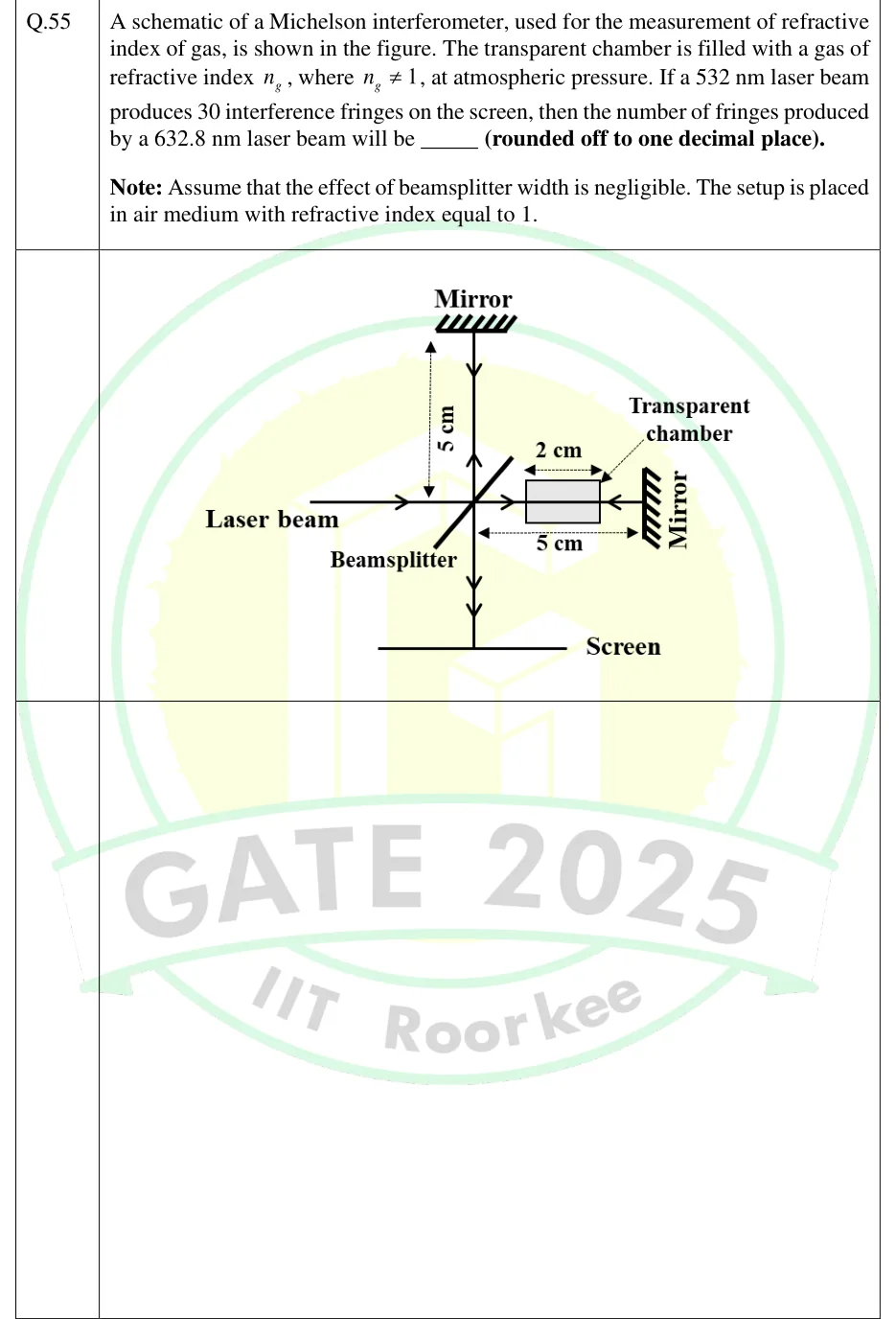
A schematic of a Michelson interferometer, used for the measurement of refractive index of gas, is shown in the figure. The transparent chamber is filled with a gas of refractive index , where , at atmospheric pressure. If a 532 nm laser beam produces 30 interference fringes on the screen, then the number of fringes produced by a 632.8 nm laser beam will be ______ (rounded off to one decimal place). Note: Assume that the effect of beamsplitter width is negligible. The setup is placed in air medium with refractive index equal to 1.

GATE 2025 IN question 55: Michelson interferometer.Tap to open full size
Figure from the GATE 2025 IN paper. It is part of the question.
Figure description

Michelson interferometer. A laser beam enters horizontally from the left and meets a 45-degree beamsplitter. One arm goes up to a fixed mirror at the top, 5 cm from the beamsplitter (dimension marked 5 cm, vertical). The other arm goes right to a vertical mirror, 5 cm from the beamsplitter (marked 5 cm, horizontal). A transparent gas chamber of length 2 cm (marked 2 cm) sits in the right-hand arm, between the beamsplitter and the right mirror, next to the mirror. The recombined beams travel down from the beamsplitter to a horizontal screen at the bottom. The setup is in air of refractive index 1.

Answer and solution
GATE 2025 IN Q.55: answer and solution

GATE 2023 IN Q.38

GATE 2023 · INQ.38 · 2 marks · MCQ

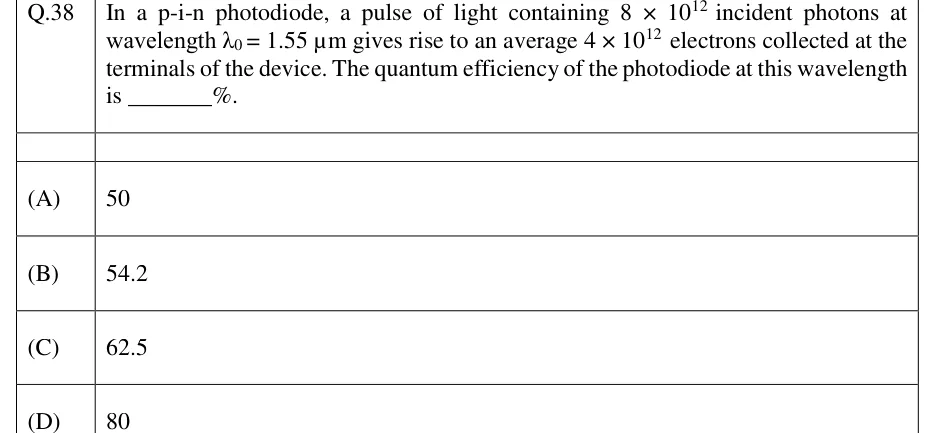
In a p-i-n photodiode, a pulse of light containing incident photons at wavelength gives rise to an average electrons collected at the terminals of the device. The quantum efficiency of the photodiode at this wavelength is ______ %.

  1. (A)

    50

  2. (B)

    54.2

  3. (C)

    62.5

  4. (D)

    80

Answer and solution
See the question in the paper
GATE 2023 IN Q.38: answer and solution

GATE 2022 IN Q.27

GATE 2022 · INQ.27 · 1 mark · NAT

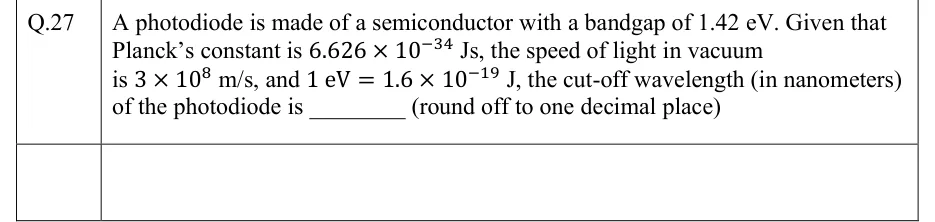
A photodiode is made of a semiconductor with a bandgap of 1.42 eV. Given that Planck's constant is 6.626 × 10^{-34} Js, the speed of light in vacuum is 3 × 10^8 m/s, and 1 eV = 1.6 × 10^{-19} J, the cut-off wavelength (in nanometers) of the photodiode is ________ (round off to one decimal place)

Answer and solution
See the question in the paper
GATE 2022 IN Q.27: answer and solution

GATE 2022 IN Q.39

GATE 2022 · INQ.39 · 2 marks · MCQ

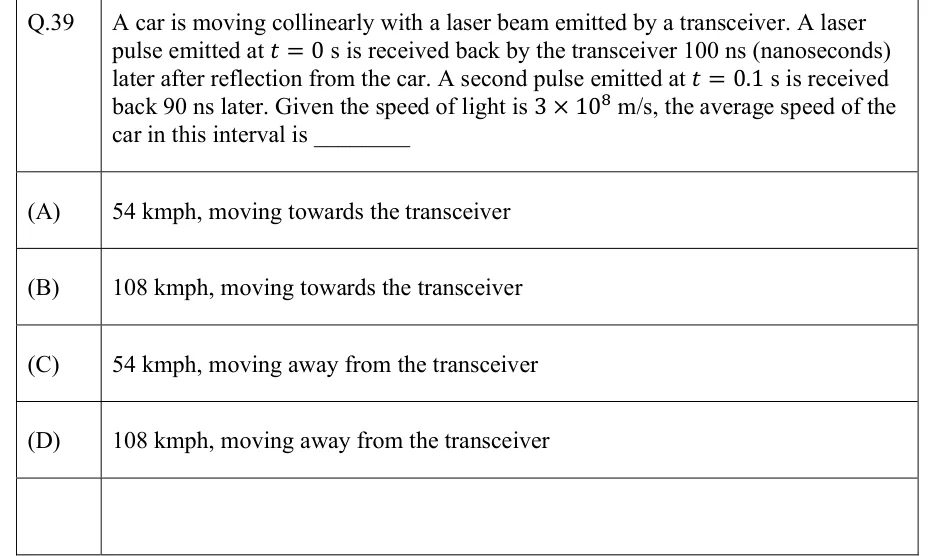
A car is moving collinearly with a laser beam emitted by a transceiver. A laser pulse emitted at t = 0 s is received back by the transceiver 100 ns (nanoseconds) later after reflection from the car. A second pulse emitted at t = 0.1 s is received back 90 ns later. Given the speed of light is 3 × 10^8 m/s, the average speed of the car in this interval is ________

  1. (A)

    54 kmph, moving towards the transceiver

  2. (B)

    108 kmph, moving towards the transceiver

  3. (C)

    54 kmph, moving away from the transceiver

  4. (D)

    108 kmph, moving away from the transceiver

Answer and solution
See the question in the paper
GATE 2022 IN Q.39: answer and solution

GATE 2022 IN Q.51

GATE 2022 · INQ.51 · 2 marks · NAT

Monochromatic light of wavelength 532 nm is used to measure the absorption coefficient of a material in a UV-Visible Spectrophotometer. The measured light intensity after transmission through a 1 cm thick sample of the material is 0.414 mW/cm^2. For a sample of thickness 2 cm, the measured light intensity is 0.186 mW/cm^2. The absorption coefficient (in cm^-1) of the material is ________ (round off to two decimal places)

Answer and solution
See the question in the paper
GATE 2022 IN Q.51: answer and solution

GATE 2018 IN Q.54

GATE 2018 · INQ.54 · 2 marks · NAT

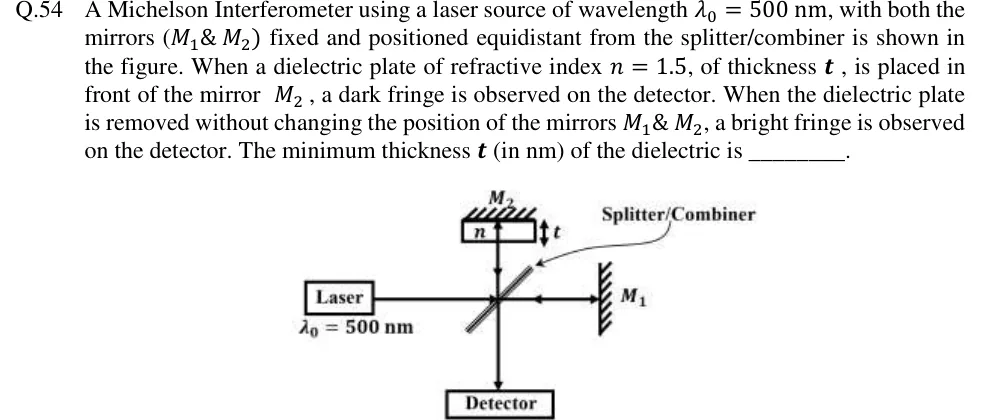
A Michelson Interferometer using a laser source of wavelength nm, with both the mirrors ( & ) fixed and positioned equidistant from the splitter/combiner is shown in the figure. When a dielectric plate of refractive index , of thickness , is placed in front of the mirror , a dark fringe is observed on the detector. When the dielectric plate is removed without changing the position of the mirrors & , a bright fringe is observed on the detector. The minimum thickness (in nm) of the dielectric is ________.

GATE 2018 IN question 54: Michelson interferometer.Tap to open full size
Figure from the GATE 2018 IN paper. It is part of the question.
Figure description

Michelson interferometer. A laser (λ0 = 500 nm) on the left sends a beam horizontally to a splitter/combiner (tilted semi-transparent plate) at the centre. Mirror M1 is on the right, perpendicular to the horizontal beam. Mirror M2 is at the top, perpendicular to the vertical beam. A dielectric plate of index n and thickness t sits directly in front of M2 (between the splitter and M2), so the beam crosses it twice. A detector is placed below the splitter/combiner. Both mirrors are equidistant from the splitter.

Answer and solution
GATE 2018 IN Q.54: answer and solution

PRACTICE

6 questions to test yourself

PRACTICE 11 mark · NAT

In a Michelson interferometer using light of wavelength 600 nm in air, the movable mirror moves along the beam and 500 fringes pass the detector. The displacement of the mirror, in micrometres, is ______.

Answer and solution

Answer: (accepted range )

  1. .

  2. nm m.

PRACTICE 21 mark · MCQ

A solution in a cuvette has an absorbance of 0.30 at a chosen wavelength. Another solution of the same substance at twice the concentration is measured in the same cuvette at the same wavelength. Assuming the Beer-Lambert law holds, the transmittance of the second solution is approximately

  1. (A)

    12.5 %

  2. (B)

    25 %

  3. (C)

    50 %

  4. (D)

    60 %

Answer and solution

Answer: (B)

  1. , so the new absorbance is .

  2. , about 25 %.

  3. Check: the first solution had ; doubling squares the transmittance, .

PRACTICE 32 marks · NAT

A step-index fibre has core index 1.48 and cladding index 1.46. Light enters from air. The maximum acceptance angle (half-angle of the acceptance cone, measured from the fibre axis), in degrees, is ______.

Answer and solution

Answer: (accepted range )

  1. .

  2. with .

  3. .

PRACTICE 42 marks · MSQ

Which of the following statements are correct?

  1. (A)

    Within its linear range, the reverse photocurrent of a photodiode is proportional to the incident optical power.

  2. (B)

    An LDR responds faster than a photodiode.

  3. (C)

    An LED has a wider spectral width than a laser diode.

  4. (D)

    In a magnetic-sector mass analyser with fixed accelerating voltage and field, the path radius of an ion is proportional to the square root of m/q.

Answer and solution

Answer: (A), (C), (D)

  1. A is correct: .

  2. B is wrong: LDRs are slow compared with photodiodes.

  3. C is correct: LED emission is spontaneous and broad-band; laser emission is narrow.

  4. D is correct: .

PRACTICE 52 marks · NAT

A thin transparent plate of refractive index 1.5 is placed normal to the beam in one arm of a Michelson interferometer illuminated with light of wavelength 600 nm (surrounding medium air, index 1). As the plate is inserted, 50 fringes are counted. The thickness of the plate, in micrometres, is ______.

Answer and solution

Answer: (accepted range )

  1. The light crosses the plate twice, so the optical path changes by .

  2. .

  3. m.

PRACTICE 61 mark · NAT

A silicon photodiode has a band gap of 1.12 eV. Taking eV µm, its cut-off wavelength, in nanometres, is ______.

Answer and solution

Answer: (accepted range )

  1. m.

  2. m nm.

OFFICIAL GATE 2027 SYLLABUS WORDING

Copied from the GATE 2027 syllabus; see all 2027 syllabi.

GATE IN

Optical sources and detectors: LED, laser, photo-diode, light dependent resistor, square law detectors and their characteristics; interferometer: applications in metrology; basics of fiber optic sensing. Near- infrared (NIR) sensing, Ultraviolet-Visible (UV-VIS) spectrophotometers, mass spectrometer

Preparing in Kolkata? IAE Academy's course for GATE IN.