IAE Academy

GATE IN

Temperature measurement

Temperature measurement covers contact sensors (thermocouples, RTDs, thermistors, semiconductor sensors) and non-contact ones (pyrometers, bolometers), each with its own law, range and error sources. GATE questions ask for an emf, resistance or temperature from the sensor law, the effect of lead resistance or emissivity, and the first-order lag of the sensor. Know each law with its conventions, and why one connection or sensor is preferred over another.

5 previous-year questions · 5 solved · 5 practice questions

Temperature scales and the choice of sensor

Temperature is measured indirectly, through a property that changes with it: an emf, a resistance, a junction voltage, or emitted radiation. Absolute temperature is in kelvin (K). Any law with in an exponent, a reciprocal or a fourth power needs kelvin. Laws that are linear in a temperature difference can use degrees Celsius.

TEMPERATURE SCALE CONVERSIONS

A change of 1 K equals a change of 1 °C and 1.8 °F. Use 273 when the question does.

Sensors compared

Sensor

Quantity that changes

Character

Thermocouple

Seebeck emf of two dissimilar metals

Self-powered, wide range, small output (about 10 to 60 µV per °C, depending on the pair), needs a reference junction

RTD (platinum)

Resistance rises with T

Accurate, stable, nearly linear, needs excitation current

Thermistor (NTC)

Resistance falls steeply with T

Very sensitive, narrow range, strongly non-linear

Semiconductor (IC) sensor

Junction voltage or a PTAT current

Linear output, low cost, limited to roughly -55 to 150 °C

Radiation pyrometer

Emitted power, proportional to T^4

Non-contact, high temperatures, depends on emissivity

Optical pyrometer

Brightness of a narrow visible band

Non-contact, hot bodies that glow visibly, needs an operator or an automatic matching lamp

Bolometer

Resistance change on absorbing radiation

Detector of radiant power (infrared, microwave)

Thermocouples

When two dissimilar metals A and B are joined at two junctions held at different temperatures, an emf appears in the loop. This is the Seebeck effect. The emf depends only on the metals and on the two junction temperatures. It is measured with one junction at a known reference temperature. Unless stated, tables and equations give the emf with the reference junction at 0 °C.

THERMOCOUPLE EMF, QUADRATIC APPROXIMATION

T in °C, a and b depend on the pair. dE/dT is the thermoelectric sensitivity (Seebeck coefficient of the pair). For hot junction T_1 and cold junction T_2: E = E(T_1) - E(T_2).

NEUTRAL AND INVERSION TEMPERATURES

For E = aT + bT^2 with a > 0 and b < 0. The emf is maximum when the hot junction is at T_n (where dE/dT = 0), whatever the cold-junction temperature T_c. It returns to zero at the inversion temperature T_i, which lies as far above T_n as T_c lies below it. With the cold junction at 0 °C, T_i = -a/b = 2T_n.

The three laws

  1. Law of homogeneous circuit: a single homogeneous metal cannot produce a net emf by temperature differences alone, and the emf does not depend on how temperature varies along the wires between the junctions.

  2. Law of intermediate metals: inserting a third metal into the loop (for example the leads of a meter) does not change the emf, provided its two new junctions are at the same temperature.

  3. Law of intermediate temperatures: . This is why a table made for a 0 °C reference serves any reference: .

Reference-junction compensation: the instrument sees , so the true hot-junction emf is found by adding . An ice bath fixes the reference at 0 °C. Electronic compensation measures the terminal temperature with an RTD or semiconductor sensor and adds a voltage equal to . Extension or compensating cables carry the junction to the instrument, and must be of the same pair (or matching emf) up to the reference point.

Common types at GATE level (approximate, for comparison only)

Type

Pair (positive / negative)

Notes

K

Chromel / Alumel

General purpose, up to about 1200 °C, sensitivity about 40 µV/°C

J

Iron / Constantan

Up to about 750 °C, the iron leg oxidises rapidly at high temperature

T

Copper / Constantan

Low temperatures (below about 350 °C), moisture resistant

E

Chromel / Constantan

Highest sensitivity of the common types, about 60 µV/°C

S, R

Platinum-rhodium / Platinum

High temperature, accurate, low output of about 10 µV/°C, costly

B

Platinum-rhodium (30%) / Platinum-rhodium (6%)

Very high temperature, almost no output at low temperature

THERMOPILE

N identical thermocouples in series, with all hot junctions at the hot temperature and all cold junctions at the cold one. Output and sensitivity are N times those of one thermocouple. It is used to detect radiant power.

WORKED EXAMPLE

A thermocouple has emf E(T) = 40T - 0.05T^2 µV with T in °C (reference 0 °C). Its hot junction is at 300 °C and its reference (terminals) at 25 °C. Find the emf the meter reads and the neutral temperature.

Solution
  1. E(300) = 40(300) - 0.05(300)^2 = 12000 - 4500 = 7500 µV.

  2. E(25) = 40(25) - 0.05(25)^2 = 1000 - 31.25 = 968.75 µV.

  3. By the law of intermediate temperatures, E(300,25) = 7500 - 968.75 = 6531.25 µV.

  4. Neutral temperature T_n = -a/(2b) = -40/(2 x (-0.05)) = 400 °C.

Answer: Meter reads 6531.25 µV (about 6.53 mV); T_n = 400 °C.

EXAM TIP

A meter with its terminals at 25 °C reads LESS than the tabulated 0 °C-reference value. Always add E(T_ref,0) to the reading before looking up the temperature. Do not add 25 °C to the final temperature.

Resistance temperature detectors (RTDs)

A metal's resistance rises with temperature. Platinum is the standard material because it is stable and nearly linear. A Pt100 has at 0 °C. The temperature coefficient is referred to 0 °C unless the question states otherwise, and for standard platinum it is about C.

RTD LINEAR LAW

T in °C, α referred to 0 °C. Good over a modest range.

CHANGING THE REFERENCE TEMPERATURE OF Α

α_0 is referred to 0 °C and α_{T1} to T_1 (°C). Both describe the same linear law. For example, α_0 = 0.00385 /°C gives α_20 = 0.00385/1.077 = 0.003575 /°C.

CALLENDAR-VAN DUSEN FORM

For industrial platinum A = 3.9083 x 10^-3 /°C, B = -5.775 x 10^-7 /°C^2, C = -4.183 x 10^-12 /°C^4. Sensitivity falls slightly as T rises because B is negative.

RTD lead connections

Connection

How it works

Lead-wire error

2-wire

Leads are in series with the RTD, so the meter sees R_T + 2R_L

Not compensated. Error in temperature is 2R_L/(R_0 α)

3-wire

In a Wheatstone bridge one lead is in the RTD arm, one in the adjacent arm, and the third in the detector or supply line

Cancels for equal leads at the balance point (equal ratio arms), and nearly cancels elsewhere

4-wire

Two leads carry a constant current, two other leads sense the voltage with a high-impedance meter

Eliminated, since no current flows in the sensing leads

LEAD-WIRE ERROR OF A 2-WIRE RTD

R_L is the resistance of each lead. The lead resistance is assumed constant and the linear law is used.

RTD IN A WHEATSTONE BRIDGE

Bridge with supply V_s, the RTD in one arm and the other three arms equal to R_0, so it balances at 0 °C. The approximation needs αT much less than 2. The exact output is slightly non-linear in T.

Self-heating: the excitation current dissipates in the RTD. The temperature error is , where is the dissipation constant in W/°C. Keeping the current small limits it.

WORKED EXAMPLE

A Pt100 (R_0 = 100 Ω, α = 0.00385 /°C) is connected by two wires, each of resistance 1.5 Ω, to a meter that assumes zero lead resistance. Find the indicated temperature when the sensor is at 150 °C.

Solution
  1. R_T = 100(1 + 0.00385 x 150) = 100 x 1.5775 = 157.75 Ω.

  2. The meter measures 157.75 + 2(1.5) = 160.75 Ω.

  3. Indicated T = (160.75/100 - 1)/0.00385 = 0.6075/0.00385 = 157.8 °C.

  4. Check: error = 3/(100 x 0.00385) = 7.79 °C, so 150 + 7.79 = 157.8 °C.

Answer: About 157.8 °C, an error of about +7.8 °C.

Thermistors and semiconductor sensors

A thermistor is a semiconductor resistor. An NTC (negative temperature coefficient) thermistor's resistance falls steeply as temperature rises. It is far more sensitive than an RTD, but non-linear and useful over a narrow range. Temperature in these formulas is in kelvin.

NTC THERMISTOR LAW

R_0 is the resistance at reference temperature T_0 (kelvin), β is the material constant in kelvin. R falls as T rises.

Β FROM TWO READINGS

T_1, T_2 in kelvin, R_1 and R_2 the resistances at them.

THERMISTOR TEMPERATURE COEFFICIENT

Negative for NTC, and its magnitude falls as T rises. At room temperature it is a few per cent per kelvin.

STEINHART-HART EQUATION

T in kelvin, R in ohms. A, B and C are found from three calibration points. It fits a thermistor more closely over a wide range than the single-β law.

Self-heating: power raises the thermistor above the ambient by . This error is large because R is large and is small. Linearisation: a fixed resistor in parallel with the thermistor flattens its curve and lowers the sensitivity. A series resistor in a voltage divider is also used. Neither makes the response truly linear over a wide range.

Semiconductor (IC) temperature sensors use the junction of a transistor. The base-emitter voltage falls by about 2 mV per °C for silicon at room temperature (CTAT). The difference of the base-emitter voltages of two matched transistors run at a current-density ratio is proportional to absolute temperature (PTAT). The ratio comes from a current ratio with equal emitter areas, or from equal currents with an emitter-area ratio . IC sensors give a voltage output (for example 10 mV/°C) or a current output (for example 1 µA/K).

PTAT VOLTAGE

For two matched transistors at current-density ratio n. kT/q is about 25.85 mV at 300 K. The output is linear in absolute temperature.

WORKED EXAMPLE

An NTC thermistor has R = 10 kΩ at 25 °C and β = 3500 K. Find its resistance at 50 °C and its temperature coefficient at 25 °C.

Solution
  1. T_0 = 298.15 K and T = 323.15 K.

  2. 1/T - 1/T_0 = 0.0030945 - 0.0033540 = -0.00025948 /K.

  3. β x (-0.00025948) = -0.9082, so R = 10 exp(-0.9082) = 10 x 0.4033 = 4.03 kΩ.

  4. α_T at 25 °C = -3500/(298.15)^2 = -3500/88893 = -0.0394 /K.

Answer: R(50 °C) ≈ 4.03 kΩ and α_T ≈ -3.9 % per K.

EXAM TIP

Convert to kelvin before using the thermistor law. Using °C in 1/T gives a wrong answer. A thermistor's β is a constant for the stated range, not for all temperatures.

Radiation pyrometers and bolometers

A radiation (total radiation) pyrometer focuses the radiation from a hot surface on a detector, often a thermopile. The radiant emittance of a surface of emissivity obeys the Stefan-Boltzmann law. Emissivity is 1 for a black body and less than 1 for real surfaces. The instrument is calibrated against a black body, so a real surface appears cooler than it is. While the target fills the instrument's field of view, the reading does not depend on the distance to the target.

STEFAN-BOLTZMANN LAW

T in kelvin. With surroundings at T_s, the net emission is εσ(T^4 - T_s^4).

EMISSIVITY CORRECTION (TOTAL RADIATION)

T_a is the black-body (apparent) temperature the pyrometer shows, T is the true surface temperature in kelvin. Valid when radiation from the surroundings is neglected and ε is the total emissivity.

WIEN'S DISPLACEMENT LAW

The wavelength at which a black body's spectral emission peaks falls as its temperature rises. T in kelvin.

An optical pyrometer (disappearing filament type) compares the brightness of the target with a calibrated lamp filament through a narrow band near m. The operator adjusts the lamp current until the filament vanishes against the target. In a narrow band the Wien approximation holds when is much smaller than m K, which is true at 0.65 µm over the usual pyrometer range.

EMISSIVITY CORRECTION (OPTICAL PYROMETER)

T_a is the brightness temperature read, ε_λ the spectral emissivity at wavelength λ, temperatures in kelvin. Since ln ε_λ < 0, the true temperature is above the reading.

TWO-COLOUR (RATIO) PYROMETER

Ratio of spectral radiances at two wavelengths, under the Wien approximation. For a grey body (ε_1 = ε_2) the emissivity cancels, so the temperature follows from the ratio alone.

A bolometer is a very small element (a thermistor, a metal film or a barretter wire) that absorbs radiant power, warms, and changes its resistance. It is placed in a bridge, and the unbalance gives the absorbed power, for infrared radiation or microwave power. Its sensitivity can be stated as (Ω/W) for the element, or as bridge output volts per watt. A thermistor bolometer has high sensitivity and a negative coefficient. A metal one has a positive coefficient and is more rugged.

WORKED EXAMPLE

A total radiation pyrometer calibrated for a black body reads 1200 K when sighted on a furnace wall of emissivity 0.64. Neglect radiation from the surroundings. Find the true temperature of the wall.

Solution
  1. The pyrometer responds to W = σT_a^4 for its reading, and the wall gives W = εσT^4.

  2. Equating, T = T_a/ε^{1/4}.

  3. ε^{1/4} = (0.64)^{0.25} = (0.8)^{0.5} = 0.8944.

  4. T = 1200/0.8944 = 1341.6 K.

Answer: About 1342 K (about 1068 °C).

EXAM TIP

A low emissivity makes the reading too LOW, so the true temperature is higher than the indication. A total radiation pyrometer uses the fourth root, not the square root or the first power.

Dynamic response of temperature sensors

A bare sensor in a fluid exchanges heat by convection. If the sensor is treated as a lumped mass with one thermal capacity, its response is first order: the rate of heat storage equals the heat entering by convection. The lumped model needs the temperature inside the sensor to be nearly uniform, that is, a small Biot number ( below about 0.1). A thermowell or sheath adds a second lag and the response becomes second order, but at GATE level a first-order response is the standard model.

FIRST-ORDER SENSOR MODEL

T_m is the sensor temperature, T_f the fluid temperature, m the mass, c the specific heat, h the film coefficient, A the surface area. A small, light sensor has a small τ.

STEP RESPONSE

The fluid steps from the initial temperature T_0 to T_f at t = 0. The sensor reaches 63.2 % of the step at t = τ, 90 % at 2.303τ and about 98 % at 4τ.

RAMP RESPONSE (STEADY-STATE LAG)

For a fluid temperature rising at a steady rate r (°C/s), after the transient dies away the reading lags the fluid by rτ in temperature, which is a time lag of τ.

WORKED EXAMPLE

A temperature sensor has a time constant of 8 s. It is at 20 °C and is plunged into a fluid at 120 °C. What does it read after 12 s, and when does it reach 90 % of the step?

Solution
  1. T_m(12) = 120 - 100 e^{-12/8} = 120 - 100 e^{-1.5}.

  2. e^{-1.5} = 0.2231, so T_m = 120 - 22.31 = 97.7 °C.

  3. 90 % of the step needs e^{-t/τ} = 0.1, so t = τ ln 10 = 8 x 2.303 = 18.4 s.

Answer: 97.7 °C after 12 s; 90 % of the step is reached at about 18.4 s.

EXAM TIP

A larger film coefficient h (a stirred liquid rather than still gas) gives a smaller τ, since τ = mc/(hA). The same sensor is slower in still air than in a flowing liquid.

PREVIOUS-YEAR QUESTIONS

5 questions from the IN papers

Try each question first, then open the answer. We placed each question under a topic ourselves; the exam paper does not label topics.

See these papers in full: GATE IN 2026 · GATE IN 2025 · GATE IN 2022 · GATE IN 2018

GATE 2026 IN Q.30

GATE 2026 · INQ.30 · 1 mark · MSQ

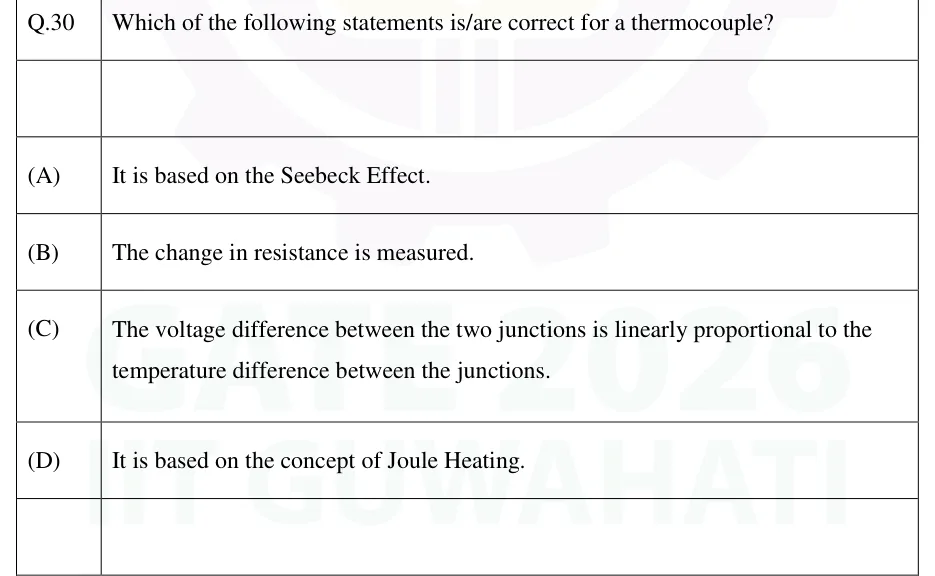
Which of the following statements is/are correct for a thermocouple?

  1. (A)

    It is based on the Seebeck Effect.

  2. (B)

    The change in resistance is measured.

  3. (C)

    The voltage difference between the two junctions is linearly proportional to the temperature difference between the junctions.

  4. (D)

    It is based on the concept of Joule Heating.
Answer and solution
See the question in the paper
GATE 2026 IN Q.30: answer and solution

GATE 2026 IN Q.51

GATE 2026 · INQ.51 · 2 marks · MCQ

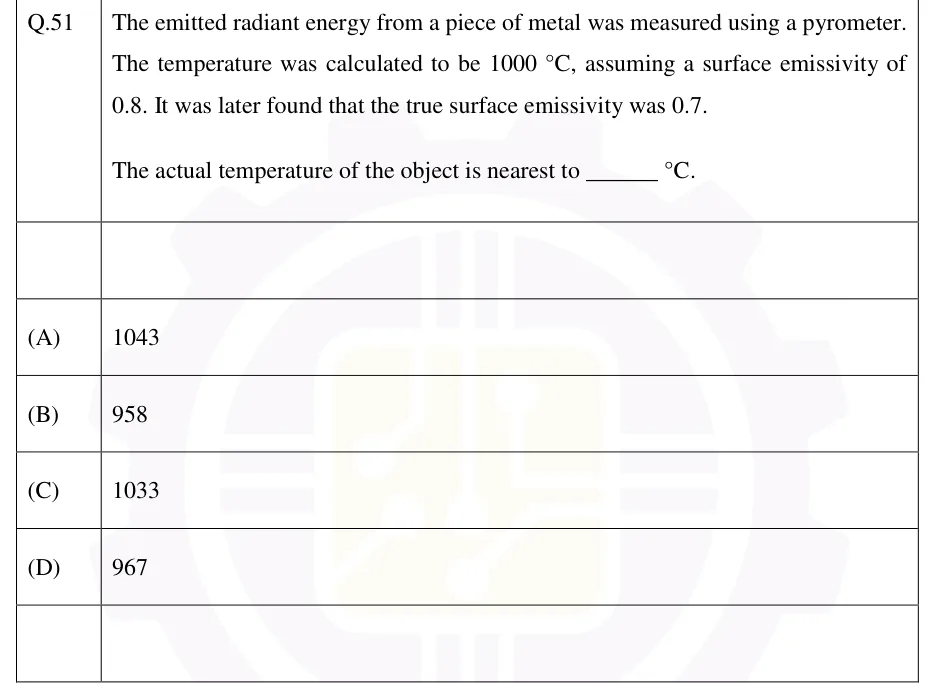
The emitted radiant energy from a piece of metal was measured using a pyrometer. The temperature was calculated to be 1000 °C, assuming a surface emissivity of 0.8. It was later found that the true surface emissivity was 0.7. The actual temperature of the object is nearest to ______ °C.

  1. (A)

    1043

  2. (B)

    958

  3. (C)

    1033

  4. (D)

    967

Answer and solution
See the question in the paper
GATE 2026 IN Q.51: answer and solution

GATE 2022 IN Q.19

GATE 2022 · INQ.19 · 1 mark · MCQ

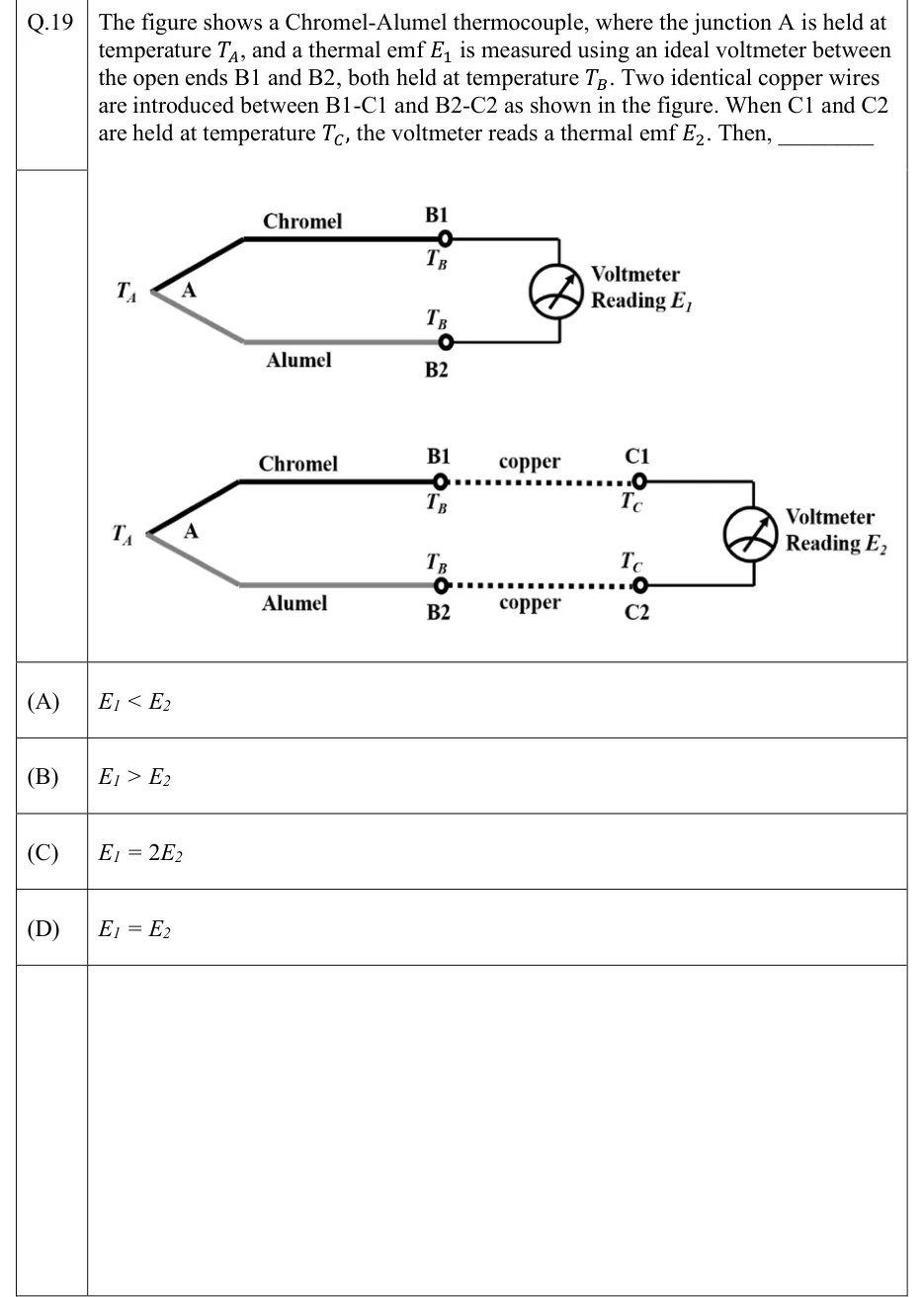
The figure shows a Chromel-Alumel thermocouple, where the junction A is held at temperature , and a thermal emf is measured using an ideal voltmeter between the open ends B1 and B2, both held at temperature . Two identical copper wires are introduced between B1-C1 and B2-C2 as shown in the figure. When C1 and C2 are held at temperature , the voltmeter reads a thermal emf . Then, ________

GATE 2022 IN question 19: Two sketches.Tap to open full size
Figure from the GATE 2022 IN paper. It is part of the question.
Figure description

Two sketches. Top: a Chromel wire (thick black) and an Alumel wire (grey) meet at junction A at temperature T_A on the left. Their open ends B1 (Chromel, upper) and B2 (Alumel, lower), both marked at temperature T_B, connect directly to a voltmeter reading E_1. Bottom: the same thermocouple with junction A at T_A and ends B1, B2 at T_B, but now a dotted copper wire runs from B1 to C1 and another identical copper wire from B2 to C2. C1 and C2 are both marked at temperature T_C, and the voltmeter, connected across C1 and C2, reads E_2.

  1. (A)

  2. (B)

  3. (C)

  4. (D)

Answer and solution
GATE 2022 IN Q.19: answer and solution

GATE 2018 IN Q.22

GATE 2018 · INQ.22 · 1 mark · NAT

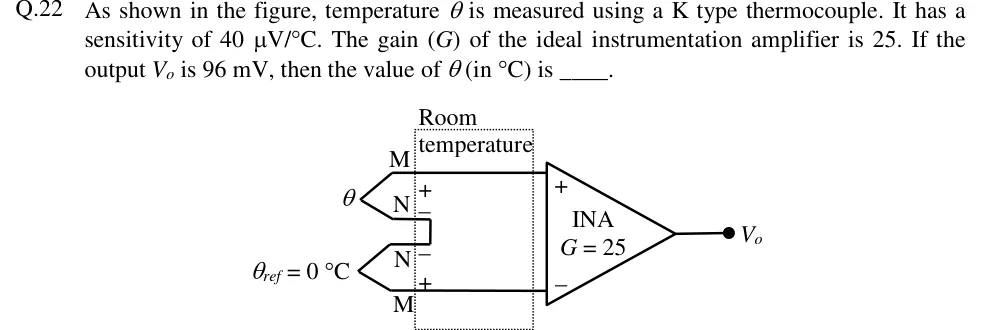
As shown in the figure, temperature is measured using a K type thermocouple. It has a sensitivity of . The gain () of the ideal instrumentation amplifier is 25. If the output is 96 mV, then the value of (in C) is ____.

GATE 2018 IN question 22: Two thermocouple junctions in series opposition.Tap to open full size
Figure from the GATE 2018 IN paper. It is part of the question.
Figure description

Two thermocouple junctions in series opposition. The measuring junction (M-N, labelled with temperature theta) is at the top-left, the reference junction (N-M, labelled theta_ref = 0 degC) at the bottom-left. The two N legs of the junctions are joined to each other by a short link inside a dotted box labelled 'Room temperature'. The M legs run out of the box, the top M lead to the + input and the bottom M lead to the - input of an ideal instrumentation amplifier (INA, G = 25), whose output is V_o.

Answer and solution
GATE 2018 IN Q.22: answer and solution

PRACTICE

5 questions to test yourself

PRACTICE 11 mark · NAT

A Pt100 RTD (R_0 = 100 Ω, linear law with α = 0.00385 per °C referred to 0 °C) is connected to a meter by two wires of resistance 2.0 Ω each. The meter assumes zero lead resistance. When the sensor is at 100 °C, what temperature in °C does the meter indicate?

Answer and solution

Answer: (accepted range )

  1. R_T = 100(1 + 0.00385 x 100) = 138.5 Ω.

  2. Measured resistance = 138.5 + 2(2.0) = 142.5 Ω.

  3. Indicated T = (142.5/100 - 1)/0.00385 = 0.425/0.00385 = 110.4 °C.

PRACTICE 22 marks · MCQ

An NTC thermistor has resistance 5 kΩ at 300 K and 2 kΩ at 330 K. Using R = R_0 exp[β(1/T - 1/T_0)], the value of β is nearest to:

  1. (A)

    2.75 x 10^3 K

  2. (B)

    3.02 x 10^3 K

  3. (C)

    3.30 x 10^3 K

  4. (D)

    3.63 x 10^3 K

Answer and solution

Answer: (B)

  1. β = ln(R_1/R_2)/(1/T_1 - 1/T_2) with T_1 = 300 K, T_2 = 330 K.

  2. 1/300 - 1/330 = 30/(300 x 330) = 1/3300 per K.

  3. ln(5/2) = 0.9163, so β = 3300 x 0.9163 = 3024 K.

PRACTICE 32 marks · MSQ

Which of the following statements about thermocouples are correct? (Emf is taken with the reference at 0 °C unless stated.)

  1. (A)

    Inserting a third homogeneous metal into the loop does not change the emf if its two new junctions are at the same temperature.

  2. (B)

    The emf depends on how the temperature varies along the wires between the two junctions.

  3. (C)

    A thermopile of N identical thermocouples in series, with all hot junctions at one temperature and all cold junctions at the other, gives N times the output emf of one thermocouple.

  4. (D)

    For hot junction at T_1 and cold junction at T_2, the emf equals E(T_1,0) - E(T_2,0).

Answer and solution

Answer: (A), (C), (D)

  1. A is the law of intermediate metals and is true.

  2. B is false: by the law of homogeneous circuit only the two junction temperatures matter.

  3. C is true: the emfs of identical thermocouples in series add.

  4. D is the law of intermediate temperatures and is true.

PRACTICE 42 marks · NAT

A temperature sensor behaves as a first-order system with time constant 5 s. It is at 30 °C when it is suddenly placed in a fluid at 130 °C. After how many seconds, to two decimal places, does it read 100 °C?

Answer and solution

Answer: (accepted range )

  1. T_m(t) = 130 - 100 e^{-t/5}.

  2. Set 100 = 130 - 100 e^{-t/5}, so e^{-t/5} = 0.3.

  3. t = 5 ln(1/0.3) = 5 x 1.204 = 6.02 s.

PRACTICE 51 mark · NAT

A total radiation pyrometer is calibrated for a black body. It views a surface of emissivity 0.5 whose true temperature is 900 K. Neglecting radiation from the surroundings, what temperature in kelvin does the pyrometer indicate?

Answer and solution

Answer: (accepted range )

  1. The pyrometer reading satisfies σT_a^4 = εσT^4.

  2. T_a = T ε^{1/4} = 900 x (0.5)^{0.25}.

  3. (0.5)^{0.25} = 0.8409, so T_a = 756.8 K.

OFFICIAL GATE 2027 SYLLABUS WORDING

Copied from the GATE 2027 syllabus; see all 2027 syllabi.

GATE IN

temperature (thermocouple, bolometer, 2, 3, 4 wire RTD, thermistor, pyrometer and semiconductor sensor)

Preparing in Kolkata? IAE Academy's course for GATE IN.