
IAE Academy

GATE 2026 IN Q.30: solution and answer

GATE 2026 · INQ.30 · 1 mark · MSQ

Which of the following statements is/are correct for a thermocouple?

  1. (A)

    It is based on the Seebeck Effect.

  2. (B)

    The change in resistance is measured.

  3. (C)

    The voltage difference between the two junctions is linearly proportional to the temperature difference between the junctions.

  4. (D)

    It is based on the concept of Joule Heating.
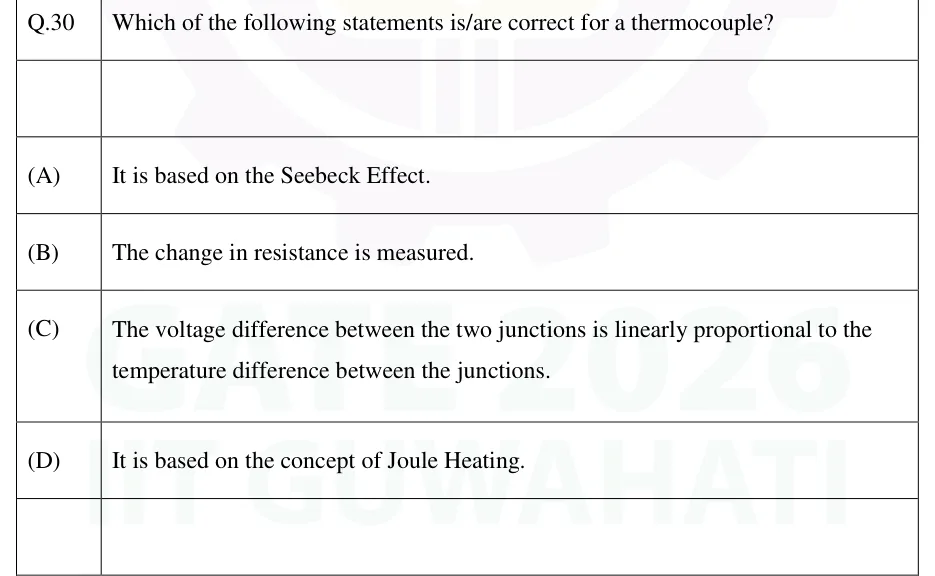
See the question in the paper

Answer and solution

ANSWER

Only (A) is correct: a thermocouple works on the Seebeck effect. Its emf is not linearly proportional to the junction temperature difference in general.

Official answer: ASource: Official answer key, GATE 2026 IN (IIT Guwahati)

  1. A thermocouple is two dissimilar metals joined at two junctions: a measuring (hot) junction at and a reference (cold) junction at , often held at . When a thermo-emf appears in the loop. This is the Seebeck effect, so (A) is correct.

  2. A thermocouple is a self-generating (active) sensor: its output is a voltage, and no change in resistance is measured. Measuring a change in resistance describes an RTD or a thermistor. (B) is wrong.

  3. The Seebeck coefficient is itself a function of temperature, so the emf is , not a constant times . Over a working range it is described by a polynomial, (with the reference junction at ), which is why reference tables or polynomial correction are needed to convert emf to temperature.

  4. So the emf is only approximately proportional to the temperature difference over a narrow range; in general the relation is non-linear. Statement (C), which states a linear proportionality without qualification, is therefore wrong.

  5. Joule heating is dissipation in a conductor carrying current. It is a loss effect and is not the working principle of a thermocouple; it does not depend on the direction of current or on a junction of dissimilar metals. (D) is wrong.

  6. Only statement (A) is correct.

KEY IDEA

A thermocouple is a self-generating sensor based on the Seebeck effect. Its emf is , and because the Seebeck coefficient varies with temperature, the emf-temperature relation is non-linear (a polynomial). It is only approximately linear over a small range.

WATCH OUT FOR

Treating the first-order approximation as exact and marking (C). The thermocouple characteristic is non-linear, which is why reference tables and polynomial fits are used. Another slip is confusing a thermocouple with an RTD (resistance change) or naming Joule heating instead of the Seebeck effect.

From the GATE 2026 IN paper. Every question of this paper · Download the full paper · All 5 Temperature questions, with notes

More Temperature questions