
IAE Academy

GATE 2018 IN Q.22: solution and answer

GATE 2018 · INQ.22 · 1 mark · NAT

As shown in the figure, temperature is measured using a K type thermocouple. It has a sensitivity of . The gain () of the ideal instrumentation amplifier is 25. If the output is 96 mV, then the value of (in C) is ____.
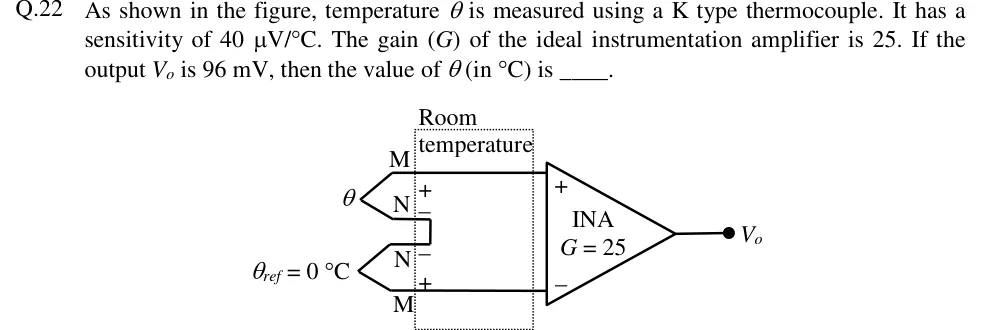
GATE 2018 IN question 22: Two thermocouple junctions in series opposition.Tap to open full size
Figure from the GATE 2018 IN paper. It is part of the question.
Figure description

Two thermocouple junctions in series opposition. The measuring junction (M-N, labelled with temperature theta) is at the top-left, the reference junction (N-M, labelled theta_ref = 0 degC) at the bottom-left. The two N legs of the junctions are joined to each other by a short link inside a dotted box labelled 'Room temperature'. The M legs run out of the box, the top M lead to the + input and the bottom M lead to the - input of an ideal instrumentation amplifier (INA, G = 25), whose output is V_o.

Answer and solution

ANSWER

Official answer: 95 to 97Source: Official answer key, GATE 2018 IN (IIT Guwahati)

  1. The two thermocouple junctions (M-N at and N-M at ) are connected in series opposition through the joined N legs. Every other joint (the N-N link and the M leads meeting the amplifier terminals) is at room temperature, and by the law of intermediate metals and temperatures these add no net emf. The net emf is therefore .

  2. The reference junction is at and , so .

  3. The ideal instrumentation amplifier has gain and the emf is applied across its inputs, so .

  4. The input emf is

  5. The temperature is

KEY IDEA

With the reference junction at , the thermocouple emf is . An ideal amplifier of gain gives , so . Joints at room temperature in the circuit add no net emf.

WATCH OUT FOR

Forgetting to divide by the amplifier gain, or mixing mV with V and being off by a factor of 1000. Another slip is to subtract room temperature from , even though the reference junction here is held at .

From the GATE 2018 IN paper. Every question of this paper · Download the full paper · All 5 Temperature questions, with notes

More Temperature questions