GATE 2023 IN Q.13
Which of the following flow meters offers the lowest resistance to the flow?
- (A)
Turbine flow meter
- (B)
Orifice flow meter*
- (C)
Venturi meter
- (D)
Electromagnetic flow meter

GATE IN
Pressure and flow measurement covers how a process pressure is sensed (liquid columns, elastic elements, low- and high-pressure gauges) and how volumetric flow is inferred from differential pressure, float position, induced emf, ultrasonic timing or turbine speed. These notes collect the square-law and linear relations, the conditions behind each meter, and which meter suits which fluid and range.
2 previous-year questions · 2 solved · 6 practice questions
Pressure is normal force per unit area, measured in pascal (Pa = N/m²) in SI. Convention: gauge pressure is measured relative to the local atmosphere, absolute pressure relative to a perfect vacuum, and a vacuum (negative gauge) reading is the amount by which the pressure is below atmospheric. Useful equivalents: 1 atm = 101325 Pa = 760 mmHg, 1 bar = Pa, 1 torr ≈ 1 mmHg ≈ 133.3 Pa.
ABSOLUTE AND GAUGE PRESSURE
Gauge pressure is negative below atmospheric; absolute pressure is never negative.
HYDROSTATIC PRESSURE
SI units. p is the pressure difference between two points a vertical height h apart in a fluid of density at rest.
U-TUBE MANOMETER
Both pressure taps at the same elevation. is the manometer liquid, the fluid above it in the limbs, h the difference of levels. For a gas, and .
INCLINED-TUBE MANOMETER
L is the reading along the inclined tube of area a, its angle to the horizontal, A the area of the well; a gas sits above the liquid (otherwise use ). For the vertical height is , so the reading is times what a vertical tube would show. The magnification rises as falls, so it suits small pressures.
WELL-TYPE MANOMETER
h is the rise read on the vertical tube of area a, A the area of the well. The well level falls by ; only the tube reading is taken. For it reduces to .
EXAM TIP
In a U-tube with a liquid of density above the manometer liquid on both limbs, subtract it: use . Forgetting this is a common error when water sits above mercury. A gas above the liquid can usually be neglected.
An elastic element deflects when pressure acts on it. The deflection is small and roughly proportional to pressure within the elastic limit, so a secondary transducer converts it to an electrical signal (or a pointer movement).
Element | Motion produced | Typical use |
|---|---|---|
Bourdon tube (C, spiral, helical) | Closed end moves as the flattened oval section tends to become circular; spiral and helical forms give larger motion | Medium to very high pressure; also vacuum and compound (pressure-vacuum) ranges |
Diaphragm (flat, corrugated, capsule) | Centre deflection | Low pressure and small differential pressures; capsules for the lowest ranges |
Bellows | Axial extension against a spring | Low to medium pressure, larger stroke |
FLAT CLAMPED DIAPHRAGM, CENTRE DEFLECTION
Circular flat diaphragm clamped at its edge, radius R, thickness t, Young's modulus E, Poisson's ratio , uniform pressure difference p. Valid while the deflection is small compared with the thickness; the deflection is then linear in p.
Secondary transducers used with these elements include the potentiometer, LVDT, variable capacitance (diaphragm as one plate), bonded strain gauges on the diaphragm, and piezoresistive silicon diaphragms. With an LVDT the output voltage is proportional to core displacement within its linear range, hence to pressure.
EXAM TIP
A Bourdon gauge reads gauge pressure, because the outside of the tube is at atmospheric pressure. An element with an evacuated, sealed reference chamber (for example an evacuated capsule) reads absolute pressure.
Below about 1 mmHg, liquid and elastic gauges lose sensitivity, so gauges that depend on a gas property are used. The ranges below are approximate and differ between instruments.
Gauge | Principle | Approximate range | Note |
|---|---|---|---|
McLeod | Compresses a known gas volume (Boyle's law) and reads a mercury column | about to 10 mmHg | Absolute; independent of the kind of gas for non-condensable gases, but vapours condense on compression and are misread; used as a calibration standard; not continuous |
Pirani | Heat loss of a heated filament depends on gas thermal conductivity, which varies with pressure; filament resistance is read in a bridge | about to 1 mmHg | Calibration depends on the gas |
Thermocouple gauge | Thermocouple on a heated filament senses its temperature, which varies with gas conduction | about to 1 mmHg | Same principle as Pirani; gas-dependent |
Hot-cathode ionisation | Electrons from a hot cathode ionise gas; for a fixed electron emission current the ion current is proportional to pressure | about to mmHg | Very low pressures; calibration depends on the gas; the filament can burn out if exposed to air at high pressure |
Cold-cathode (Penning) ionisation | A high-voltage discharge in a magnetic field ionises gas; discharge current rises with pressure | about to mmHg | No hot filament, so robust; calibration depends on the gas |
MCLEOD GAUGE (SQUARE-LAW READING)
The gas of total trapped volume V at unknown pressure p is compressed into a closed capillary of area a. The mercury in the open reference capillary is raised level with the closed end, so the trapped gas column length equals the level difference h. Boyle's law gives with pressures in mmHg; use consistent units (a in mm², h in mm, V in mm³ gives p in mmHg).
A Knudsen (radiometer) gauge measures the force on a vane from gas molecules leaving a heated surface; at very low pressure its reading does not depend on the kind of gas. For high pressure (hundreds of bar and above) heavy-wall Bourdon tubes and strain-gauge or piezoresistive diaphragm transducers are used. The Bridgman gauge uses a coil of manganin wire whose resistance changes almost linearly with pressure. Piezoelectric sensors respond to changes in pressure only (dynamic pressure) and cannot hold a static value. A dead-weight tester is the primary standard used to calibrate pressure gauges.
DEAD-WEIGHT TESTER
m is the total mass of the piston and the weights on it, the effective piston area; the oil pressure that floats the piston is applied to the gauge under test. SI units.
CONTINUITY
Q volumetric flow rate, v mean velocity, mass flow rate.
BERNOULLI (HORIZONTAL)
Steady, incompressible, frictionless flow along a streamline at the same elevation.
A variable-head (differential-pressure) meter places a restriction in the pipe; velocity rises and static pressure falls. The pressure drop across the restriction is measured. The ratio of throat (or orifice) diameter to pipe diameter sets the severity of the restriction. A discharge coefficient accounts for friction and flow contraction.
ORIFICE, VENTURI AND NOZZLE FLOW RATE
is the throat or orifice area, , the fluid density; incompressible fluid. is the velocity-of-approach factor, and is called the flow coefficient. Q is proportional to . For a gas with an appreciable pressure drop, multiply by an expansibility factor .
VARIABLE-HEAD METER WITH A U-TUBE MANOMETER
h is the manometer level difference, the manometer liquid, the flowing liquid filling the leads; from . The manometer reads the piezometric difference, so the same relation holds for an inclined or vertical meter.
PITOT TUBE
stagnation pressure, static pressure, ; incompressible flow (low Mach number for a gas). Gives the local velocity at the tip, not the mean velocity.
Meter | Permanent pressure loss | Remarks |
|---|---|---|
Orifice plate | Highest | Cheap, easy to fit, simple to change |
Flow nozzle | Medium | Suits high-velocity, high-temperature flows such as steam; its rounded inlet erodes less than a sharp orifice edge |
Venturi tube | Lowest | Gradual cone and diffuser give good pressure recovery; costly and long |
EXAM TIP
Because , the differential-pressure transmitter output for a linear flow signal needs a square-root extractor, and low flows are measured with poor accuracy (a 10 % flow gives only 1 % of full-scale ). Quadrupling only doubles the flow.
WORKED EXAMPLE
An orifice plate of bore 50 mm is fitted in a 100 mm pipe carrying water ( kg/m³). The measured differential pressure is 20 kPa and . Find the volumetric flow rate.
, so and .
Orifice area m².
m/s.
m³/s.
Answer: m³/s, about 7.7 L/s.
In a rotameter a float, denser than the fluid, sits in a vertical tapered tube, with flow going upward. The float rises until the annular gap is large enough for the pressure drop across the float to balance its weight less buoyancy. That pressure drop stays constant (hence 'variable area, constant head'), and the float height indicates the flow. The meter must be mounted vertically.
ROTAMETER
annular area between float and tube, float volume, float cross-section, float density, fluid density. With a small linear taper, and the bore at the zero mark equal to the float diameter, and so Q are nearly proportional to float height, giving a nearly linear scale. The calibration holds only for the fluid density (and viscosity) it was made for.
EXAM TIP
The mass flow is , which is stationary at . A float of density about twice the fluid density therefore makes the mass-flow reading insensitive to small changes in fluid density.
The electromagnetic flowmeter applies Faraday's law: a conducting liquid moving at velocity v through a transverse magnetic field B in a pipe of diameter D induces an emf between two electrodes on a diameter perpendicular to both v and B.
ELECTROMAGNETIC FLOWMETER
Uniform field B; v is the mean velocity for axisymmetric flow; SI units (B in tesla). The emf is linear in flow and, above the minimum conductivity, independent of density, viscosity, temperature and pressure.
Conditions for an electromagnetic flowmeter
The fluid must be electrically conductive (a minimum conductivity of the order of microsiemens per centimetre); it cannot measure gases or most pure hydrocarbons.
The meter tube is non-magnetic and has an insulating liner so the emf is not short-circuited.
No obstruction and negligible pressure drop; the pipe must run full.
Pulsed DC or AC excitation is used to avoid electrode polarisation and drift.
WORKED EXAMPLE
An electromagnetic flowmeter on a 100 mm pipe uses a field of 0.05 T. Water flows at 0.01 m³/s. Find the induced emf.
Pipe area m².
Mean velocity m/s.
V.
Answer: mV.
An ultrasonic transit-time flowmeter sends pulses diagonally across the pipe, once with the flow and once against it. The pulse travelling downstream arrives sooner. The path length is L and the path makes an angle with the flow; c is the speed of sound in the fluid. The velocity v obtained is the average along the acoustic path; a profile correction relates it to the mean velocity over the pipe area.
ULTRASONIC TRANSIT-TIME
From and . Since the approximation is used, so . It needs a clean fluid, and this form depends on c, which varies with temperature.
TRANSIT-TIME, RECIPROCAL FORM
Exact, and independent of the speed of sound c, so a meter computing v this way is not affected by temperature changes in c.
ULTRASONIC DOPPLER
is the transmitted frequency and the angle between the beam and the flow, with transmitter and receiver both at that angle. The beam is reflected by particles or bubbles moving with the fluid, so the fluid must contain scatterers.
A turbine flowmeter has a bladed rotor whose speed is proportional to the flow velocity over its working range. A magnetic pickup produces a pulse each time a blade passes.
TURBINE FLOWMETER
f is the pulse frequency, K the K-factor in pulses per unit volume; the total count gives total volume. Linear over its working range; needs clean, low-viscosity fluid (K changes with viscosity), and wears in the bearings.
Mass flow. Volumetric meters give only if the density is known; for gases it is corrected for pressure and temperature. A differential-pressure meter gives . Coriolis and thermal mass flowmeters read mass flow directly.
Meter | Fluid needed | Output vs flow | Obstruction in pipe |
|---|---|---|---|
Orifice, venturi, nozzle | Clean fluid, gas or liquid | (square law) | Yes |
Rotameter | Clean fluid, gas or liquid | About linear in float height | Float in tapered tube |
Electromagnetic | Conductive liquid | Linear | None |
Ultrasonic transit time | Clean fluid | Linear in | None |
Ultrasonic Doppler | Fluid with particles or bubbles | Linear in | None |
Turbine | Clean, low-viscosity fluid | Linear in frequency | Rotor |
EXAM TIP
When a question gives a fluid and asks which meter works, check the conditions first: a non-conductive fluid rules out the electromagnetic meter; a dirty fluid or slurry rules out transit time (Doppler suits it); for slurries and abrasive fluids prefer a meter with no obstruction (electromagnetic if the liquid is conductive, or Doppler).
PREVIOUS-YEAR QUESTIONS
Try each question first, then open the answer. We placed each question under a topic ourselves; the exam paper does not label topics.
See these papers in full: GATE IN 2023 · GATE IN 2018
Which of the following flow meters offers the lowest resistance to the flow?
Turbine flow meter
Orifice flow meter*
Venturi meter
Electromagnetic flow meter
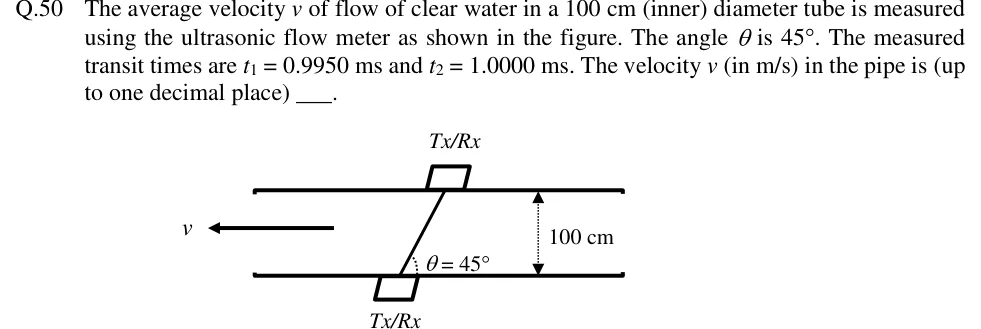
The average velocity of flow of clear water in a 100 cm (inner) diameter tube is measured using the ultrasonic flow meter as shown in the figure. The angle is . The measured transit times are ms and ms. The velocity (in m/s) in the pipe is (up to one decimal place) ___.
 Tap to open full size
A horizontal pipe drawn as two parallel horizontal walls, with the inner diameter marked 100 cm by a vertical double-headed dotted arrow at the right. An arrow labelled v points left, showing the flow direction. Two transducers, each labelled Tx/Rx, are mounted one on the top wall and one on the bottom wall, offset along the pipe axis. A slanted straight line joins them, crossing the pipe at angle theta = 45 degrees to the pipe axis (angle marked at the lower transducer, measured from the bottom wall to the slanted path).
PRACTICE
An inclined-tube manometer uses a liquid of density 800 kg/m³ and is set at to the horizontal. Its well is large enough for the change in well level to be neglected, and the pressures applied are of a gas. The liquid moves 0.25 m along the tube. Taking m/s², find the pressure difference in Pa.
Answer: (accepted range )
.
.
Pa.
For an orifice meter in a pipe carrying an incompressible fluid, the differential pressure across the plate is increased to four times its value, all else unchanged. The volumetric flow rate becomes
the same
twice
four times
sixteen times
Answer: (B)
.
, so the flow doubles.
An ultrasonic transit-time flowmeter has a diagonal path of length 0.30 m inclined at to the flow. The speed of sound in the liquid is 1500 m/s and the mean flow velocity is 2 m/s. Find the difference between upstream and downstream transit times in nanoseconds.
Answer: (accepted range )
.
.
s ns. The exact expression gives the same value to the digits shown.
Which of the following statements about an electromagnetic flowmeter are correct?
The measured fluid must be electrically conductive.
For axisymmetric flow the induced emf is proportional to the mean velocity.
It can be used for dry air in a pipe.
It introduces essentially no obstruction or pressure drop in the pipe.
Answer: (A), (B), (D)
Faraday's law needs a conducting fluid, so A is true and C is false.
gives emf proportional to mean velocity: B true.
No part of the meter projects into the flow: D true.
A turbine flowmeter has a K-factor of 250 pulses per litre. A counter records 12000 pulses in exactly one minute. Find the average flow rate in litres per minute.
Answer: (accepted range )
Volume L in one minute.
So the average flow rate is 48 L/min.
A McLeod gauge has total trapped gas volume and a closed capillary of cross-section . The gas is compressed so that the column in the capillary has height mm, equal to the level difference. Assuming , the pressure of the gas is closest to
mmHg
mmHg
mmHg
mmHg
Answer: (B)
Convert units: .
mmHg.
Check: , so the approximation holds.
OFFICIAL GATE 2027 SYLLABUS WORDING
Copied from the GATE 2027 syllabus; see all 2027 syllabi.
GATE IN
pressure (including low and high pressure), flow (variable head, variable area, electromagnetic, ultrasonic, turbine flowmeters)
Preparing in Kolkata? IAE Academy's course for GATE IN.