IAE Academy

GATE IN

Level, pH, conductivity and viscosity

This topic covers four process measurements: liquid level (hydrostatic head, bubbler, displacer, float, capacitive, ultrasonic and radar), pH (glass electrode and the Nernst slope), conductivity (cell constant, AC excitation and temperature compensation) and viscosity (capillary, falling-sphere, rotational and efflux types). Questions here are short calculations from a handful of formulas plus conceptual choices, such as why a pH amplifier needs very high input impedance or which level method ignores the vapour space.

1 previous-year question · 1 solved · 5 practice questions

Level by hydrostatic head and displacer

A liquid column of height and density produces a pressure at its base. A differential pressure (DP) transmitter converts this pressure to a level signal. SI units are used throughout: pressure in Pa, density in kg/m, m/s. The output is a 4-20 mA loop with 4 mA as the live zero.

HYDROSTATIC HEAD

Open tank, high side to the tank, low side to atmosphere; is the liquid height above the tapping point. If the transmitter sits a height below the tapping point (impulse line full of the same liquid), , and the transmitter is given a zero suppression of so that empty still reads 4 mA.

In a bubbler (purge or dip-tube) system, air or nitrogen is fed slowly down a tube that reaches near the tank bottom. Once gas bubbles out of the tube end, the gas back-pressure equals the hydrostatic pressure of the liquid above the tube end (open tank), and a pressure gauge or transmitter reads it. Like any hydrostatic method, it depends on the liquid density.

In a closed (pressurised) tank, the vapour pressure acts on the liquid surface as well. The low side of the transmitter is connected to the top of the tank. With a dry low-side leg (vapour only, its own weight negligible and no condensation), the vapour pressure cancels and the DP still depends only on . If vapour can condense in the leg, the leg is deliberately filled with liquid. A wet leg of height and density adds a constant pressure on the low side, so the DP becomes , which is negative at low level. The transmitter is then given a zero elevation: its lower range value is set to so that empty still gives 4 mA.

DP WITH A WET LEG (CLOSED TANK)

Wet leg of height above the high-side tapping, on the low side. Lower range value (4 mA), upper range value (20 mA); the span is still .

A displacer is a long cylinder hung in the liquid. By Archimedes' principle, the upward buoyant force equals the weight of liquid displaced. As the level rises, more of the displacer is submerged, the apparent weight falls, and a force or torque sensor reads the level. A float, by contrast, rides on the surface and gives the position directly.

BUOYANT FORCE ON A DISPLACER

is the displacer's uniform cross-sectional area and the submerged length (partly submerged); the buoyancy of the vapour above the liquid is neglected. Apparent weight , where is the displacer's weight in air.

EXAM TIP

Hydrostatic, bubbler and displacer methods all depend on the liquid density, so a change in density (temperature or composition) causes a level error. A float follows the surface; its immersion depth shifts only slightly with density, so its density error is small by comparison.

Capacitive, ultrasonic and radar level

A capacitive probe is a rod (radius ) inside a coaxial tube or the metal tank wall (inner radius ). The liquid replaces air as the dielectric over the wetted length , so the capacitance increases linearly with level. For an insulating liquid of relative permittivity and probe length :

COAXIAL CAPACITIVE LEVEL PROBE

Insulating liquid, , gas above the liquid taken as , end (fringing) effects neglected. Capacitance is linear in ; at it is the empty value .

For a conducting liquid, the probe rod is insulated and the liquid acts as the second plate, so capacitance again rises with the wetted length. Here the insulating sleeve's thickness and permittivity set the capacitance per unit length, so the reading depends very little on the liquid's own permittivity.

Ultrasonic and radar sensors are non-contact. A transmitter at the top of the tank, at height above the tank bottom, sends a pulse and times the echo from the liquid surface. The distance to the surface is half the round-trip path.

ECHO-TIME LEVEL (ULTRASONIC OR RADAR)

is the round-trip time and the wave speed in the space above the liquid: speed of sound for ultrasonic, speed of light for radar.

Method

Contact with liquid

Depends on liquid density

Main limitation

Float

Yes

Little

Moving parts; sticky liquids

Displacer

Yes

Yes, directly

Density change gives error

DP (hydrostatic) or bubbler

Via tapping point or dip tube

Yes, directly

Density change; impulse-line care in closed tanks

Capacitive

Yes

No, but depends on (insulating liquid)

Coating of the probe; change

Ultrasonic

No

No

Speed of sound varies with temperature and gas; needs a gas path (no vacuum); foam and vapour affect it

Radar

No

No

Needs the liquid to reflect the beam; very low gives a weak echo

EXAM TIP

The speed of sound in a gas rises with absolute temperature, with in kelvin (about 343 m/s in air at 20 °C), so ultrasonic level needs temperature compensation, and it cannot work in vacuum. The speed of electromagnetic waves in the vapour space is essentially constant for most vapours at ordinary pressures, so radar normally needs no such correction and also works in vacuum. A dense high-pressure vapour, such as high-pressure steam, slows the wave noticeably and is the exception.

pH measurement

pH is defined as , where is the hydrogen-ion activity; in dilute solutions this is close to with in mol/L. A glass electrode has a thin hydrogen-sensitive glass membrane. The potential across it, measured against a reference electrode, follows the Nernst equation. Convention used here: the measured potential falls as pH rises (the sign reverses if the cell's leads are swapped; the slope magnitude does not change).

NERNST EQUATION FOR A PH ELECTRODE

J/(mol K), C/mol, in kelvin. is the potential at pH 0 and combines the reference and internal potentials. An ideal electrode with its isopotential point at pH 7 and zero offset gives , that is, 0 mV at pH 7.

ELECTRODE SLOPE

in kelvin. At 25 °C ( K) the slope is about 59.16 mV per pH; at 0 °C about 54.2 mV; at 50 °C about 64.1 mV.

The reference electrode (commonly silver/silver chloride) gives a fixed potential through a liquid junction; a combination electrode houses the glass and reference electrodes in one body. A meter is calibrated with two buffer solutions: one buffer (usually pH 7) sets the offset and a second sets the slope. The glass response departs from the ideal slope at very high pH (alkaline or sodium error, reading too low) and at very low pH (acid error).

Because the slope depends on temperature, a pH meter includes a temperature sensor, often a Pt100 or thermistor, and applies automatic temperature compensation. This corrects the slope. It does not correct the change of the solution's own pH with temperature, which is a real chemical change.

The glass membrane has a very high resistance, typically about 10 MΩ to 1000 MΩ. The measuring amplifier must therefore have an input impedance much larger still (of the order of ). Otherwise a current drawn from the electrode drops voltage across the membrane resistance and causes a loading error. Short, shielded cable is also needed to limit leakage and noise pickup.

EXAM TIP

A change of one pH unit means a change of about 59 mV at 25 °C, and the potential changes by the same amount for each unit, so equal pH steps give equal voltage steps. The slope grows with temperature, so a reading taken at any temperature different from the calibration temperature needs slope compensation.

Conductivity measurement

The conductivity of an electrolyte (SI unit S/m) is found by measuring the conductance between two electrodes in a cell. The cell constant depends only on geometry, assuming a uniform field between parallel electrodes of area separated by distance .

CELL CONSTANT AND CONDUCTIVITY

in m, the measured cell resistance in ohms, in S/m. Unit conversion: 1 S/m S/cm.

  1. Use AC excitation, typically in the range of hundreds of hertz to a few kilohertz.

  2. DC would cause electrolysis and electrode polarisation, which adds a false voltage drop at the electrode surface and makes the measured resistance wrong. Platinised (platinum-black) electrodes further reduce polarisation.

  3. Low-conductivity liquids (pure water) use a small cell constant, and high-conductivity liquids use a large one, so that the cell resistance stays in a convenient range.

  4. Electrodeless (toroidal or inductive) cells couple to the liquid through two coils with no electrodes in contact, which suits high-conductivity, corrosive or fouling liquids.

  5. Temperature compensation is needed, because ionic conductivity increases with temperature.

LINEAR TEMPERATURE COMPENSATION OF CONDUCTIVITY

in °C, readings referred to 25 °C; is the solution's temperature coefficient, about 0.02 per °C for many salt solutions. The meter reports .

EXAM TIP

The resistance of a metal conductor rises with temperature, but the resistance of an electrolyte falls, because its ions move more freely. Do not carry the metal intuition over to electrolytes: for an electrolyte, higher temperature means lower cell resistance.

Viscosity measurement

Dynamic viscosity (Pa s) is the ratio of shear stress to shear rate in a Newtonian fluid; for a non-Newtonian fluid this ratio changes with shear rate and is called the apparent viscosity. Kinematic viscosity is (m/s). Older units: 1 poise (P) Pa s, so 1 cP mPa s; 1 stokes (St) m/s, so 1 cSt m/s. Three standard principles are used, plus efflux cups.

CAPILLARY VISCOMETER (POISEUILLE)

Steady, fully developed laminar flow of a Newtonian liquid in a tube of radius and length under pressure drop ; is the volume flow rate.

FALLING-SPHERE VISCOMETER (STOKES)

Sphere radius and density falling at constant terminal speed in an unbounded Newtonian liquid of density ; valid for small Reynolds number ( below about 1, creeping flow). Near a container wall the sphere falls slower, so a wall correction is needed.

ROTATIONAL (CONCENTRIC CYLINDER) VISCOMETER

Inner cylinder of radius and immersed height turns at angular speed relative to a coaxial outer cylinder of radius (either cylinder may be the one turning); is the torque. Steady laminar flow of a Newtonian liquid, end effects neglected.

In the capillary type, the flow rate or time for a fixed volume to pass is measured under a known pressure drop. In the falling-sphere type, the sphere is timed over a known distance to get . In the rotational type, the torque at a fixed speed (or the speed at fixed torque) gives directly; it also suits non-Newtonian fluids because the shear rate can be varied. Efflux-cup (orifice) viscometers time the outflow of a fixed volume through a short orifice and convert the time to kinematic viscosity with an empirical relation of the form , where and are instrument constants.

WORKED EXAMPLE

An open tank holds a liquid of density 800 kg/m. A DP transmitter at the tank bottom is calibrated so that a level of 0 m gives 4 mA and 5 m gives 20 mA, linear. Take m/s. Find the DP at full level and the current at a level of 3 m.

Solution
  1. DP at full level: Pa kPa.

  2. The output is linear in level, so mA.

  3. mA.

Answer: Full-level DP is 39.24 kPa and the current at 3 m is 13.6 mA.

WORKED EXAMPLE

A glass pH electrode behaves ideally with the Nernst slope. The electrode potential is 0 mV at pH 7. Find the potential difference between pH 4 and pH 7 buffers at 50 °C. Use mV per pH with in kelvin.

Solution
  1. K.

  2. Slope: mV per pH.

  3. The pH difference is units, so the potential difference is mV.

  4. The potential at pH 4 is higher than at pH 7, since decreases as pH rises in the convention used here.

Answer: About 192.4 mV, with pH 4 more positive than pH 7.

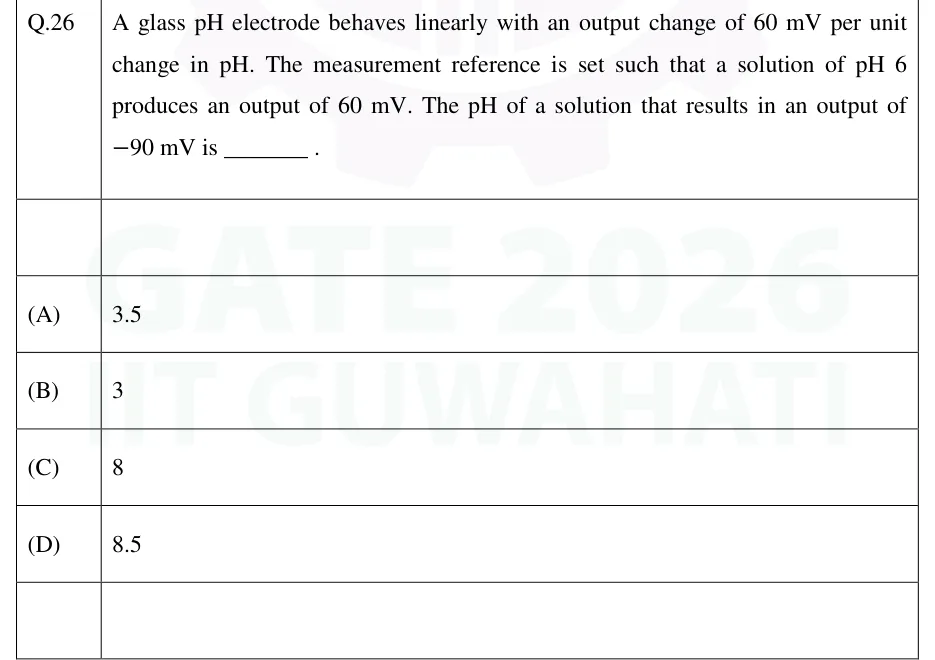
PREVIOUS-YEAR QUESTIONS

1 question from the IN papers

Try each question first, then open the answer. We placed each question under a topic ourselves; the exam paper does not label topics.

See these papers in full: GATE IN 2026

PRACTICE

5 questions to test yourself

PRACTICE 11 mark · NAT

An open tank contains water of density 1000 kg/m to a height of 2.5 m above the tapping point of a DP transmitter at the bottom. Take m/s. The differential pressure, in kPa, is ______ (round to two decimal places).

Answer and solution

Answer: (accepted range )

  1. For an open tank, .

  2. Pa.

  3. In kPa this is 24.525, which is 24.53 to two decimal places.

PRACTICE 21 mark · MCQ

A glass pH electrode follows the Nernst equation with slope mV per pH ( in kelvin). Its slope at 37 °C, in mV per pH, is closest to

  1. (A)

    54.2

  2. (B)

    59.2

  3. (C)

    61.5

  4. (D)

    64.1

Answer and solution

Answer: (C)

  1. K.

  2. mV per pH.

  3. Options A, B and D correspond to about 0 °C, 25 °C and 50 °C respectively.

PRACTICE 32 marks · MSQ

Which of the following statements are correct?

  1. (A)

    A glass pH electrode needs a measuring amplifier of very high input impedance because the glass membrane resistance is very large.

  2. (B)

    A conductivity cell is best excited with DC to avoid noise from the supply frequency.

  3. (C)

    Radar level measurement requires correction for the temperature dependence of the speed of sound in the vapour space.

  4. (D)

    The echo time in an ultrasonic level sensor depends on the speed of sound in the gas above the liquid.

Answer and solution

Answer: (A), (D)

  1. A is true: a low-impedance input would draw current through the large membrane resistance and cause a loading error.

  2. B is false: DC causes electrolysis and polarisation at the electrodes, so AC excitation is used.

  3. C is false: radar uses electromagnetic waves, not sound, and their speed in the vapour space is essentially constant at ordinary pressures.

  4. D is true: with the speed of sound in the gas, so for a given level the echo time depends on .

PRACTICE 42 marks · NAT

A conductivity cell has two parallel electrodes, each of area 2 cm, separated by 1 cm, and the field between them is uniform. The measured resistance of the cell filled with an electrolyte is 250 . The conductivity of the electrolyte, in S/m, is ______ .

Answer and solution

Answer: (accepted range )

  1. Cell constant: .

  2. S/m.

PRACTICE 52 marks · NAT

A glass sphere of radius 1 mm and density 2500 kg/m falls at a constant terminal speed of 0.02 m/s in a liquid of density 900 kg/m. Assume Stokes' law applies and take m/s. The dynamic viscosity of the liquid, in Pa s, is ______ (round to three decimal places).

Answer and solution

Answer: (accepted range )

  1. Stokes: .

  2. Numerator: .

  3. Denominator: .

  4. Pa s, which is 0.174 to three decimal places.

  5. Check: , below 1, so Stokes' law is valid.

OFFICIAL GATE 2027 SYLLABUS WORDING

Copied from the GATE 2027 syllabus; see all 2027 syllabi.

GATE IN

liquid level, pH, conductivity and viscosity measurement

Preparing in Kolkata? IAE Academy's course for GATE IN.