IAE Academy

GATE 2026 IN Q.26: solution and answer

GATE 2026 · INQ.26 · 1 mark · MCQ

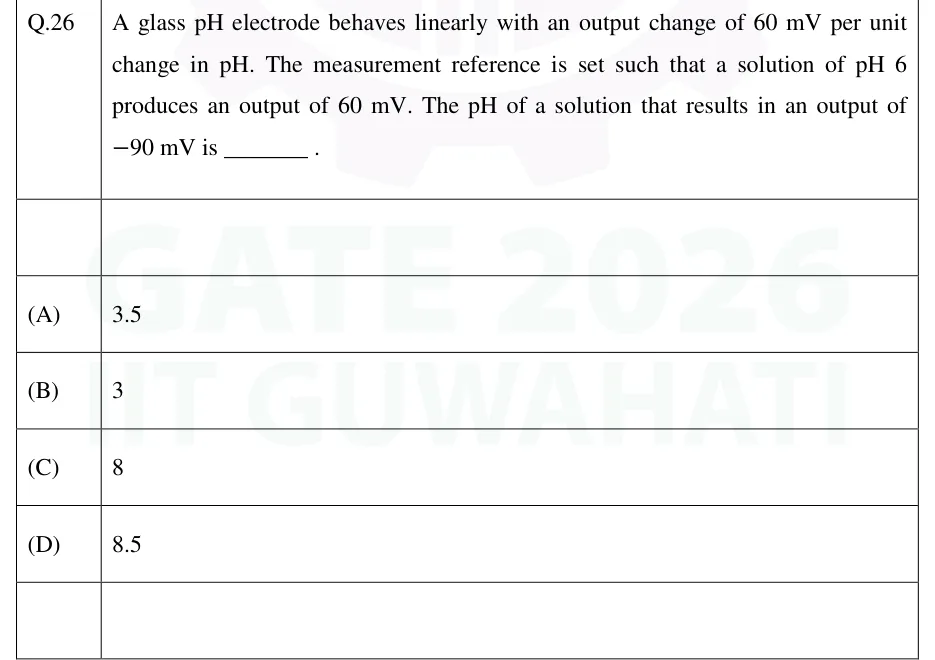
A glass pH electrode behaves linearly with an output change of 60 mV per unit change in pH. The measurement reference is set such that a solution of pH 6 produces an output of 60 mV. The pH of a solution that results in an output of −90 mV is ________ .

  1. (A)

    3.5

  2. (B)

    3

  3. (C)

    8

  4. (D)

    8.5

See the question in the paper

Answer and solution

ANSWER

The pH is 8.5, option (D). A glass electrode's output falls by 60 mV for each unit rise in pH, so a drop of 150 mV from the pH 6 reference means a rise of 2.5 pH units.

Official answer: DSource: Official answer key, GATE 2026 IN (IIT Guwahati)

  1. A glass pH electrode follows the Nernst equation. Its potential depends on the hydrogen-ion activity: So the output falls as pH rises. The slope is negative.

  2. The question gives the size of the slope as per pH unit, so the sensitivity is . The linear model about the reference point is in mV.

  3. Reference point: at the output is , so

  4. Set the output to :

  5. Rearrange: , so .

  6. Result: .

  7. Check: going from to is a change of , which is pH units at . A more negative output means a less acidic solution, so the pH rises from 6 to 8.5. The answer is (D).

KEY IDEA

By the Nernst equation, a glass electrode's potential is , so its slope against pH is negative (about at ). A more negative output means a higher pH, i.e. a more alkaline solution.

WATCH OUT FOR

Taking the slope as just because the question says "60 mV per unit change in pH" gives , option (A). That sign is the wrong way round for a glass electrode: its output drops as pH rises, so a fall from to means the pH goes up.

From the GATE 2026 IN paper. Every question of this paper · Download the full paper · All 1 Level & analytical questions, with notes