
IAE Academy

GATE 2025 IN Q.55: solution and answer

GATE 2025 · INQ.55 · 2 marks · NAT

A schematic of a Michelson interferometer, used for the measurement of refractive index of gas, is shown in the figure. The transparent chamber is filled with a gas of refractive index , where , at atmospheric pressure. If a 532 nm laser beam produces 30 interference fringes on the screen, then the number of fringes produced by a 632.8 nm laser beam will be ______ (rounded off to one decimal place). Note: Assume that the effect of beamsplitter width is negligible. The setup is placed in air medium with refractive index equal to 1.
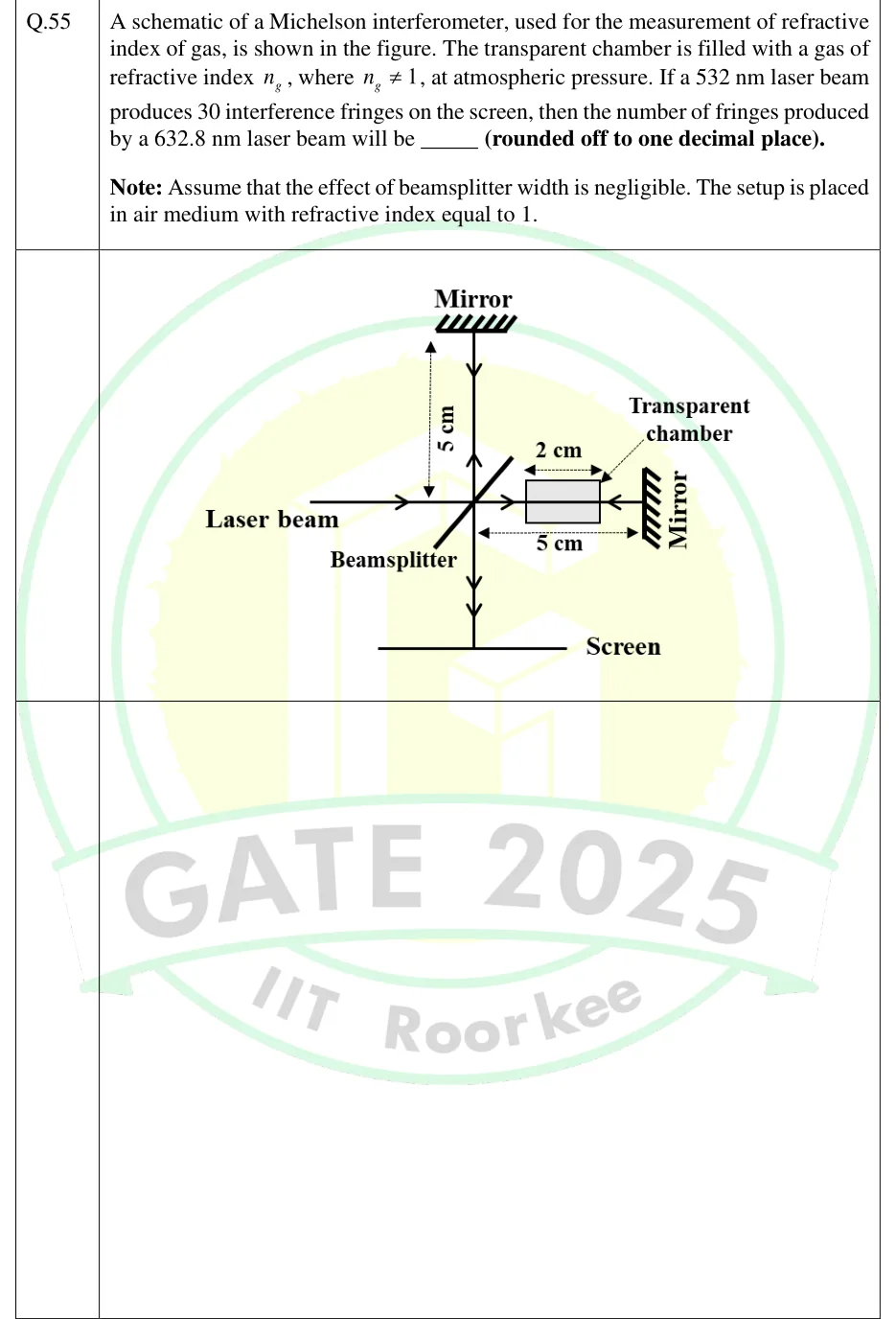
GATE 2025 IN question 55: Michelson interferometer.Tap to open full size
Figure from the GATE 2025 IN paper. It is part of the question.
Figure description

Michelson interferometer. A laser beam enters horizontally from the left and meets a 45-degree beamsplitter. One arm goes up to a fixed mirror at the top, 5 cm from the beamsplitter (dimension marked 5 cm, vertical). The other arm goes right to a vertical mirror, 5 cm from the beamsplitter (marked 5 cm, horizontal). A transparent gas chamber of length 2 cm (marked 2 cm) sits in the right-hand arm, between the beamsplitter and the right mirror, next to the mirror. The recombined beams travel down from the beamsplitter to a horizontal screen at the bottom. The setup is in air of refractive index 1.

Answer and solution

ANSWER

The 632.8 nm laser produces about 25.2 fringes.

Official answer: 24.5 to 25.5Source: Official answer key, GATE 2025 IN (IIT Roorkee)

  1. The beam crosses the gas chamber twice (to the right-hand mirror and back), so the gas adds an optical path compared with the same length of air, with . The two arms are otherwise identical in length and the beamsplitter width is neglected, so nothing else changes.

  2. The fringe count is the extra path divided by the wavelength: .

  3. For and : .

  4. Take to be the same at 632.8 nm (dispersion neglected). The path change is then unchanged, so .

  5. .

  6. Rounded to one decimal place, fringes.

KEY IDEA

The number of fringes shifted equals the extra optical path from the gas, , divided by the wavelength. With the gas and chamber unchanged, the count varies inversely with wavelength, so you do not need to find .

WATCH OUT FOR

Using a single pass, , instead of the double pass . The factor cancels in the ratio here, but it gives a wrong . Another slip is to invert the ratio and get .

From the GATE 2025 IN paper. Every question of this paper · Download the full paper · All 11 Optical questions, with notes

More Optical questions