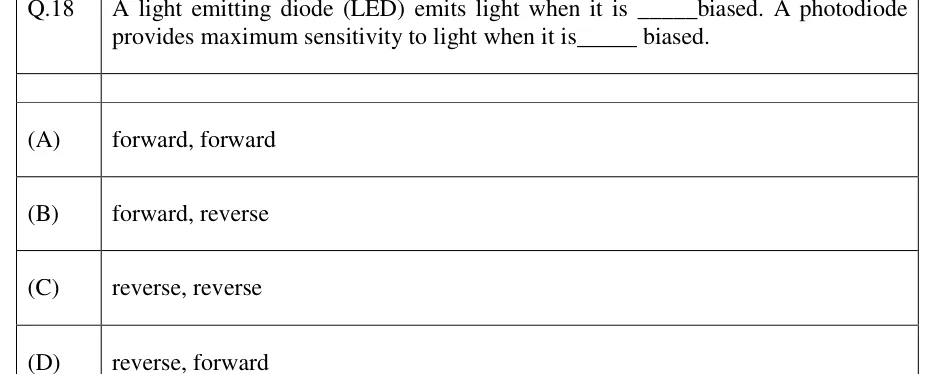
A light emitting diode (LED) emits light when it is _____ biased. A photodiode provides maximum sensitivity to light when it is _____ biased.
- (A)
forward, forward
- (B)
forward, reverse
- (C)
reverse, reverse
- (D)
reverse, forward

A light emitting diode (LED) emits light when it is _____ biased. A photodiode provides maximum sensitivity to light when it is _____ biased.
forward, forward
forward, reverse
reverse, reverse
reverse, forward
ANSWER
Option (B): the LED is forward biased and the photodiode is reverse biased.
Official answer: BSource: Official answer key, GATE 2023 IN (IIT Kanpur)
An LED emits light by radiative recombination of electrons and holes in the junction. Forward bias injects carriers across the junction, so they recombine and emit photons. The LED must be forward biased.
In a photodiode, incident photons create electron-hole pairs in and near the depletion region. The photocurrent is the flow of these collected carriers.
Reverse bias widens the depletion region and raises the electric field. This gives a larger collection volume and faster sweep-out of carriers. It also lowers junction capacitance and keeps the dark current small, so the photocurrent is a clean, linear measure of the light.
So the photodiode is most sensitive when it is reverse biased (photoconductive mode).
The pair is (forward, reverse), which is option (B).
KEY IDEA
An LED needs forward bias so carriers recombine and emit light. A photodiode needs reverse bias so its wide depletion region and strong field collect photo-generated carriers efficiently.
WATCH OUT FOR
Assuming both devices work the same way, so that a photodiode is also forward biased, or mixing up the two. Forward bias on a photodiode makes it behave like an ordinary diode, and the photocurrent is then swamped by the large forward current.
From the GATE 2023 IN paper. Every question of this paper · Download the full paper · All 11 Optical questions, with notes