IAE Academy

GATE EC · IN

Amplitude and angle modulation, receivers and multiplexing

Analog modulation places a message signal on a high-frequency carrier for transmission, and a receiver recovers it. This topic covers conventional AM, DSB-SC, SSB and VSB; FM and PM with their Bessel spectra and Carson's rule; coherent and envelope detection and the effect of local-carrier errors; noise performance and pre-emphasis; superheterodyne receivers and the image frequency; and FDM and TDM. Conventions used throughout: powers are into a load unless a resistance is shown, spectra are in Hz, the AM modulation index is , the FM/PM modulation index is , and channel noise is white with two-sided PSD .

15 previous-year questions · 13 solved · 6 practice questions

Conventional AM: modulation index, power and detection

In conventional (full-carrier) AM the message varies the envelope of a carrier of frequency : , where (in ) is the amplitude sensitivity. Convention: the modulation index is ; for a single tone it is . If the wave is written as (that is, ), then . With the envelope never goes negative, so a simple envelope detector can recover .

SINGLE-TONE AM WAVE

Carrier plus two sidebands, each of amplitude . Bandwidth (for a general message, where is the highest message frequency).

POWER AND EFFICIENCY (SINGLE TONE)

These power relations hold for any . Without overmodulation () the efficiency is at most , reached at . Each sideband carries . In terms of antenna (load) current, .

MULTI-TONE AM

For a message made of tones of different frequencies, each with its own index . Use in the power and efficiency formulas. The condition is enough to keep the envelope from going negative.

POWER FOR A GENERAL MESSAGE

Use when is not a single tone. Assumes has zero mean; is the mean-square value (power) of the message.

MODULATION INDEX FROM THE WAVEFORM

and are the maximum and minimum of the envelope, for a single tone with . For (overmodulation) the envelope is distorted and an envelope detector fails.

ENVELOPE DETECTOR RC CONDITION

The first condition (with replaced by for a general message) lets the capacitor smooth out the carrier ripple yet follow the envelope. The second is the condition, for a single tone of index , that avoids diagonal clipping (the capacitor discharging slower than the envelope falls).

SQUARE-LAW DETECTOR DISTORTION (SINGLE TONE)

After low-pass filtering, a square-law detector's output is proportional to the squared envelope. Besides the message it contains a term in ; for a single tone this is a second harmonic of at of the fundamental, so a small keeps the distortion small.

EXAM TIP

Conventional AM has low efficiency because the carrier carries no information. If a question gives total power and carrier power, get directly instead of computing amplitudes.

DSB-SC, SSB and VSB

Suppressing the carrier saves power. DSB-SC transmits both sidebands; SSB transmits only one, halving the bandwidth; VSB transmits one sideband almost fully and a vestige of the other. VSB suits messages with significant low-frequency content (for example, analog television video), where the sharp filter SSB needs is impractical.

DSB-SC SIGNAL AND POWER

Power in a load, for a zero-mean message. The spectrum has no carrier component. The envelope is , not , so an envelope detector cannot be used; DSB-SC needs coherent detection.

COHERENT DETECTION WITH ERRORS

DSB-SC input, local carrier of unit amplitude or , followed by a low-pass filter. The output vanishes at (quadrature null effect), and a frequency error gives a beating (fading) output. For SSB, a phase error causes phase distortion of the output, and a frequency error shifts every output tone by . A Costas loop or a squaring loop recovers a synchronous carrier for DSB-SC.

SSB SIGNAL (PHASE-SHIFT FORM)

Upper sign gives USB, lower sign gives LSB. is the Hilbert transform of and has the same power as . Power in a load. Coherent detection with a unit-amplitude local carrier gives .

Comparison of AM types

Type

Carrier sent?

Bandwidth

Detection

Remarks

Conventional AM

Yes

Envelope (simple)

Needs ; low power efficiency

DSB-SC

No

Coherent

Both sidebands carry the same information

SSB

No

Coherent

Least bandwidth; no carrier power; filter method impractical for messages with content near DC

VSB

Not needed; added in television (VSB plus carrier)

Slightly more than

Coherent (or envelope when the carrier is added)

Used when the message has significant low-frequency content

SSB generation methods

  1. Filter method: generate DSB-SC with a balanced modulator, then pass it through a sharp band-pass filter that keeps one sideband. The filter needs a very narrow transition band, so this is often done at a low carrier frequency and then up-converted.

  2. Phase-shift method: form and , using a wideband phase shifter (Hilbert transformer) for the message and a shift of the carrier (which turns into ), then subtract for USB or add for LSB.

  3. VSB: pass DSB-SC through a filter that satisfies for ; the roll-off is odd-symmetric about .

EXAM TIP

For the DSB-SC wave , the power is ; an SSB wave made of one of its sidebands has power (both in a load).

Angle modulation: FM and PM

In angle modulation the message changes the phase of the carrier. For PM the phase deviation is proportional to ; for FM the instantaneous frequency deviation is proportional to , so the phase is proportional to the integral of . The envelope is constant (), so the transmitted power does not depend on the message. Convention: the modulation index is for a single tone (for PM, is also the peak phase deviation in radians).

PM AND FM DEFINITIONS

in rad/V, in Hz/V. Instantaneous frequency: FM ; PM . FM by is PM by , and PM by is FM by .

DEVIATION AND MODULATION INDEX (TONE $A_M\COS 2\PI F_M T$)

In FM, depends only on the amplitude of the message and falls as rises. In PM, depends only on the amplitude and grows with .

SINGLE-TONE FM SPECTRUM

Spectral lines at with amplitudes . The carrier amplitude vanishes at

POWER OF AN FM WAVE

In a load. Total power is independent of ; modulation only redistributes power from the carrier to the sidebands. Power in the carrier plus pairs of sidebands is .

CARSON'S RULE

An approximation; for a single tone it contains roughly 98 percent of the total power. For , (narrowband); for , (wideband). For a general message use , with peak deviation and deviation ratio .

NARROWBAND FM (NBFM)

Carrier plus two sidebands of amplitude , like AM, but the sideband sum is in phase quadrature with the carrier (the lower sideband's sign is reversed relative to AM), so the envelope is nearly constant.

Useful Bessel values

0.5

0.938

0.242

0.031

0.003

1

0.765

0.440

0.115

0.020

2

0.224

0.577

0.353

0.129

5

0.047

0.365

EXAM TIP

For tone modulation, sidebands lie only at integer multiples of from the carrier, never at or any other spacing. For wideband FM the number of significant sideband pairs is about , so matches Carson's rule.

FM demodulation, pre-emphasis and noise

An FM demodulator converts frequency variation to amplitude variation. Slope detectors and balanced (Foster-Seeley or ratio) discriminators use the slope of a tuned circuit; a phase-locked loop (PLL) demodulator tracks the input phase, and its VCO control voltage is the output. A limiter before the discriminator removes amplitude variations caused by noise. Convention: white channel noise with two-sided PSD and message bandwidth .

Procedure to compare detectors at high carrier-to-noise ratio

  1. Define the channel (reference) SNR as : the received signal power divided by the noise power in the message band, both at the receiver input.

  2. Compute the output SNR for the given scheme using its figure of merit.

  3. The ratio is the figure of merit; larger means better noise performance.

  4. Check the threshold: envelope detection of AM and FM discriminators both fail (the output SNR collapses) when the input SNR falls below a threshold.

FIGURE OF MERIT (SINGLE TONE, LARGE INPUT SNR)

Coherent detection for DSB-SC and SSB; envelope detection for AM above threshold, with , so its figure of merit is at most ; FM above threshold without pre-emphasis. For a general zero-mean message of power : AM gives and FM gives . FM beats fully modulated () AM when , that is . Above threshold, FM trades bandwidth for noise performance.

PRE-EMPHASIS AND DE-EMPHASIS

The noise at an FM discriminator's output has a PSD proportional to , so high-frequency message components suffer most. The transmitter boosts the high frequencies (pre-emphasis) and the receiver cuts them by the same amount (de-emphasis). The overall response to the message is flat, while the high-frequency noise is reduced. A time constant corresponds to kHz.

DE-EMPHASIS NOISE IMPROVEMENT

Ratio of the output noise power without de-emphasis to that with it, for the noise PSD over , assuming pre-emphasis does not change the transmitted peak deviation. Example: kHz and kHz give (about 13.3 dB).

EXAM TIP

FM's noise advantage over AM is bought with bandwidth. At equal received power and noise PSD, DSB-SC and SSB have the same figure of merit (1), and AM with envelope detection is always worse (at most ).

Superheterodyne receivers

A superheterodyne receiver translates every incoming station to one fixed intermediate frequency (IF) using a mixer and a tunable local oscillator (LO). Most of the gain and selectivity is then provided at the fixed IF. The chain is: RF amplifier and tuned filter, mixer with LO, IF amplifier and filter, demodulator, audio amplifier. Common IFs are 455 kHz for AM broadcast and 10.7 MHz for FM broadcast.

IF AND IMAGE FREQUENCY (HIGH-SIDE LO)

is the wanted station frequency. The image station lies at and also mixes down to , causing interference. With a low-side LO (), .

IMAGE REJECTION RATIO

For a single tuned circuit of loaded quality factor at the RF stage. is a voltage ratio; in dB it is . With identical tuned stages before the mixer, their ratios multiply. A larger IF moves the image farther from and improves image rejection; a smaller IF makes adjacent-channel selectivity easier to achieve.

LO TUNING RANGE

High-side LO. For LC tuning , so the capacitance ratio is the square of the frequency ratio. With the LO above the signal the required ratio is much smaller: for 540-1650 kHz and a 455 kHz IF it is about 2.1 high-side against about 14 low-side, which is why the high-side LO is standard in AM broadcast receivers.

EXAM TIP

For either LO side and any type of modulation, . After the mixer the image sits exactly at the IF, so the IF filter cannot remove it; it must be rejected by RF tuning before the mixer.

Multiplexing and transmitter/receiver architecture

Multiplexing lets several message signals share one channel. In frequency-division multiplexing (FDM) each signal modulates a different subcarrier and occupies its own band at all times. In time-division multiplexing (TDM) the signals are sampled and their samples are interleaved in time slots, so each uses the whole channel bandwidth for a short time.

FDM BANDWIDTH

is the guard band between adjacent channels. For identical SSB channels of bandwidth , . For DSB-SC or AM channels each .

TDM SAMPLING AND BIT RATE

channels, each band-limited to and sampled at (the frame rate), at or above the Nyquist rate . The minimum (Nyquist) transmission bandwidth is half the pulse rate: for PAM-TDM and for binary PCM-TDM. Add synchronisation bits per frame if given.

FDM versus TDM

Feature

FDM

TDM

Sharing

Frequency bands

Time slots

Typical signals

Analog

Sampled / digital

Main impairment

Crosstalk between channels from non-linearity

Crosstalk from inter-symbol interference in a band-limited channel; timing (synchronisation) errors

Guard needed

Guard bands in frequency

Guard times between slots

Functional architecture of transmitters and receivers

  1. AM transmitter: carrier oscillator, buffer, modulator (high-level modulation in the final power amplifier, or low-level modulation followed by a linear amplifier), power amplifier, antenna.

  2. Direct FM transmitter: a VCO whose frequency is controlled by , plus an AFC loop to hold the mean carrier frequency.

  3. Indirect (Armstrong) FM: the message is integrated and applied to a narrowband phase modulator whose carrier comes from a stable crystal oscillator, giving narrowband FM; frequency multipliers then raise both and by the factor , and a mixer shifts the carrier without changing .

  4. Receiver: a tuned-radio-frequency (TRF) receiver amplifies at the signal frequency; the superheterodyne receiver converts to a fixed IF first.

EXAM TIP

A frequency multiplier multiplies the frequency deviation and the modulation index by , not only the carrier. A mixer (frequency translation) changes the carrier frequency but leaves and unchanged.

Worked examples

WORKED EXAMPLE · AM POWER AND EFFICIENCY

An AM wave volts is delivered to a load. Find the total transmitted power, the power in the sidebands and the efficiency.

Solution
  1. Carrier amplitude V, so W.

  2. , so W.

  3. Sideband power W.

  4. Efficiency , about 15.3 percent.

Answer: W, sideband power W, efficiency about .

WORKED EXAMPLE · FM BANDWIDTH WITH CHANGING MESSAGE

A message V drives an FM modulator with kHz/V. Find , and the Carson bandwidth. Then find the bandwidth when the message frequency is doubled with the same amplitude.

Solution
  1. kHz.

  2. .

  3. Carson: kHz.

  4. At kHz, stays kHz (FM), , kHz.

Answer: kHz, , kHz; at kHz, kHz.

WORKED EXAMPLE · IMAGE FREQUENCY AND IMAGE REJECTION

A superheterodyne receiver with a 455 kHz IF and a high-side local oscillator is tuned to 1000 kHz. Its RF stage is a single tuned circuit with . Find the image frequency and the image rejection ratio in dB.

Solution
  1. kHz, so kHz.

  2. .

  3. , so .

  4. In dB: dB.

Answer: kHz; , about dB.

PREVIOUS-YEAR QUESTIONS

15 questions from the EC and IN papers

Try each question first, then open the answer. We placed each question under a topic ourselves; the exam paper does not label topics.

See these papers in full: GATE ECE 2026 · GATE ECE 2025 · GATE ECE 2024 · GATE ECE 2023 · GATE ECE 2022 · GATE ECE 2020 · GATE ECE 2018 · GATE IN 2026 · GATE IN 2024 · GATE IN 2022 · GATE IN 2018

GATE 2026 EC Q.57

GATE 2026 · ECQ.57 · 2 marks · MSQ

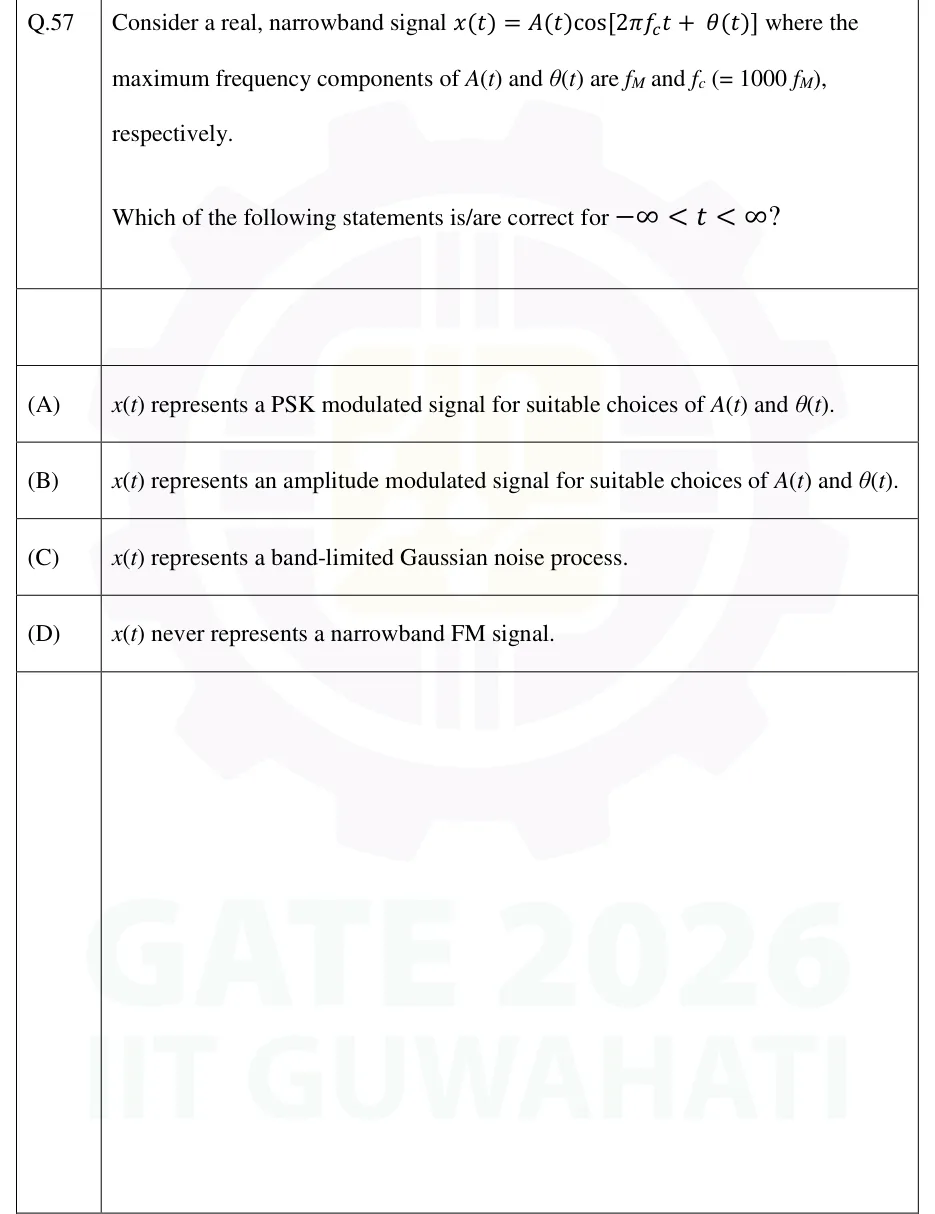
Consider a real, narrowband signal where the maximum frequency components of and are and , respectively. Which of the following statements is/are correct for ?

  1. (A)

    represents a PSK modulated signal for suitable choices of and .

  2. (B)

    represents an amplitude modulated signal for suitable choices of and .

  3. (C)

    represents a band-limited Gaussian noise process.

  4. (D)

    never represents a narrowband FM signal.

Official answer

Official answer: A, B, CSource: Official answer key, GATE 2026 EC (IIT Guwahati)
See the question in the paper
GATE 2026 EC Q.57: official answer

GATE 2025 EC Q.14

GATE 2025 · ECQ.14 · 1 mark · MCQ

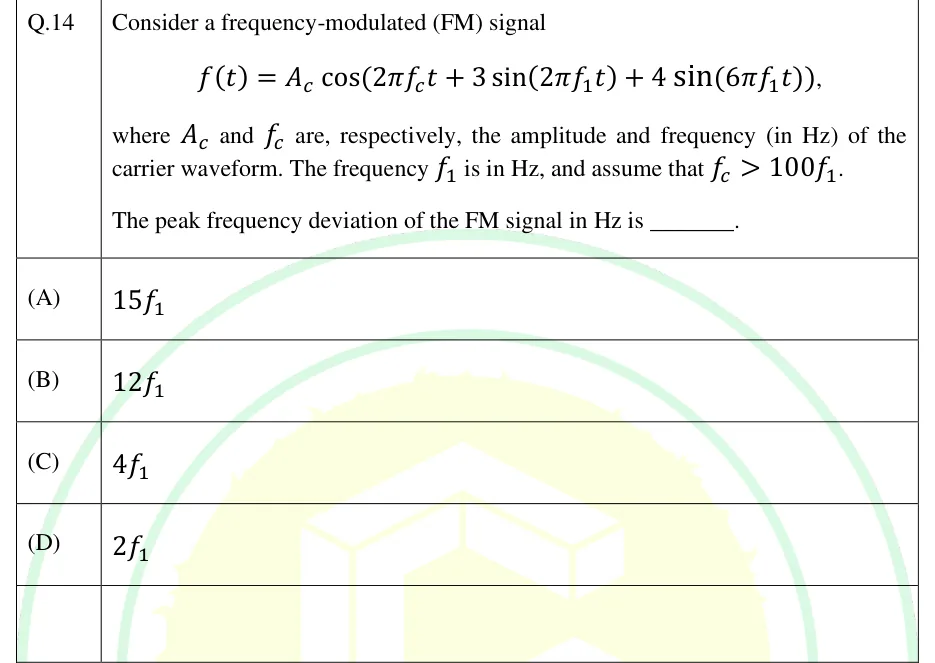
Consider a frequency-modulated (FM) signal , where and are, respectively, the amplitude and frequency (in Hz) of the carrier waveform. The frequency is in Hz, and assume that . The peak frequency deviation of the FM signal in Hz is ______.

  1. (A)

  2. (B)

  3. (C)

  4. (D)

Answer and solution
See the question in the paper
GATE 2025 EC Q.14: answer and solution

GATE 2025 EC Q.28

GATE 2025 · ECQ.28 · 1 mark · MSQ

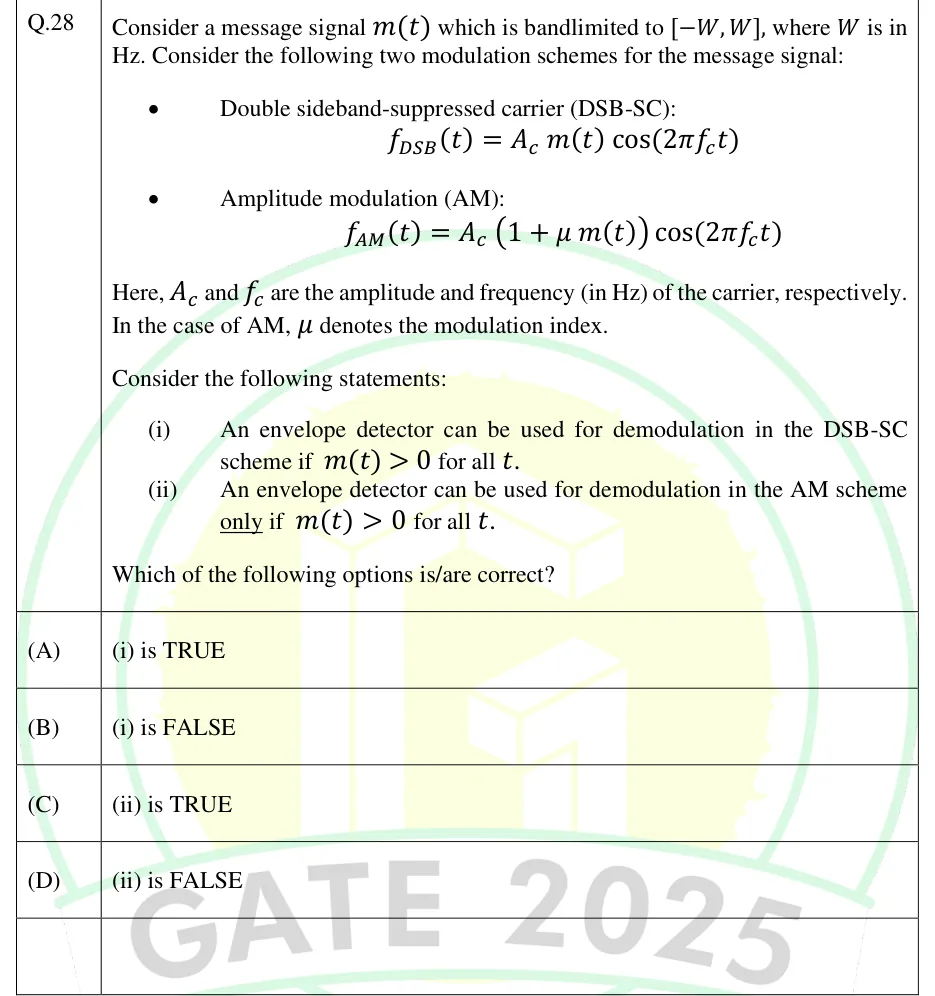
Consider a message signal which is bandlimited to , where is in Hz. Consider the following two modulation schemes for the message signal:
- Double sideband-suppressed carrier (DSB-SC):
- Amplitude modulation (AM):
Here, and are the amplitude and frequency (in Hz) of the carrier, respectively. In the case of AM, denotes the modulation index.
Consider the following statements:
(i) An envelope detector can be used for demodulation in the DSB-SC scheme if for all .
(ii) An envelope detector can be used for demodulation in the AM scheme only if for all .
Which of the following options is/are correct?

  1. (A)

    (i) is TRUE

  2. (B)

    (i) is FALSE

  3. (C)

    (ii) is TRUE

  4. (D)

    (ii) is FALSE

Answer and solution
See the question in the paper
GATE 2025 EC Q.28: answer and solution

GATE 2024 IN Q.48

GATE 2024 · INQ.48 · 2 marks · MCQ

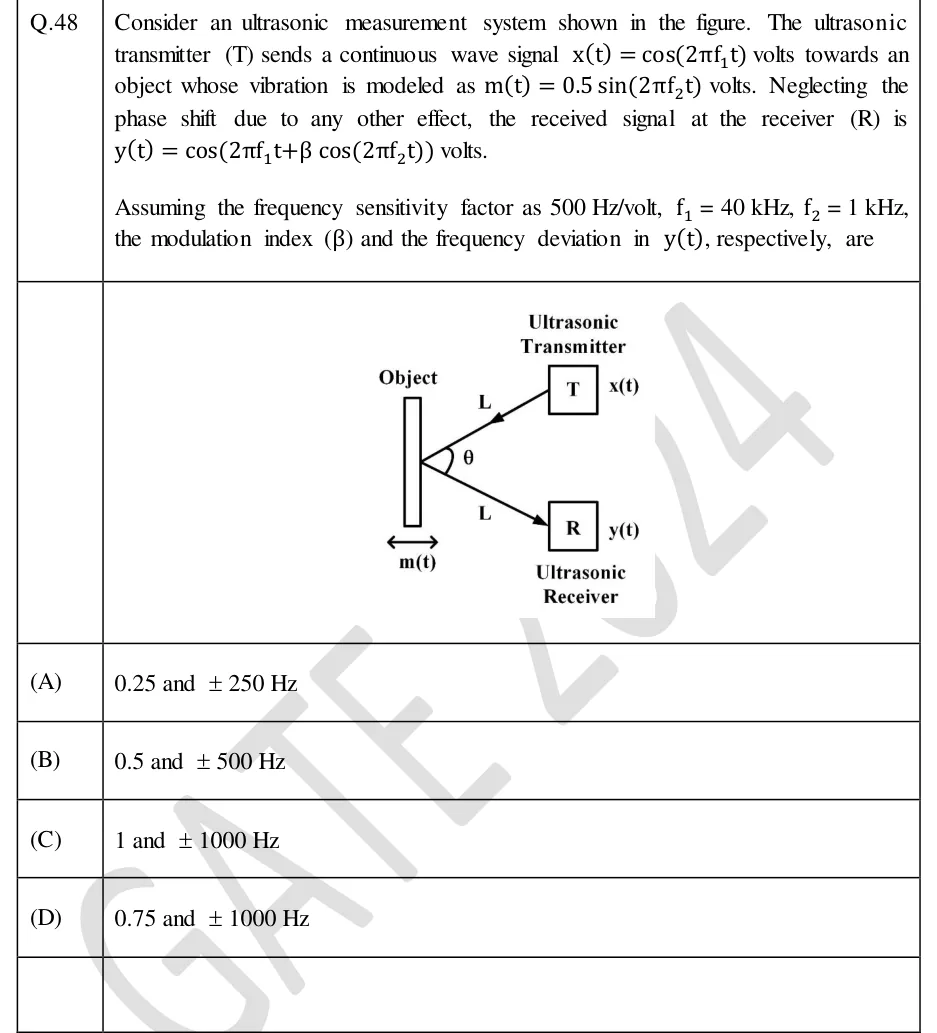
Consider an ultrasonic measurement system shown in the figure. The ultrasonic transmitter (T) sends a continuous wave signal volts towards an object whose vibration is modeled as volts. Neglecting the phase shift due to any other effect, the received signal at the receiver (R) is volts. Assuming the frequency sensitivity factor as 500 Hz/volt, kHz, kHz, the modulation index () and the frequency deviation in , respectively, are

GATE 2024 IN question 48: A transmitter block T (top right, labelled Ultrasonic Transmitter) emits x(t) along a path of length L toward a vertical…Tap to open full size
Figure from the GATE 2024 IN paper. It is part of the question.
Figure description

A transmitter block T (top right, labelled Ultrasonic Transmitter) emits x(t) along a path of length L toward a vertical rectangular Object on the left. The object can move horizontally, shown by a double-headed arrow labelled m(t). The reflected path, also of length L, goes from the object to a receiver block R (bottom right, labelled Ultrasonic Receiver) producing y(t). The angle between the incident and reflected paths at the object is labelled theta.

  1. (A)

    0.25 and ±250 Hz

  2. (B)

    0.5 and ±500 Hz

  3. (C)

    1 and ±1000 Hz

  4. (D)

    0.75 and ±1000 Hz

Answer and solution
GATE 2024 IN Q.48: answer and solution

GATE 2023 EC Q.45

GATE 2023 · ECQ.45 · 2 marks · MCQ

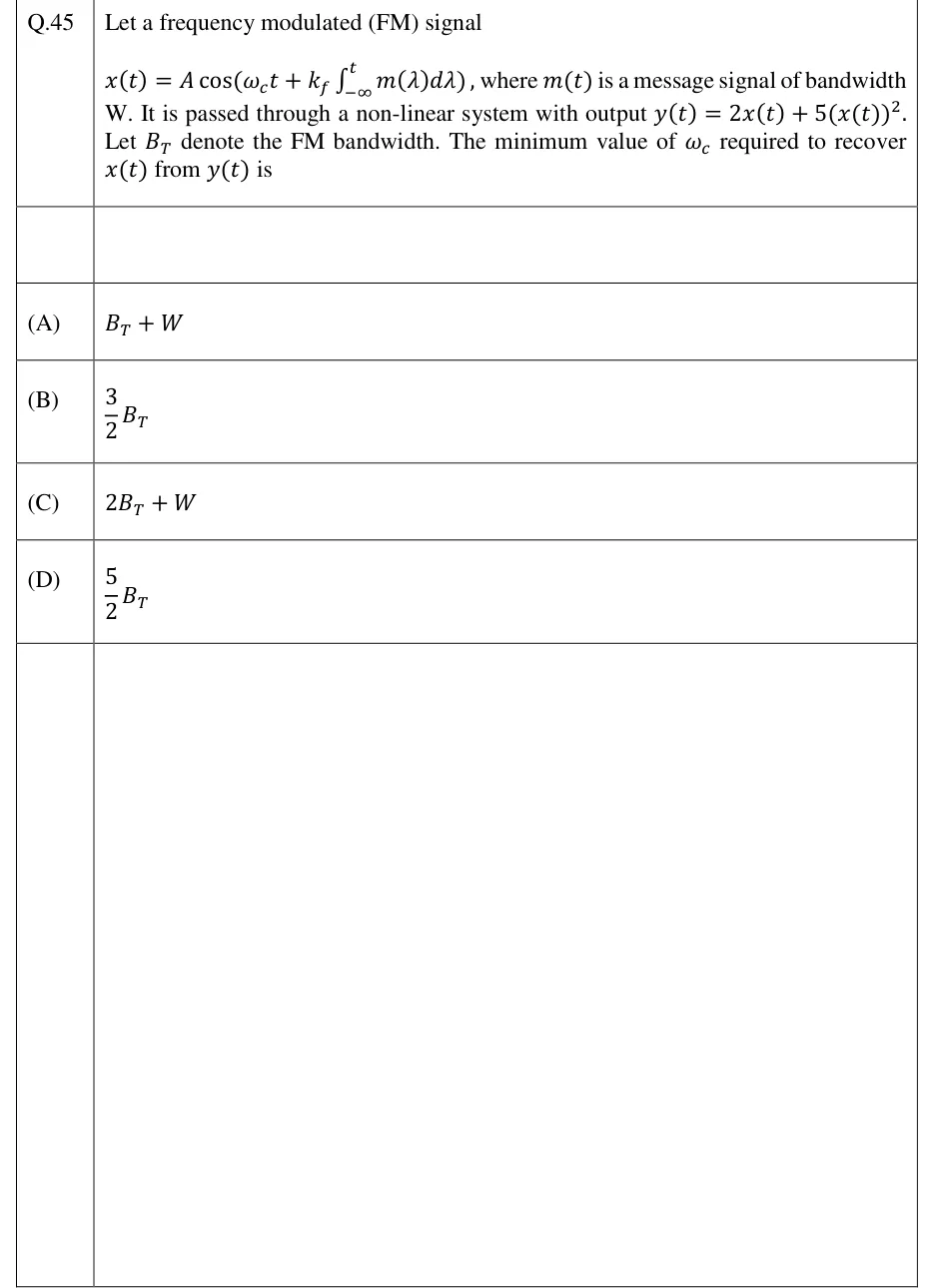
Let a frequency modulated (FM) signal , where is a message signal of bandwidth . It is passed through a non-linear system with output . Let denote the FM bandwidth. The minimum value of required to recover from is

  1. (A)

  2. (B)

  3. (C)

  4. (D)

Official answer
See the question in the paper
GATE 2023 EC Q.45: official answer

GATE 2022 EC Q.51

GATE 2022 · ECQ.51 · 2 marks · MSQ

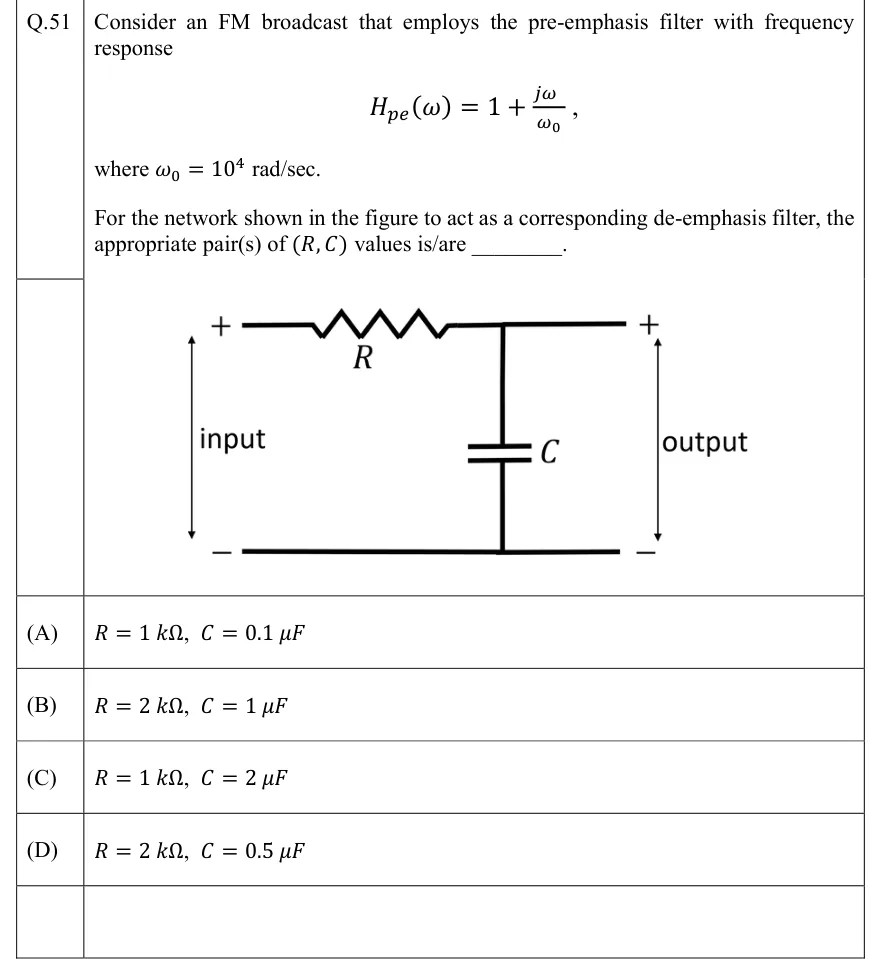
Consider an FM broadcast that employs the pre-emphasis filter with frequency response , where rad/sec. For the network shown in the figure to act as a corresponding de-emphasis filter, the appropriate pair(s) of values is/are ________.

GATE 2022 EC question 51: A first-order RC network.Tap to open full size
Figure from the GATE 2022 EC paper. It is part of the question.
Figure description

A first-order RC network. The input voltage (with + at top, - at bottom) drives a series resistor R in the top rail. The resistor's right end connects to the output + terminal and to the top of a shunt capacitor C, which connects down to the bottom rail. The bottom rail joins the input - and output - terminals. The output voltage is taken across C.

  1. (A)

    ,

  2. (B)

    ,

  3. (C)

    ,

  4. (D)

    ,

Answer and solution
GATE 2022 EC Q.51: answer and solution

GATE 2022 IN Q.16

GATE 2022 · INQ.16 · 1 mark · MCQ

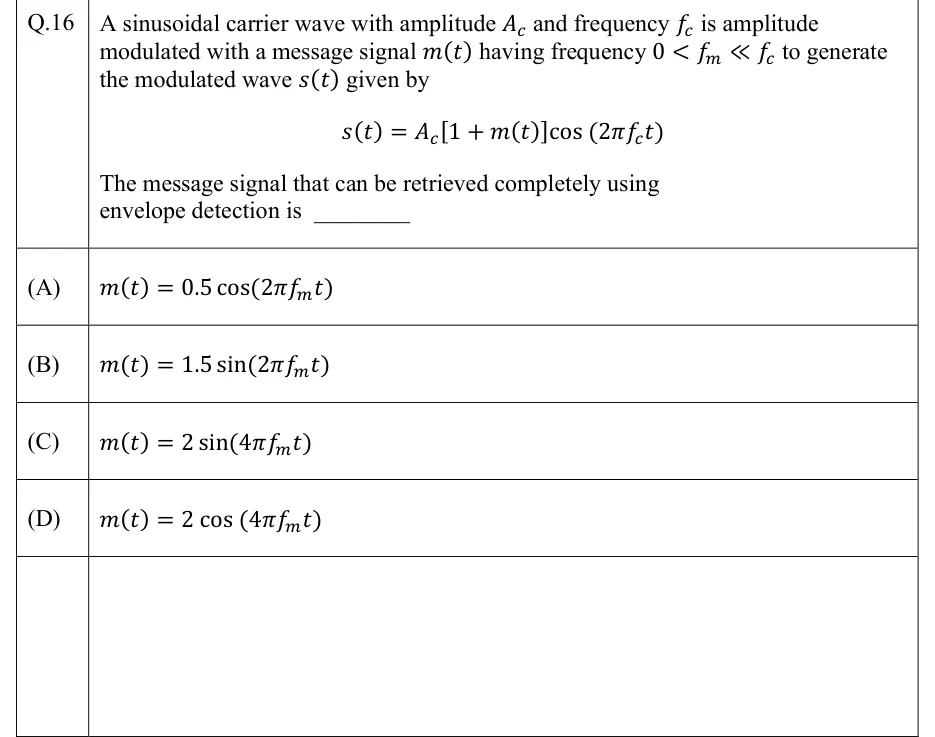
A sinusoidal carrier wave with amplitude and frequency is amplitude modulated with a message signal having frequency to generate the modulated wave given by . The message signal that can be retrieved completely using envelope detection is ________

  1. (A)

  2. (B)

  3. (C)

  4. (D)

Answer and solution
See the question in the paper
GATE 2022 IN Q.16: answer and solution
Show the other 5 questions

GATE 2020 EC Q.42

GATE 2020 · ECQ.42 · 2 marks · MCQ

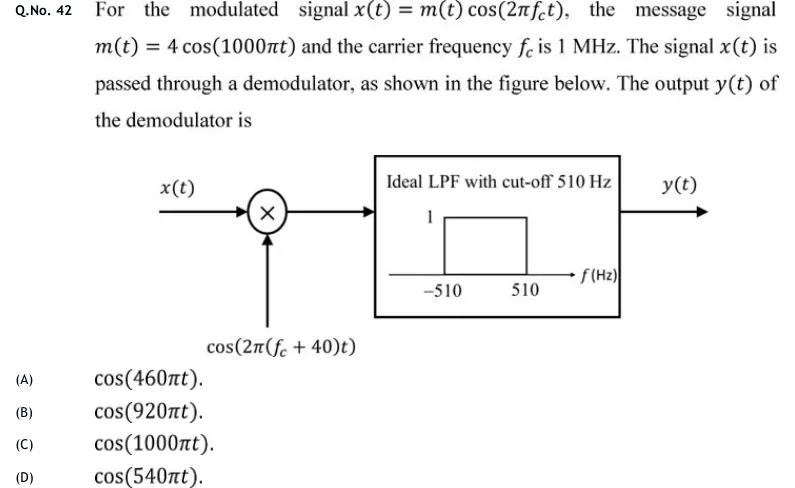
For the modulated signal , the message signal and the carrier frequency is 1 MHz. The signal is passed through a demodulator, as shown in the figure below. The output of the demodulator is

GATE 2020 EC question 42: Block diagram: input x(t) goes into a multiplier (circle with a cross).Tap to open full size
Figure from the GATE 2020 EC paper. It is part of the question.
Figure description

Block diagram: input x(t) goes into a multiplier (circle with a cross). A second input enters the multiplier from below, labelled cos(2π(f_c + 40)t). The multiplier output feeds a box labelled 'Ideal LPF with cut-off 510 Hz'. Inside the box is a plot of the frequency response, with the f (Hz) axis, a rectangular passband of height 1 from -510 to 510, and ticks at -510 and 510. The box output is y(t).

  1. (A)

    cos(460πt).

  2. (B)

    cos(920πt).

  3. (C)

    cos(1000πt).

  4. (D)

    cos(540πt).

Answer and solution
GATE 2020 EC Q.42: answer and solution

GATE 2020 EC Q.47

GATE 2020 · ECQ.47 · 2 marks · NAT

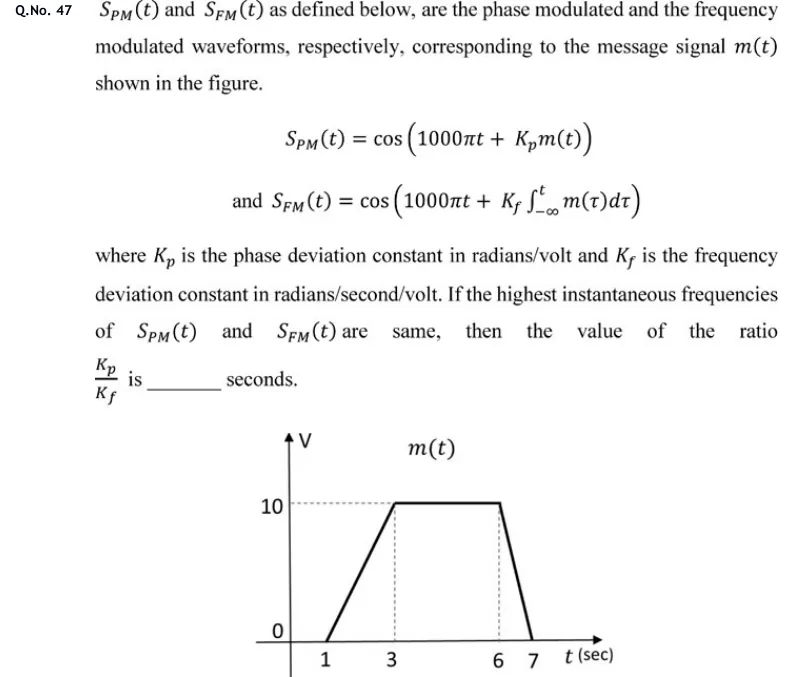
and as defined below, are the phase modulated and the frequency modulated waveforms, respectively, corresponding to the message signal shown in the figure.


and

where is the phase deviation constant in radians/volt and is the frequency deviation constant in radians/second/volt. If the highest instantaneous frequencies of and are same, then the value of the ratio is ______ seconds.

GATE 2020 EC question 47: Plot of m(t) in volts versus t in seconds.Tap to open full size
Figure from the GATE 2020 EC paper. It is part of the question.
Figure description

Plot of m(t) in volts versus t in seconds. m(t) = 0 for t < 1 s; rises linearly from 0 V at t = 1 s to 10 V at t = 3 s; stays constant at 10 V from t = 3 s to t = 6 s (dashed guide lines at t = 3 and t = 6, and a dashed horizontal line at 10 V); falls linearly from 10 V at t = 6 s to 0 V at t = 7 s; 0 afterwards. Axes labelled V and t (sec).

Answer and solution
GATE 2020 EC Q.47: answer and solution

GATE 2018 EC Q.27

GATE 2018 · ECQ.27 · 2 marks · MCQ

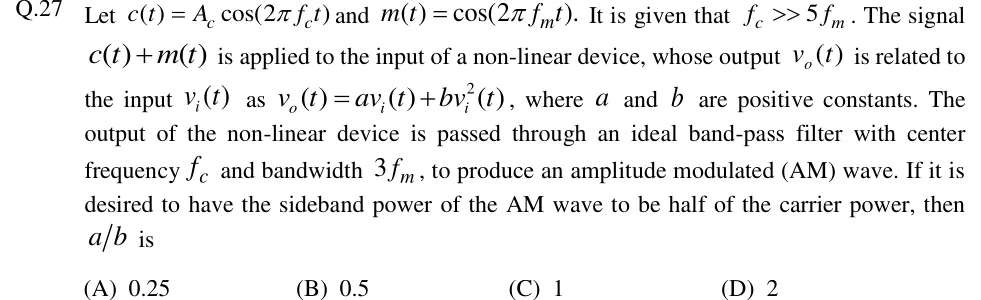
Let and . It is given that . The signal is applied to the input of a non-linear device, whose output is related to the input as , where and are positive constants. The output of the non-linear device is passed through an ideal band-pass filter with center frequency and bandwidth , to produce an amplitude modulated (AM) wave. If it is desired to have the sideband power of the AM wave to be half of the carrier power, then is

  1. (A)

    0.25

  2. (B)

    0.5

  3. (C)

    1

  4. (D)

    2

Answer and solution
See the question in the paper
GATE 2018 EC Q.27: answer and solution

GATE 2018 IN Q.24

GATE 2018 · INQ.24 · 1 mark · NAT

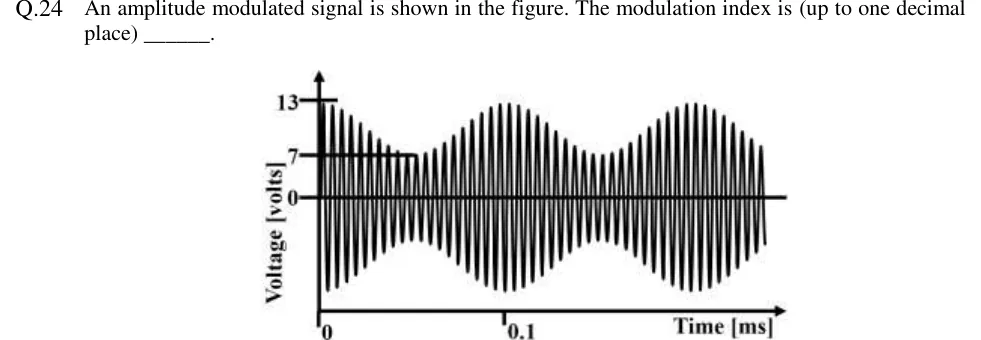
An amplitude modulated signal is shown in the figure. The modulation index is (up to one decimal place) ______.

GATE 2018 IN question 24: Voltage [volts] versus Time [ms] plot of an AM waveform.Tap to open full size
Figure from the GATE 2018 IN paper. It is part of the question.
Figure description

Voltage [volts] versus Time [ms] plot of an AM waveform. The vertical axis has labelled levels 13, 7 and 0, with the zero line drawn across the plot. The time axis is marked at 0 and 0.1. The carrier oscillates rapidly, and its envelope varies sinusoidally in time. The envelope peaks (maximum amplitude) at the level 13 V, marked with a horizontal line from the 13 label. The envelope troughs (minimum amplitude) at the level 7 V, marked with a horizontal line from the 7 label out to the first trough. The envelope completes about two cycles over the plotted interval, with a peak near the start, a trough, a second peak near 0.1 ms, and so on. The waveform is symmetric about the zero line.

Answer and solution
GATE 2018 IN Q.24: answer and solution

PRACTICE

6 questions to test yourself

PRACTICE 11 mark · MCQ

A single-tone AM wave has modulation index . What fraction of the total transmitted power is carried by the two sidebands?

  1. (A)

    24.2 percent

  2. (B)

    32 percent

  3. (C)

    64 percent

  4. (D)

    40 percent

Answer and solution

Answer: (A)

  1. Efficiency .

  2. , so .

  3. So 24.2 percent of the total power is in the sidebands.

PRACTICE 22 marks · MSQ

Which of the following statements are correct? (Assume ideal filters and no noise.)

  1. (A)

    An envelope detector can recover the message from a DSB-SC wave for any message .

  2. (B)

    For coherent detection of DSB-SC with a constant phase error in the local carrier, the output is proportional to .

  3. (C)

    The bandwidth of an SSB signal is half that of the corresponding DSB-SC signal.

  4. (D)

    The total power of an FM wave increases as the modulation index increases.

Answer and solution

Answer: (B), (C)

  1. A is false: the envelope of DSB-SC is , which differs from whenever changes sign.

  2. B is true: multiplying by and low-pass filtering gives .

  3. C is true: DSB-SC has bandwidth and SSB has bandwidth .

  4. D is false: FM power is for every ; modulation only redistributes power.

PRACTICE 32 marks · NAT

Four signals, each band-limited to 3 kHz, are time-division multiplexed. Each is sampled at its Nyquist rate and every sample is encoded with 8 bits. Ignoring any synchronisation bits, find the bit rate of the multiplexed stream in kbps.

Answer and solution

Answer: (accepted range )

  1. Nyquist rate per signal is kHz, i.e. 6000 samples per second.

  2. Total sample rate samples per second.

  3. Bit rate bps kbps.

PRACTICE 41 mark · NAT

The FM wave V is applied to a load. Taking and , find the percentage of the total power carried by the carrier and the first pair of sidebands.

Answer and solution

Answer: (accepted range )

  1. Here . The fraction of power in the carrier and the first sideband pair is .

  2. and .

  3. Sum , so about 97.2 percent of the total power (total power W).

PRACTICE 51 mark · NAT

A superheterodyne AM receiver has an intermediate frequency of 455 kHz and its local oscillator is above the signal frequency. When tuned to a station at 900 kHz, find the image frequency in kHz.

Answer and solution

Answer: (accepted range )

  1. Local oscillator frequency kHz.

  2. Image frequency kHz.

  3. Equivalently kHz.

PRACTICE 62 marks · NAT

An FM modulator with fixed produces a modulation index for a tone of frequency 2 kHz. The tone amplitude is doubled and its frequency is halved. Using Carson's rule, find the new FM bandwidth in kHz.

Answer and solution

Answer: (accepted range )

  1. Original kHz.

  2. Doubling the amplitude doubles in FM: kHz.

  3. New kHz, so kHz.

OFFICIAL GATE 2027 SYLLABUS WORDING

Copied from the GATE 2027 syllabus; see all 2027 syllabi.

GATE EC

Analog Communications: Amplitude modulation and demodulation, angle modulation and demodulation, spectra of AM and FM, super heterodyne receivers

GATE IN

Amplitude and frequency modulation and demodulation … frequency and time division multiplexing … functional architectures of transmitters and receivers

Preparing in Kolkata? IAE Academy's course for GATE ECE or GATE IN.